Image to help understand the article
A Confucian scholar turned militia commander
Gi Sam-yeon emerged as a leading commander of Korea’s anti-Japanese resistance after the Korean Empire disbanded its armed forces in 1907. Chosen to lead the Honam Righteous Army Alliance, he brought together volunteer fighters across Korea’s southwestern region and directed a series of operations before his capture and execution in 1908.
Born Jan. 18, 1851, in Jangseong, in what is now South Jeolla province, Gi grew up in a traditional Confucian family. Also known by his pen name, Seongjae, he studied under Gi Jeong-jin, an elder relative and prominent Neo-Confucian scholar. Several members of the extended family later became commanders in the volunteer militias known in Korean history as “righteous armies.”
Early resistance after the empress’ killing
Gi first tried to raise a militia with Gi U-man after the 1895 killing of Empress Myeongseong, a national trauma that helped fuel armed resistance. They gathered supporters while moving from Jangseong toward Naju and planned an uprising in Gwangsan.
Government envoys carrying a royal order persuaded the fighters to disband before the uprising began. Gi, however, believed the order did not reflect Emperor Gojong’s true wishes and began preparing another campaign. The plan was exposed by an informant from the Iljinhoe, a pro-Japanese political organization.
Gi was arrested on the day of his daughter’s wedding and imprisoned first in Jeonju and then in Seoul. After more than a month in custody, he escaped with help from court official Yi Yong-tae and went into hiding.
Organizing the Honam Righteous Army Alliance
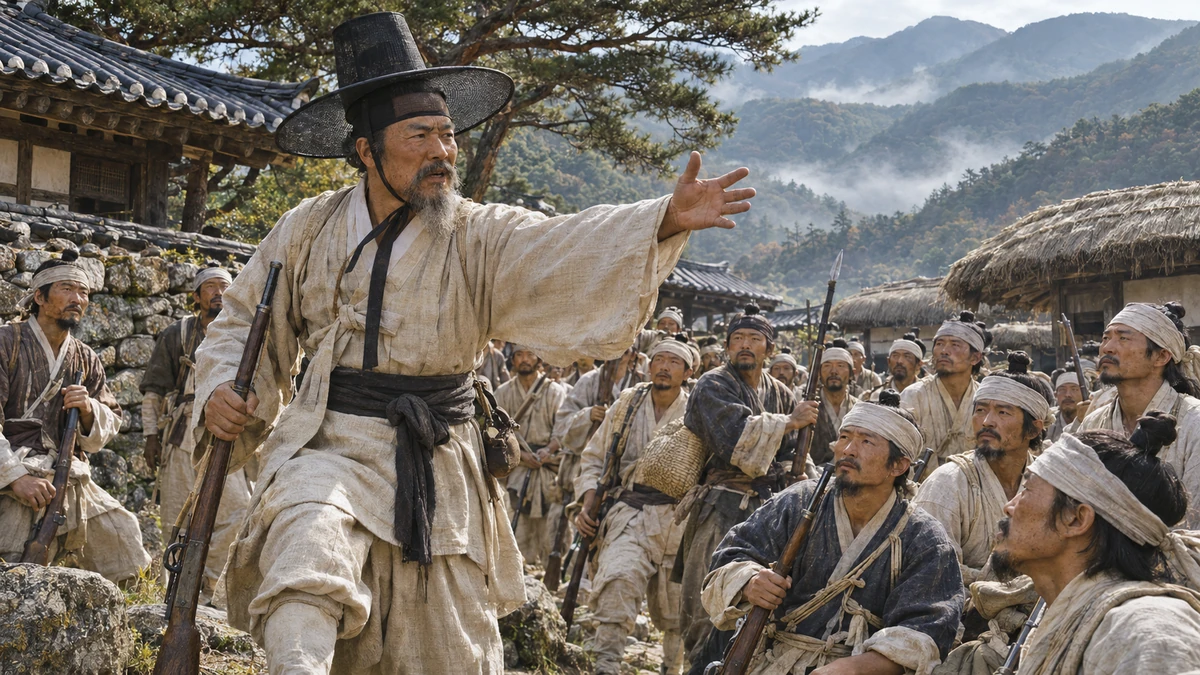
Armed resistance spread again after the Korean Empire’s military was dissolved in 1907. That September, Gi met with militia fighters at Seoksu Seungam on Mount Surok and was selected as commander of the Honam Righteous Army Alliance. “Honam” is the traditional name for Korea’s southwestern Jeolla region.
On Sept. 23, Gi’s force won a significant engagement while advancing toward Munsuam in Gochang. Local officials and residents supplied the militia with weapons and provisions. The alliance went on to record victories in Gochang, Yeonggwang, Buan and Jeongeup, later expanding with assistance from officials in Gwangju.
Gi’s fighters also sought food for their campaign. On Dec. 7, about 100 militia members attacked and burned a police outpost at Beopseongpo and seized grain from a warehouse. They kept what was needed for military funds and provisions and distributed the remainder to residents.
As battlefield conditions worsened, the alliance divided into smaller units and adopted guerrilla tactics. A force led by Kim Jun won a major engagement at Mudongchon, but severe winter weather scattered many of the fighters. Gi attempted to regroup the regional units for an attack on Jangseong around the winter solstice, though the plan was never carried out.
Escape, capture and execution
On Dec. 27, Gi led his fighters into the rugged Chuwol mountain fortress near Damyang to observe the New Year holiday. Heavy rain fell overnight, leaving troops sleeping outdoors exposed to the cold. An attacking force took advantage of weakened defenses and surrounded the camp, causing dozens of casualties. Gi escaped when fog suddenly covered the area.
Wounded, he sought treatment at the mountain home of a relative in Sunchang. He told his troops to spend the holiday with their families and return on the 15th day of the first lunar month, then hid in a private home in Gusudong.
On Lunar New Year’s Day, dozens of men arrived and threatened the homeowner with rifles and bayonets. Gi surrendered to protect the household. Kim Jun rushed toward Gwangju with 30 fighters in an attempted rescue, but Gi had already been jailed.
Gi was executed by firing squad on Feb. 3, 1908, corresponding to the second day of the first month on the lunar calendar, on a sandbank beneath Seocheon Bridge in Gwangju. Before his death, he left a poem lamenting that he had entered public service only to die before achieving victory.
A resistance that continued
After Gi’s death, the Honam militias reorganized under commanders including Kim Jun, Yi Seok-yong and Kim Yong-gu. Jo Gyeong-hwan and others continued the resistance after Kim was killed.
A memorial honoring Gi was erected in Jangseong in 1966. He is remembered for uniting volunteer forces after the imperial army’s dissolution and sustaining the anti-Japanese campaign through regional offensives, the Beopseongpo operation and guerrilla warfare.
Comments
Post a Comment