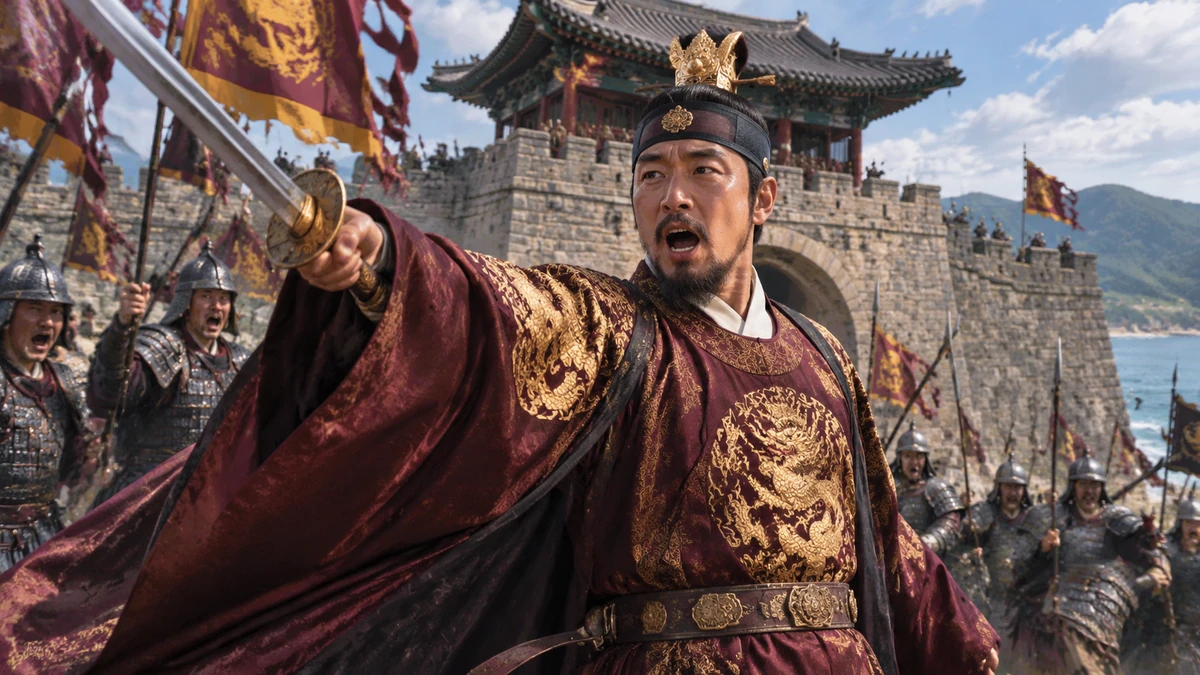
Image to help understand the article
A king determined to restore Goryeo’s independence
King Gongmin, the 31st ruler of Korea’s Goryeo dynasty, reigned from 1351 until his assassination in September 1374. His 23-year reign was defined by efforts to reduce Mongol influence, reclaim lost territory and reform a political system dominated by powerful aristocratic families.
Born in 1330 as the second son of King Chungsuk, Gongmin was sent to the Yuan dynasty’s court in China in 1341 under Mongol political pressure. He later married Princess Noguk, a member of the Yuan imperial family, in 1349. Despite his close ties to the Mongol court, he pursued a policy of restoring Goryeo’s political independence after ascending the throne in 1351.
Early reforms and resistance from powerful officials
Gongmin began his reform program within months of taking power. In February 1352, he abolished the Jeongbang, an institution responsible for government personnel appointments that had originated under the military dictatorship of Choe U. He also issued an order addressing abuses involving land ownership and slavery.
He reopened royal academic lectures and instructed government oversight agencies to report directly to him on matters affecting ordinary people. Corrupt senior officials were arrested, but the reforms threatened entrenched interests. In September 1352, official Jo Il-sin led a coup, killing several government figures and forcing his way into a powerful position. Gongmin eventually arranged Jo’s arrest and imprisoned 28 of his associates, strengthening his own administration.
Breaking with Mongol authority and reclaiming territory
Gongmin moved more aggressively against Mongol influence as the Yuan dynasty weakened amid the Red Turban Rebellion in China. In May 1356, he ordered a sweeping purge of pro-Yuan officials, including Gi Cheol and members of the powerful Gi family, which was connected to Empress Gi of the Yuan court. The crackdown became known as the Byeongsin Coup.
He abolished Mongol-era imperial titles and administrative systems, restored earlier Goryeo institutions and dismantled the office through which the Yuan government had exercised authority over Goryeo affairs.
That same year, Gongmin ordered General Yu In-u to retake territory administered by the Ssangseong General Government, a Mongol-controlled authority that had held lands north of the Cheolryeong Pass for nearly a century. Goryeo forces succeeded, restoring control over territory north of the pass. The campaign was a defining symbol of Gongmin’s independence drive. Local figures Yi Ja-chun and his son Yi Seong-gye, who would later establish Korea’s Joseon dynasty, played an important role in the victory.
Gongmin also ordered attacks against Yuan military relay stations beyond the Yalu River. Goryeo forces captured three of the eight stations, an operation regarded as the kingdom’s first expedition into the Liaodong region.
Foreign invasions and growing instability
Despite his political ambitions, Gongmin faced repeated military crises. Red Turban forces invaded Goryeo in 1359, reaching and capturing the northwestern city of Seogyeong before Goryeo troops forced them to retreat in February 1360. A second invasion in November 1361 brought an estimated 200,000 Red Turban fighters into the kingdom. They captured the capital, Gaegyeong, before Goryeo forces eventually drove them back across the Yalu River.
The invasions complicated Gongmin’s anti-Mongol policy because the Red Turbans were Han Chinese rebels fighting Mongol rule. Seeking to stabilize relations with the Yuan court, Goryeo temporarily restored some earlier administrative arrangements.
Japanese pirate raids were another persistent threat. Beginning in earnest around 1350, the raiders targeted grain transport vessels and storage facilities along Korea’s southern coast before expanding toward the waters near Gyeonggi Province. Some attacks involved fleets of more than 100 ships penetrating inland waterways. The threat became serious enough that Goryeo officials considered moving the capital. Although commanders including Choe Yeong and Kim Sok-myeong won important battles, the raids continued throughout Gongmin’s reign.
Political violence further weakened the government. In 1362, Gongmin’s associate Kim Yong orchestrated the deaths of several military commanders. The following year, rebels attacked the temporary royal residence at Heungwang Temple in an attempt to assassinate the king. Gongmin escaped, and Choe Yeong suppressed the uprising. In January 1364, forces supported by the Yuan court invaded under Deokheung-gun and Choe Yu, but Choe Yeong’s troops defeated them.
The death of Queen Noguk and the rise of Sin Don
A personal tragedy marked a turning point in Gongmin’s reign. In 1365, Queen Noguk, who had been unable to have a child for many years, became pregnant but died following a difficult delivery. The king was devastated. Historical accounts describe him mourning before her portrait, withdrawing from government affairs and devoting himself to Buddhist ceremonies in her memory.
Later that year, Gongmin brought a Buddhist monk named Sin Don to the royal court after meeting him personally. Sin Don was appointed to senior office and became the driving force behind a renewed reform campaign.
In 1366, at Sin Don’s recommendation, the government established the Jeonmin Byeonjeong Dogam, an agency tasked with correcting illegal land seizures and wrongful enslavement. Land taken by powerful aristocratic families was to be returned to its rightful owners, while people illegally reduced to slavery were to be freed. The government also restored the national academy, the Seonggyungwan.
These measures won Sin Don popular support but provoked fierce opposition from aristocrats and emerging military elites. In July 1371, he was exiled and executed, effectively ending Gongmin’s major reform initiatives.
Diplomacy and a final campaign in the north
Gongmin also adjusted Goryeo’s foreign policy as political power shifted in East Asia. After the Ming dynasty was established in China in 1368, he sent official Yi In-im to develop cooperation with the new government against remaining Yuan forces in Liaodong.
In 1370, commanders Yi Seong-gye and Ji Yong-su attacked Dongnyeongbu and captured Oro Mountain Fortress, returning Goryeo residents living in the region to their homeland. The operation did not lead to lasting territorial expansion.
Assassination and the legacy of Gongmin
After Queen Noguk’s death and Sin Don’s removal, Gongmin increasingly withdrew from political responsibilities. In 1372, he established the Jajewi, a royal guard composed of young, physically attractive men who remained close to the king.
In September 1374, palace attendant Choe Man-saeng secretly informed Gongmin that Hong Ryun, a member of the Jajewi, had been involved with one of the king’s concubines, Consort Ik-bi. Gongmin reportedly said that everyone who knew about the affair should be killed. Fearing for his own life, Choe told Hong Ryun, who joined several others in a conspiracy to murder the king that night while he was intoxicated.
After Gongmin’s death, his 9-year-old son Monino, who took the throne as King U, became the new ruler. Rumors about his parentage later became politically significant. Although officially recognized as the son of Lady Han, he was rumored to have been born to a woman named Banya, who had been associated with Sin Don. Political opponents subsequently used the controversy to challenge the legitimacy of King U and his successor, King Chang, helping justify the eventual founding of the Joseon dynasty.
The historical record presents Gongmin as a ruler who began his reign with considerable promise but lost direction after his wife's death. His reforms failed to dismantle the power of the aristocracy, yet they helped establish a new generation of Confucian scholar-officials, known as the rising literati, as an influential political force. That group would play a major role in the transition from Goryeo to Joseon.
Gongmin was also known as a skilled painter and calligrapher. Works attributed to him include Cheonsan Daeryeopdo, Iyangdo and a portrait of Queen Noguk. His tomb, Hyeonneung, stands beside the queen’s tomb, Jeongneung, preserving the memory of a marriage that shaped both his personal life and his political reign.
Comments
Post a Comment