Image to help understand the article
A Last Stand Against Overwhelming Odds
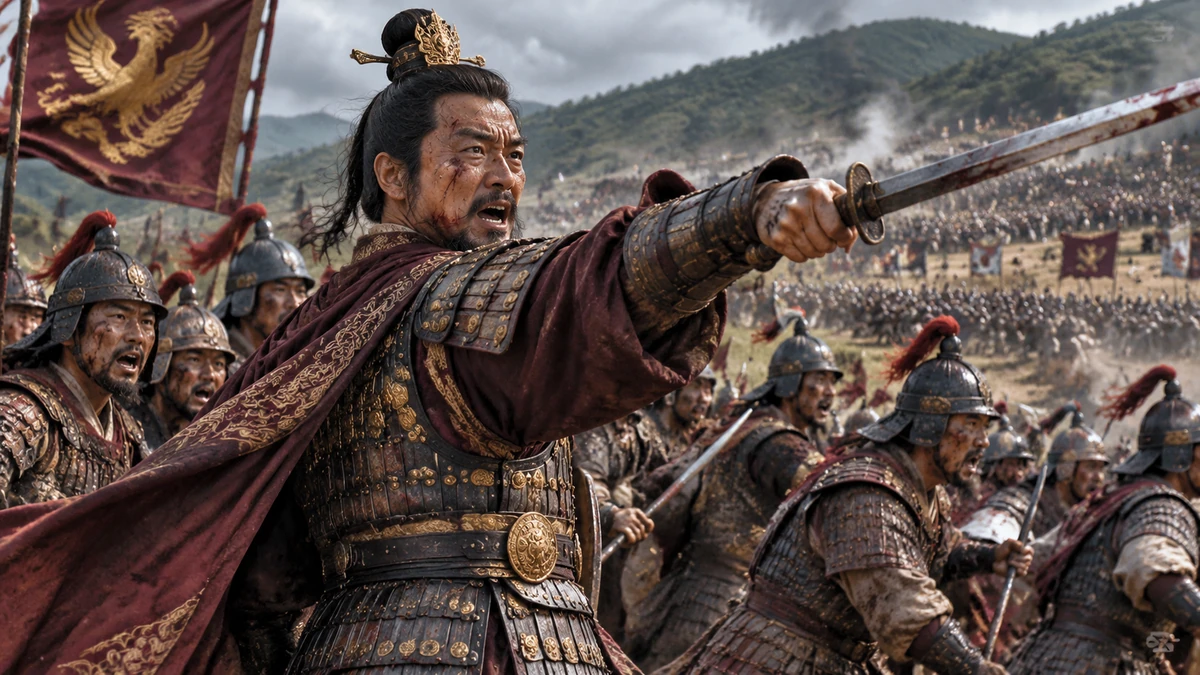
Gyebaek (階伯), a military commander of the ancient Korean kingdom of Baekje, is remembered for leading 5,000 soldiers against a Silla army reportedly numbering 50,000 at the Battle of Hwangsanbeol in 660. His forces fought five engagements against the invading army but ultimately lost. Gyebaek died on the battlefield on Aug. 21, 660, according to the lunar calendar date recorded in historical accounts. His birth year is unknown.
Gyebaek is traditionally regarded as one of Baekje's most loyal subjects, alongside the statesmen Seongchung and Heungsu. However, even his identity remains a subject of historical debate. The prevailing interpretation treats Gyebaek as his personal name. Another theory, based on records in Kim Jeong-ho's geographical work Daedongjiji, suggests he may have descended from Baekje royalty and that Gyebaek originally referred to a territory associated with his ancestors.
The 660 Invasion of Baekje
In 660, a combined Silla-Tang force launched a major assault on Baekje, one of the Three Kingdoms that dominated the Korean Peninsula before the rise of a unified Korean state. Tang commander Su Dingfang led a naval force of 130,000, while Silla's senior general Kim Yu-sin commanded 50,000 ground troops in a coordinated attack by land and sea.
On the ninth day of the seventh lunar month, Gyebaek established three military camps at Hwangsanbeol with his 5,000 troops. To encourage his outnumbered soldiers, he invoked the ancient Chinese story of King Goujian of Yue, who was said to have defeated an army of 700,000 with only 5,000 men. Baekje's forces won their first four engagements against Silla.
Hwarang Warriors and the Death of Gwan Chang
The fighting also produced two notable casualties on the Silla side. Ban-gul, the son of Kim Heum-sun, brother of commander Kim Yu-sin, was killed. Gwan Chang, the son of Silla general Kim Pum-il, was subsequently captured after leading a charge against Baekje's positions.
Impressed by the young warrior's courage and bearing despite his age, Gyebaek initially released him. But Gwan Chang returned to attack the Baekje lines. After capturing him again, Gyebaek ordered his execution.
The Final Battle at Hwangsanbeol
On the morning of the 10th day of the seventh lunar month, Silla launched a full-scale assault. Baekje's defenses collapsed, ending Gyebaek's resistance. Two Baekje commanders, Chungsang and Sangyeong, and their followers surrendered after accepting Kim Yu-sin's offer to spare them. One historical account, however, gives the number of surrendering soldiers as about 20, while another interpretation puts it at approximately 1,650.
The Samguk Sagi, a major historical chronicle compiled during Korea's Goryeo dynasty, records that Gyebaek killed his wife and children before going into battle. According to the account, he feared that defeat would leave his family captured and enslaved by the enemy. He reportedly considered death in battle preferable to surviving such humiliation.
A Hero, a Controversial Decision and Conflicting Historical Accounts
Gyebaek's legacy has been shaped by competing interpretations of his final actions. His inclusion in the biographical section of the Samguk Sagi reflects the positive assessment he received in the Goryeo period, when Confucian ideals of loyalty and duty influenced historical writing. Later Joseon-era scholars also frequently praised him as a patriot who placed his country above his family.
Not all scholars agreed. The Confucian scholar Gwon Geun argued that killing his family before the battle was cruel and may have weakened his soldiers' morale, contributing to their defeat. Other scholars, including Seo Geo-jeong, defended Gyebaek's resolve and regarded his actions as evidence of extraordinary loyalty and determination.
There is also a theory that the story of Gyebaek killing his family was created or promoted by Silla after Baekje's defeat. Under this interpretation, the story helped emphasize the incompetence of Baekje's King Uija and justify the kingdom's destruction by the Silla-Tang alliance, despite the existence of loyal commanders such as Gyebaek.
Memorials and a Legacy in Korean Popular Culture
Gyebaek continues to be honored at historical memorial sites in South Korea's Buyeo region, the former center of Baekje. Uiyeolsa Shrine was originally established in 1575 by Hong Ga-sin, the local magistrate, on Mangwolsan Mountain in Yongjeong-ri. It commemorated Seongchung, Heungsu and Gyebaek, along with the later Goryeo-era loyalist Yi Jon-o. The shrine was relocated to Namnyeong Park in 1971, where seasonal ceremonies are still held in spring and fall.
At Samchungsa Shrine inside Busosanseong Fortress, portraits of the three Baekje loyalists are displayed, and an annual memorial ceremony takes place during the Baekje Cultural Festival. A burial mound near Sinpung-ri in Nonsan, northwest of the Hwangsanbeol battlefield, has long been identified by local tradition as Gyebaek's grave. However, no conclusive evidence has established that the tomb belongs to him. The site is designated Chungcheongnam-do Monument No. 74 under the name Gyebaek General Historical Heritage Site.
His story has also remained prominent in South Korean entertainment and literature. Gyebaek has appeared in television historical dramas, including the 2011 MBC series Gyebaek, as well as productions such as Yeon Gaesomun, Queen Seondeok and The King's Dream. The 2003 film Once Upon a Time in a Battlefield also drew on the Battle of Hwangsanbeol. Several novels published between 2004 and 2018 have revisited his life and final stand.
Comments
Post a Comment