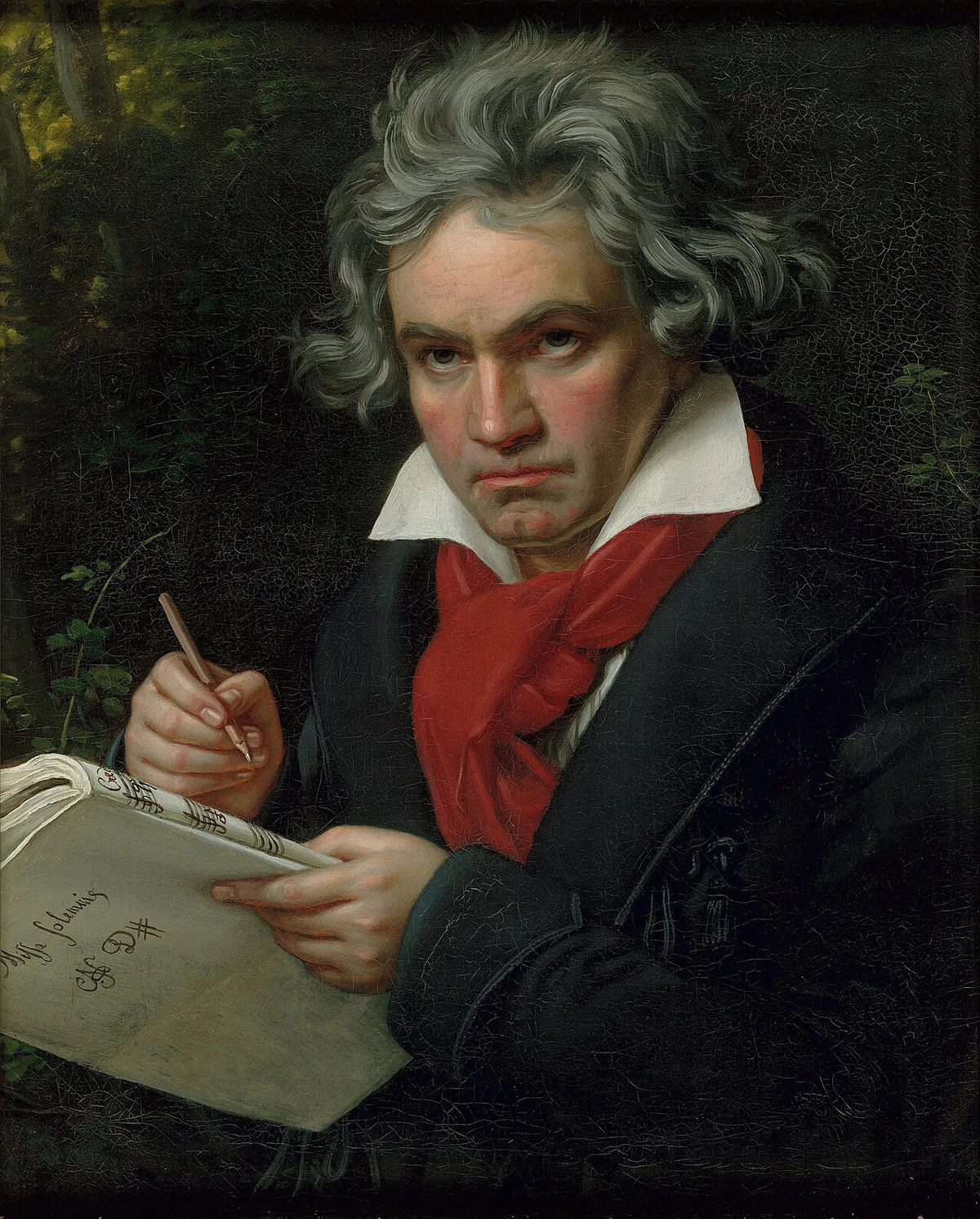
Image to help understand the article
From Bonn to Vienna
Ludwig van Beethoven, the German composer and pianist who reshaped Western music while gradually losing his hearing, began within the Classical tradition of Joseph Haydn and Wolfgang Amadeus Mozart. He ultimately expanded the scale, emotional intensity and structure of symphonies, piano sonatas and string quartets, helping clear the way for the Romantic era.
Beethoven was born in Bonn and baptized Dec. 17, 1770. Dec. 16 is widely accepted as his birthday, though no document confirms it. His grandfather, a musician from Mechelen in the Austrian Netherlands, became music director at the court of the elector of Cologne. Beethoven’s father, Johann, sang tenor in the same musical establishment and taught keyboard and violin. Of seven children in the family, Beethoven and two younger brothers survived infancy.
His earliest training came from his father and could be severe. Beethoven was sometimes pulled from bed at night and made to play the piano. Hoping to market him as a child prodigy like Mozart, Johann advertised the 7-year-old Beethoven as 6 for his first public performance in 1778.
The most important teacher of Beethoven’s Bonn years was Christian Gottlob Neefe, who taught him composition and introduced him to the music of Johann Sebastian Bach. Beethoven published his first keyboard variations, WoO 63, in 1783, along with three early piano sonatas, WoO 47. He also assisted Neefe as an organist in the court chapel and began receiving a salary in 1784.
The von Breuning family offered Beethoven refuge from his troubled home. Helene von Breuning helped cultivate his manners and his interest in literature and poetry, while Beethoven taught piano to her children. Through the family, he met Count Ferdinand von Waldstein, who became a friend and financial supporter.
After Beethoven returned from a brief visit to Vienna, his mother died in July 1787. His father’s chronic alcoholism forced him to leave court employment in 1789, and half of Johann’s pension was paid directly to Beethoven so he could support the family. Beethoven earned money teaching piano and playing viola in the court orchestra, where he became familiar with operas by Mozart, Christoph Willibald Gluck and Giovanni Paisiello.
Building a Career in Vienna
Beethoven probably first met Haydn in December 1790, when the older composer stopped in Bonn on his way to London. They met again in 1792, and Beethoven moved to Vienna that year, settling permanently in Europe’s leading musical capital. Waldstein sent him off with a prediction that, through hard work under Haydn, he would receive “Mozart’s spirit.”
In Vienna, Beethoven studied counterpoint with Haydn, violin with Ignaz Schuppanzigh and Italian vocal composition with Antonio Salieri. After Haydn left for England, Beethoven continued his studies with musicians including Johann Georg Albrechtsberger. French forces later occupied Bonn, effectively eliminating Beethoven’s obligation — and paid position — there.
Beethoven established himself in aristocratic salons through his powerful playing and improvisation. Patrons including Prince Lobkowitz, Prince Lichnowsky and Baron Gottfried van Swieten provided financial backing. He made his public debut in Vienna in 1795 and published the three piano trios of Op. 1, the first works to which he assigned an opus number. Their earnings amounted to nearly a year’s living expenses.
His reputation as a performer grew after celebrated piano contests against Joseph Wölfl in 1799 and Daniel Steibelt the following year. The “Pathétique” Sonata, Op. 13, appeared in 1799. Between 1798 and 1800, he wrote the six string quartets of Op. 18, while his Septet, Op. 20, became one of his most popular works during his lifetime.
The First Symphony premiered in 1800, and the first collection of string quartets was published in 1801. By then, Beethoven had emerged as a leading composer of the generation after Haydn and Mozart. His treatment of melody, key changes, texture and emotional character already distinguished him from his predecessors.
Hearing Loss and a New Musical Language
Beethoven began noticing hearing problems around 1798. In 1801, he told close friends about his symptoms, including tinnitus, and the strain they placed on his social life. The cause may have been otosclerosis, possibly accompanied by deterioration of the auditory nerve.
On a doctor’s advice, he stayed in Heiligenstadt outside Vienna in 1802. There he wrote a letter to his brothers describing his despair over his hearing loss and his determination to remain alive for the sake of his art. He never sent the letter. Discovered after his death, it became known as the Heiligenstadt Testament.
His deteriorating hearing did not prevent him from composing, but it undermined his performing career, a major source of income, and deepened his isolation. Contrary to the familiar image of Beethoven in total silence, he did not lose every trace of hearing. His student Carl Czerny said Beethoven could hear speech and music normally until 1812, and in his final years he could still distinguish some low tones and sudden loud sounds.
After Heiligenstadt, Beethoven’s music entered what is often called his middle or “heroic” period. His works became larger and more individual in their musical language. The Third Symphony, known as the “Eroica,” the “Razumovsky” quartets, and the “Waldstein” and “Appassionata” piano sonatas belong to this period, as do Symphonies Nos. 4 through 8, the opera “Fidelio” and the Violin Concerto.
Radical Late Works
From 1812 until his death in 1827, Beethoven produced some of his most innovative music. The “Missa Solemnis” and his final symphony, the Ninth, premiered in 1824. The period also included the “Diabelli Variations,” the “Hammerklavier” Sonata and his other late piano sonatas.
His late string quartets, written in 1825 and 1826, include the “Grosse Fuge” and are widely regarded as a summit of the form. These works stretched the conventions of chamber music just as the Ninth Symphony transformed the symphonic tradition by incorporating voices on a monumental scale.
Beethoven died in Vienna on March 26, 1827, after spending months confined to bed. He was 56. His output includes nine symphonies, 32 piano sonatas, five piano concertos and 16 string quartets, as well as a violin concerto, piano trios, violin and cello sonatas, songs, “Fidelio” — his only opera — and the “Missa Solemnis.”
Works That Defined His Legacy
The “Moonlight” Sonata, Op. 27, No. 2, dates from 1802 and was dedicated to Beethoven’s student Giulietta Guicciardi. In an 1801 letter, he wrote that he loved her, but differences in social rank prevented the relationship from advancing. The sonata remains among his best-known compositions.
The Third Symphony, written in 1803 and 1804 and premiered in 1805, was longer and broader in scope than earlier symphonies. Its first listeners were divided: Some objected to its length and structure, while others recognized it as a masterpiece.
The Fifth Symphony premiered in 1808. Reviewing it in 1810, writer and composer E.T.A. Hoffmann argued that the music stirred terror, fear and pain while awakening the infinite longing he associated with Romanticism.
The Ninth Symphony premiered in 1824, the same year as the “Missa Solemnis.” By bringing solo singers and a chorus into its finale, the Ninth became the first major example of a choral symphony. The late quartets and “Grosse Fuge,” composed in 1825 and 1826, carried Beethoven’s experimentation into his final years.
Napoleon and the “Eroica”
The dedication of the Third Symphony reflected Beethoven’s political hopes and disillusionment. Sympathetic to the ideals represented by the revolutionary leader Napoleon Bonaparte, Beethoven initially titled the work “Bonaparte.” When Napoleon declared himself emperor in 1804, Beethoven scratched the name from the manuscript’s title page. The edition published in 1806 carried a subtitle honoring the memory of a great man.
Beethoven’s hearing loss forced an early end to his performing career and pushed him to concentrate more heavily on composition. Yet his achievement was not simply that he continued writing despite disability. By enlarging inherited Classical forms and filling them with a more personal, dramatic and expansive language, he changed what instrumental music could express.
Comments
Post a Comment