Image to help understand the article
A Korean Comfort Food in Several Forms
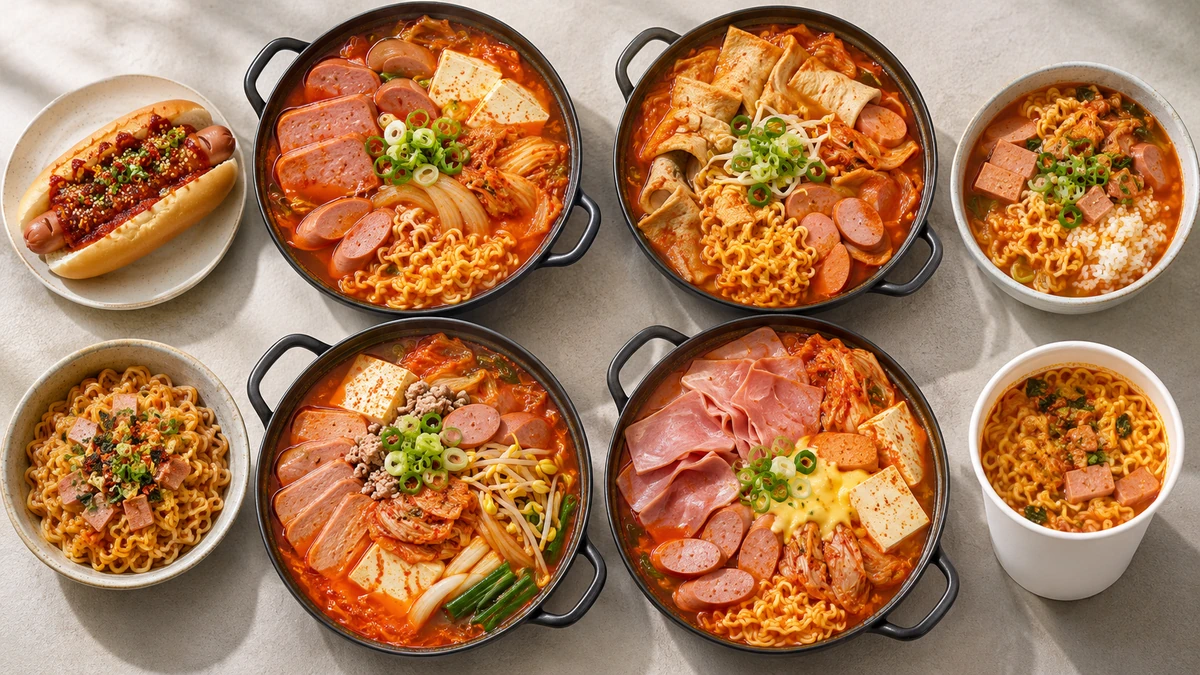
Budae jjigae, a Korean stew typically known for its mix of processed meats and other ingredients, is now sold in forms ranging from ready-to-cook meal kits to ramen and even a mala-flavored hot dog. Nutrition data from South Korea’s Ministry of Food and Drug Safety compare eight budae jjigae-related foods per 100 grams. The database figures were collected between 2019 and 2023.
Calories and Protein Vary Widely
The Ham-Deumppeuk Budae Jjigae meal kit had the lowest calorie count at 94 calories per 100 grams, followed by the Uijeongbu-style meal kit at 106, standard budae jjigae at 123 and the Odeng Sikdang meal kit at 145. The King Kong Budae Jjigae Mala Hot Dog contained 265 calories, Babmalla Budae Jjigae Ramen had 312, Bogeul Bogeul Budae Jjigae noodles had 429 and the cup-noodle version had the highest count at 446.
For protein, Bogeul Bogeul Budae Jjigae noodles ranked first at 8.66 grams per 100 grams. The cup noodles had 7.69 grams, the mala hot dog 7 grams, Babmalla ramen 6.85 grams and the Odeng Sikdang meal kit 6.27 grams. Standard budae jjigae contained 5.86 grams, the Ham-Deumppeuk meal kit 4.87 grams and the Uijeongbu-style meal kit 3.36 grams.
Sodium Data Are Incomplete
Among the five foods with sodium figures, standard budae jjigae had the lowest amount at 239 milligrams per 100 grams. The Uijeongbu-style meal kit contained 378 milligrams, the Ham-Deumppeuk meal kit 463, the Odeng Sikdang meal kit 518 and the King Kong mala hot dog 520. The government database did not provide sodium figures for Babmalla ramen or either Bogeul Bogeul noodle product, preventing a complete eight-item comparison.
Comments
Post a Comment