Image to help understand the article
A star steps behind the camera
Before Lee Jung-jae became a first-time feature director, he was best known as one of South Korea’s leading actors. With “Hunt,” Lee took on nearly every major creative role: He directed the film, co-wrote its screenplay, served as a co-producer and starred as intelligence officer Park Pyong-ho.
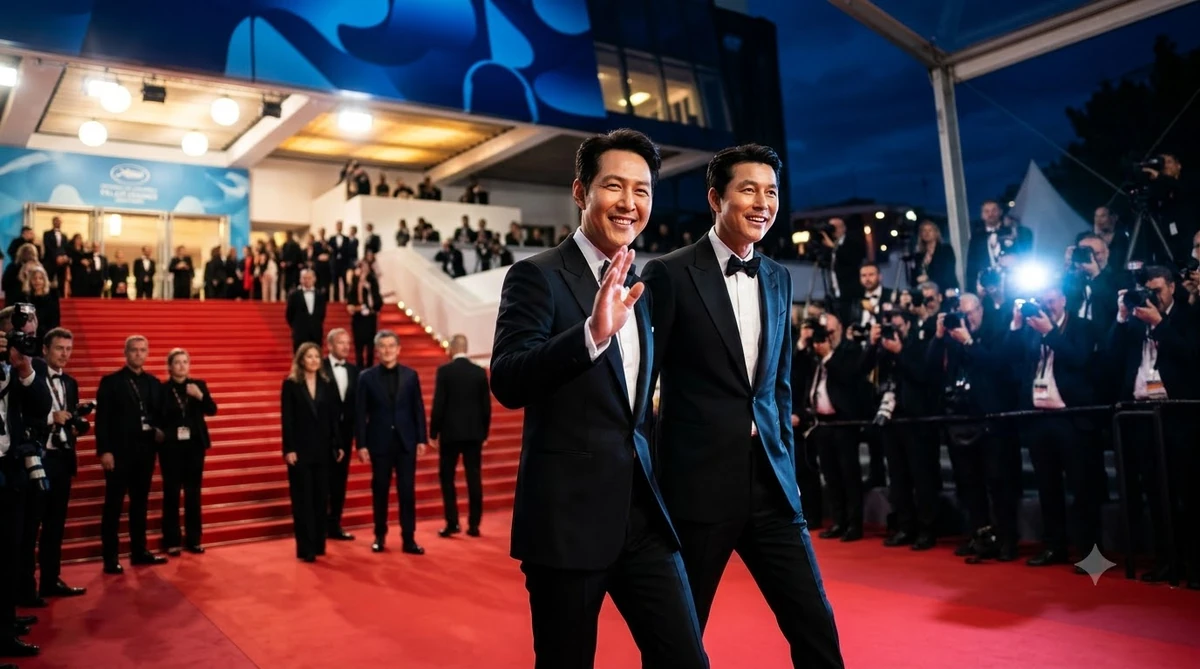
The 125-minute action drama premiered May 19, 2022, in the Midnight Screenings section of the 75th Cannes Film Festival. It opened in South Korean theaters on Aug. 10, 2022.
Set during the height of South Korea’s military dictatorship in the 1980s, the film follows two rival officials in the Agency for National Security Planning, the country’s powerful intelligence service at the time. Lee’s Park leads the agency’s overseas unit, while Kim Jung-do, played by Jung Woo-sung, runs its domestic operations.
Their uneasy partnership begins to unravel after they encounter an assassination attempt while helping protect South Korea’s president in Washington. The agency’s director later tells them that a North Korean spy known as Donglim has infiltrated the organization. When an operation in Japan involving the planned defection of a North Korean nuclear physicist also fails, the two teams begin investigating — and suspecting — each other.
The pursuit eventually leads Park and Kim toward a larger plot known as the “Korea No. 1 assassination operation.” The film combines its fictional conspiracy with events drawn from modern Korean history, including the May 1980 Gwangju Democratization Movement, the 1983 defection of North Korean pilot Lee Ung-pyeong and the 1983 bombing in Rangoon, then commonly known as Aung San.
A cast filled with familiar Korean stars
Alongside Lee and Jung, the cast includes Jeon Hye-jin as Bang Joo-kyung, Heo Sung-tae as Jang Cheol-sung and Go Youn-jung as Jo Yoo-jung. The film marked Go’s feature-film debut. Kim Jong-soo and Jung Man-sik also appear in major roles.
Several prominent South Korean actors joined in cameo or special appearances, including Hwang Jung-min, Yoo Jae-myung, Lee Sung-min, Ju Ji-hoon, Cho Woo-jin, Park Sung-woong and Kim Nam-gil.
The project began in 2017 under the title “Namsan,” with Lee attached to star, but the original production collapsed before filming. Lee continued revising the screenplay for four years. Production eventually began May 8, 2021, and wrapped Nov. 13 of that year.
From Cannes to North American theaters
“Hunt” received a seven-minute standing ovation after its Cannes premiere at the Lumière theater. It later made its North American debut in the Gala Presentations program at the Toronto International Film Festival in September 2022.
The film secured advance distribution deals covering 207 territories. In December 2022, Magnolia Pictures acquired U.S. theatrical distribution rights and released it through the company’s Magnet Releasing label.
Cannes also prompted Lee to reconsider how the film would play for audiences outside South Korea. He said he re-edited parts of the movie after the festival and planned to screen that version in Toronto, while retaining the original cut for South Korean theaters.
Some dialogue and scenes were revised to make the period’s political situation easier for international viewers to follow, requiring several actors to record lines again. Lee said he had initially assumed overseas audiences would approach the era much as younger Koreans did after learning about it in history textbooks. But he said roughly 30% of the international reviews published after Cannes reported difficulty following the plot without a working knowledge of 1980s South Korean politics.
A box-office hit despite difficult conditions
“Hunt” was the last of four major South Korean studio releases to arrive during the summer 2022 season. Its opening came as severe flooding in the Seoul metropolitan area sharply reduced moviegoing. Nationwide daily attendance fell from about 670,000 on Aug. 1 to 340,000 on Aug. 8.
Even so, “Hunt” drew 210,821 admissions on its first day, accounting for 46% of the market and taking the No. 1 spot at the box office. It opened on 1,548 screens.
The film passed 1 million admissions after four days, 2 million after seven days and 3 million on its 12th day, becoming the third South Korean film released that year to reach that mark. It crossed 4 million admissions on its 25th day. By Sept. 25, 2022, the KOBIS box-office database recorded a cumulative audience of 4,344,403. South Korea commonly measures theatrical performance by admissions as well as revenue.
Awards and divided reviews
Lee won best new director at both the Korean Association of Film Critics Awards and the Blue Dragon Film Awards. The critics association also named Jung best actor and Jeon best supporting actress. At the Blue Dragon awards, the film received additional honors for cinematography and lighting, as well as editing.
Lee Sung-hwan won a lighting award at the Grand Bell Awards, while cinematographer Lee Mo-gae received the film arts prize at the 2023 Baeksang Arts Awards.
International reviews were mixed. Deadline’s Pete Hammond praised the direction, cinematography and performances, while Variety’s Peter Debruge described the film as lengthy but lightning-fast and driven by adrenaline. Lou Thomas of the British Film Institute praised its violent action and twists but said it sometimes neglected clarity and plausibility.
Other critics were less enthusiastic. The Hollywood Reporter’s David Rooney found the characters and narrative underdeveloped, while IndieWire’s David Ehrlich gave the film a C. Clarence Tsui of the South China Morning Post rated it two out of five stars, arguing that viewers unfamiliar with the historical setting could find the plot confusing.
Based on 54 reviews, “Hunt” held a 69% score on Rotten Tomatoes with an average rating of 6 out of 10. Metacritic reported a score of 52 based on 11 critics.
South Korean reviewers similarly praised the film’s polished visuals, detailed production design, period sound and large-scale action while questioning whether its rapid momentum overwhelmed the espionage story. For Lee, however, the film established more than a new acting showcase: It marked a commercially successful directing debut built around one of the most politically turbulent periods in South Korea’s recent history.
Comments
Post a Comment