Image to help understand the article
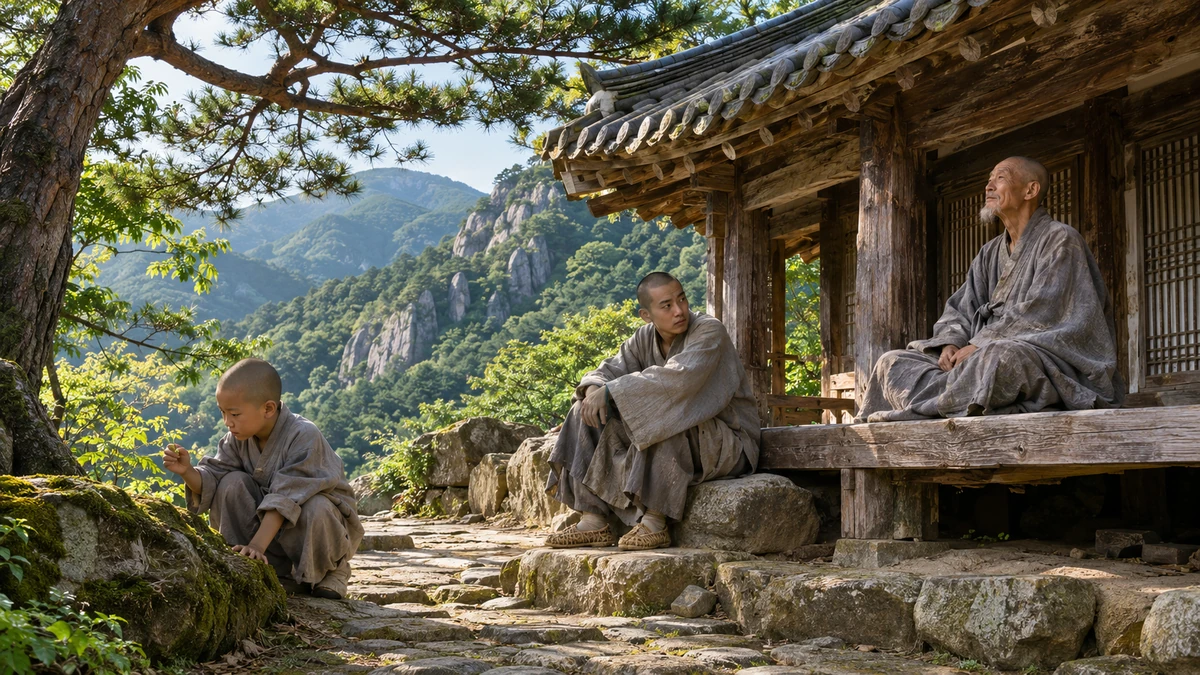
South Korean filmmaker Bae Yong-kyun’s 1989 drama “Why Has Bodhi-Dharma Left for the East?” follows three Buddhist monks at a remote mountain temple as they confront attachment, enlightenment and death. The film won the Golden Leopard, the top prize at the Locarno International Film Festival in Switzerland, and became the first Korean film released in U.S. theaters.
A Filmmaker Working Alone
Bae wrote, produced and directed the 145-minute film through Bae Yong-kyun Productions while working as a professor at Hyosung Women’s University in Daegu, now Daegu Catholic University. Better known at the time as a painter, he also handled the cinematography, production design, lighting and editing.
The project took eight years to plan and four years to make. Bae filmed it with a single camera and edited it by hand, an unusually solitary production process that drew attention alongside the finished work.
Lee Pan-yong plays the elderly Zen master Hyegok, Shin Won-sop portrays the younger monk Kibong, and Hwang Hae-jin plays the orphaned novice Haejin. The film was released in South Korea on Sept. 29, 1989.
Zen Questions Without Simple Answers
The title refers to Bodhidharma, the sixth-century Indian monk traditionally credited with bringing Zen Buddhism to China. The film does not directly explain its title, instead building its story around two hwadu, or riddles used in Zen practice to push the mind beyond ordinary reasoning.
One asks what a person’s original face was before their parents conceived them. The other asks where the master of one’s being goes when the moon rises in the heart through enlightenment or death. Hyegok gives these questions to Kibong, telling him to hold fast to them despite their lack of fixed answers. Solving them, the teacher says, will bring an unshakable peace.
Kibong has abandoned a difficult secular life in search of liberation, but he remains troubled by desire and concern for his blind mother, who has been left without adequate care. He lives with Hyegok and Haejin, through whose eyes the film also observes birth, death and the mysteries of the natural world.
Haejin injures a bird while bathing and tries to nurse it, but it dies as its mate remains nearby. A cow breaks through a fence and disappears into the woods. These events echo the monks’ struggles with confinement, loss and attachment.
A Teacher’s Death
When Kibong travels to a village to buy medicine for Hyegok, he visits his mother and becomes disgusted with himself for abandoning his family obligations. He announces that he will return to secular life. Hyegok rebukes him but does not stop him from leaving.
On his way down the mountain, Kibong is swept away by a sudden current and nearly dies. Haejin finds him, and Hyegok saves his life. After awakening, Kibong realizes that his gravely ill teacher has sacrificed his remaining strength to rescue him.
Hyegok asks Kibong to keep his death private and cremate his body on a hilltop, allowing him to return to his original place. Before his death, the teacher sends Kibong and Haejin to a full-moon festival and asks them to bring back plenty of paraffin. At the celebration, the two become absorbed in a dance, with the film suggesting that the dancer may be the old monk in another form.
They return under the bright moon to find Hyegok dead. Honoring his promise, Kibong places the body in a wooden chest and carries it uphill on a frame. A drizzle prevents the firewood from catching until he remembers the paraffin.
Kibong spends the night beside the burning body, suffering until he reaches a full understanding of death. The cow and Haejin appear near the flames, silently watching.
In the morning, Kibong searches the ashes for fragments of bone, crushes them into powder and scatters the remains over water, soil, trees and grass. By returning his teacher to nature, he resolves the spiritual riddle and attains the peace Hyegok described. He leaves the temple after entrusting the teacher’s few possessions to Haejin.
Haejin later burns those belongings in the temple stove, repeating the cremation in miniature and beginning to understand impermanence, a central Buddhist teaching that nothing remains unchanged. He enters Hyegok’s room and closes the door, suggesting that the child will take the teacher’s place. Outside, the bird flies freely, while the cow returns from the shadows into sunlight beside a person.
From European Festivals to American Theaters
At Locarno, the film received not only the Golden Leopard but also awards for directing and cinematography, along with honors from young critics and the ecumenical jury. It also screened in the Un Certain Regard section of the 1989 Cannes Film Festival and received a special jury prize from the Korean Association of Film Critics in 1990.
The film later established a milestone in the relationship between Korean cinema and American audiences. U.S. distributor Milestone Films opened it in New York on Sept. 24, 1993, before expanding screenings to more than 30 cities. That release made it the first Korean film shown commercially in U.S. theaters.
Comments
Post a Comment