Image to help understand the article
A singer born in Busan
Hyun In, one of the defining South Korean singers of the 1950s, gave voice to a generation shaped by Japanese colonial rule, national division and the Korean War. Known for songs including “Moonlit Night in Silla,” “Rainy Gomoryeong” and “Be Strong, Geum-soon,” he is often called South Korea’s “first singer” because he was the first performer to debut with a record after Korea’s liberation from Japan.
He was born Hyun Dong-joo on Dec. 14, 1919, in Busan, the major port city on Korea’s southeastern coast. He spent parts of his childhood in nearby Yangsan and moved between Busan’s Yeongdo and Dongnae districts. After his father became a Tokyo correspondent for Japan’s Mainichi newspaper, Hyun traveled to Japan, where seeing Russian bass Feodor Chaliapin perform at Hibiya Public Hall introduced him to classical music.
Classical training and a difficult road home
Hyun showed an aptitude for English, Japanese and music as a student in Seoul. He initially went to Tokyo intending to enter the Imperial Japanese Army Academy but changed course and studied voice at the Tokyo Music School, also known as the Ueno Music School. When his father cut off financial support because he opposed the decision, Hyun paid his tuition through manual labor and performed with an NHK choir.
After completing his vocal studies in 1942, he returned to Korea and worked as a music teacher for a theatrical company. The next year, seeking to avoid military conscription, he went to Shanghai and joined a Korean performance troupe, appearing in cities including Beijing and Hangzhou. Following Japan’s defeat in World War II, he was imprisoned in Beijing before returning to Korea in 1946.
His stage name reflected the upheavals of the colonial era. Under the Japanese name-changing system, he had used the name Goto Jin. He later adapted part of that name into Hyun In.
Popular success after liberation
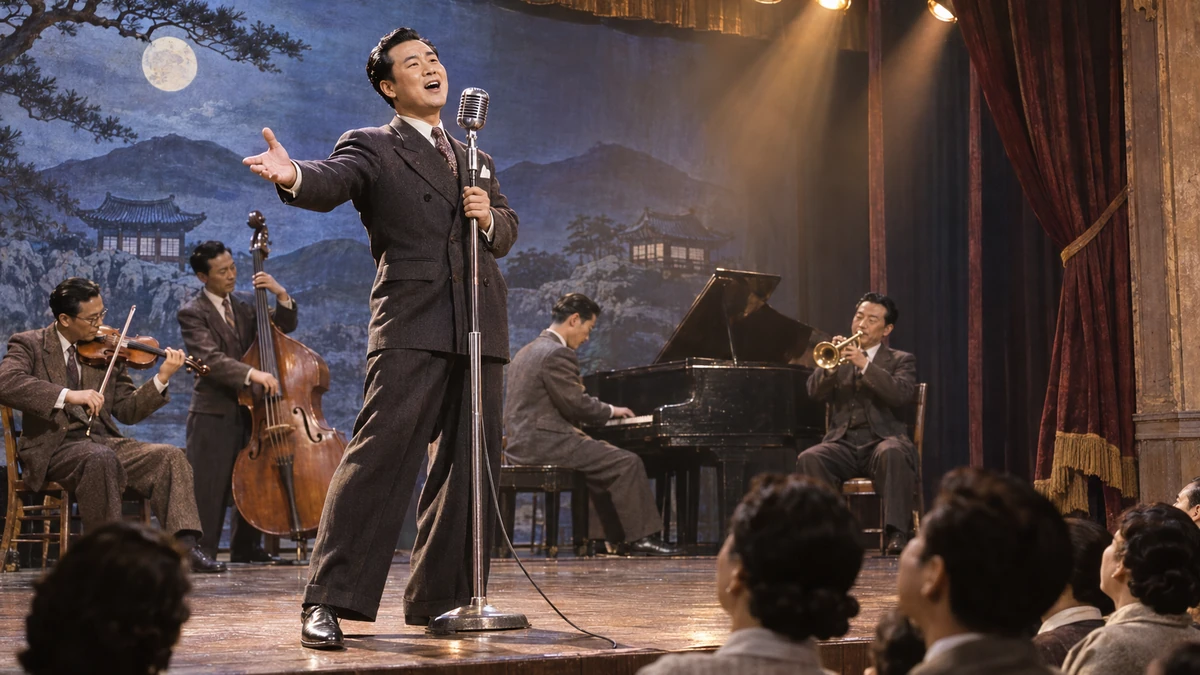
Back in Korea, Hyun performed for U.S. troops and organized a tango-focused ensemble in Busan. Composer Park Si-chun encouraged him to become a popular singer in 1947. That year, Hyun drew attention at Seoul’s Newsmans Club and scored a major success with “Moonlit Night in Silla,” written by lyricist Yoo Ho and composed by Park.
He followed with “Rainy Gomoryeong” and “Faraway Homeland.” In 1948, he released “Lucky Seoul” and a Korean adaptation of the international standard “Bésame Mucho.” He also starred in the 1949 production “Blue Hill,” described as the first musical film made after liberation, and sang its theme song. “Seoul Nocturne” was among the songs he both wrote and composed.
Hyun’s adaptations of foreign music broadened a popular music scene then dominated by trot, a Korean genre shaped by the colonial period and known for its distinctive rhythm and emotional vocal style. His performances of songs associated with French stars Édith Piaf and Yves Montand helped spur interest in chanson in South Korea in the early 1950s.
Songs of war and displacement
During the Korean War, Hyun joined a military entertainment unit and performed for troops. He released the military song “Good Night, Comrade,” while “Be Strong, Geum-soon,” “Incense of India” and “Love in a Dream” became enduring favorites. His work captured the separation, displacement and hardship experienced by ordinary Koreans during the conflict.
Hyun remained especially active in wartime Busan, which served as a refuge for people fleeing the fighting. He organized “Hyun In and His Band” for a performance at the Donga Theater and appeared in a 1952 musical production about Adm. Yi Sun-sin, the revered Korean naval commander.
After the war, Hyun returned to Seoul and joined Park Si-chun’s Silver Bell Show troupe. He continued to produce hits through the late 1950s, including “Napoli Mambo” and “Night at Bulguksa,” and composed “Arirang Mambo,” recorded by Jeon Young-joo in 1958.
New York and a return to Korean television
Hyun’s career also carried a direct American connection. His post-liberation performances for U.S. service members came as American forces established a lasting presence on the Korean Peninsula, while his later singing helped connect colonial-era Korean styles with the American-influenced pop that flourished in South Korea during the 1960s.
In 1974, he immigrated to New York City, married for a third time and started a business, but the venture struggled. He returned to South Korea in 1981 and resumed television appearances, including performances on KBS’ long-running nostalgia program “Gayo Stage.” He remained active on television until worsening diabetes forced him to stop performing in 1999.
A lasting place in Korean music history
Hyun received several major honors late in his career, including a special KBS popular music award in 1990, a Golden Disc honor in 1996 and South Korea’s Order of Cultural Merit in 1999. He died from complications of diabetes on April 13, 2002.
Music historians regard Hyun as a bridge between the trot and folk-derived popular songs of the colonial period and the pop-oriented vocal styles that emerged in the 1960s. His recordings offered comfort during some of the most difficult years of modern Korean history while introducing listeners to musical influences from Europe and the wider world.
In 2003, Busan honored its native son with a statue and song monument in Yeongdo. The memorial bears lyrics from “Be Strong, Geum-soon,” preserving the work of a singer whose voice became closely associated with war, survival and South Korea’s early popular music industry.
Comments
Post a Comment