Image to help understand the article
The International Monetary Fund urged European governments to accelerate economic reforms to prepare for potential future crises, warning that weak growth, high energy costs and rising government borrowing costs leave the region with little room to absorb new shocks.
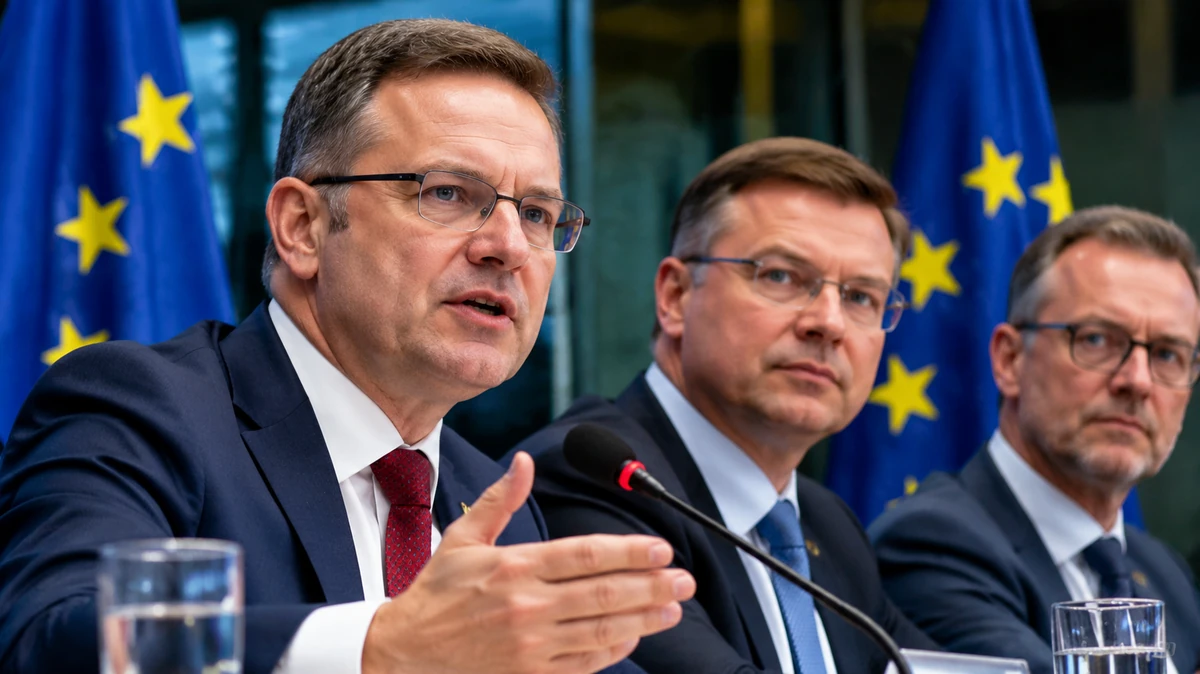
Speaking Nov. 12 at the House of the Euro in Brussels, IMF European Department Director Mateusz Szczurek presented the fund's autumn regional economic outlook, titled "Choosing Growth: Reforms for Innovation, Scale, and Resilience." Szczurek, a former Polish finance minister, was joined at the event by European Commission Executive Vice President Valdis Dombrovskis and European Central Bank Vice President Boris Vujcic.
Energy transition has helped, but Europe remains vulnerable
Szczurek said Europe had weathered the energy shock better than anticipated, partly because the expansion of renewable energy had reduced the region's dependence on imported fossil fuels. But he cautioned against interpreting that resilience as a sign that the crisis had passed.
"Europe is not out of the woods yet," he said, warning that elevated energy prices would continue to weigh on the economy. Government bond yields are also rising as concerns about public finances intensify. Szczurek described the increase as a warning that fiscal pressures cannot be ignored.
The IMF report points to persistently weak productivity growth alongside mounting spending demands, including higher defense budgets. Together, those pressures are leaving European governments with limited capacity to respond to another economic shock.
IMF sees sluggish growth across the euro area
The fund forecasts average economic growth of 1.2% this year among the 21 countries using the euro, excluding Ireland, followed by a slight slowdown to 1.1% next year. Szczurek warned that growth would remain fragile and subdued, leaving the region vulnerable to recession if another major shock occurs.
The IMF called for cautious monetary and fiscal policies alongside reforms designed to strengthen long-term growth. A central priority is reinforcing the European Union's single market, which allows goods, services, capital and people to move across member countries.
The assessment echoes remarks Szczurek made at the IMF's annual meetings in Bangkok on Oct. 16. At that briefing, he said European growth was weaker than expected before the war but not as poor as initially feared. The IMF also projected that euro-area headline inflation would remain above its target through 2028, with inflationary pressures lasting longer in Central, Southern and Eastern Europe.
The fund identified continued energy transition efforts, stronger EU single-market integration and sustained domestic reforms in Central, Southern and Eastern Europe as priorities for improving productivity.
France faces mounting pressure to restore public finances
France stands out as a major concern. Yields on its 10-year government bonds, known as OATs, exceeded 5% on Oct. 21 for the first time since 2002, while protests over high living costs have continued. The country is also subject to the EU's excessive deficit procedure, with its budget deficit reaching 5.1% of gross domestic product, well above the bloc's recommended 3% threshold.
Szczurek urged France to pass its 2027 budget as soon as possible. Prime Minister Sébastien Lecornu is seeking 54 billion euros in spending cuts in the proposed budget. Finance and Economy Minister Roland Lescure has said the government could invoke Article 49.3 of the French Constitution to enact the budget without a parliamentary vote if lawmakers fail to approve it.
The IMF projects French economic growth of just 0.4% in 2026 and 0.7% in 2027. It expects the country's budget deficit to remain elevated at 5.2% of GDP in 2026 and 4.9% in 2027.
The fund warned that political uncertainty ahead of France's 2027 presidential election could further delay planned fiscal consolidation and structural reforms. The election, scheduled for April 2027, could provide an opportunity to combine measures that put public finances on a sustainable path with reforms aimed at improving medium-term economic growth.
In its July assessment of France, the IMF said the economy had maintained modest growth in 2025 despite domestic and international shocks, including conflict in the Middle East. It also called for a credible multiyear fiscal consolidation strategy that accounts for rising defense spending, the costs of an aging population and investment demands associated with the digital and green transitions.
Comments
Post a Comment