Image to help understand the article
KBS will premiere “Munmu,” a 28-episode historical drama about the wars that reshaped the Korean Peninsula in the seventh century, on KBS 2TV at 9:20 p.m. on the 14th.
The series, reportedly made for about 30 billion won, marks the South Korean public broadcaster’s return to its signature large-scale historical drama format two years and eight months after “Korea-Khitan War.” It is the 35th such epic produced by KBS.
From unification to war with an ally
“Munmu” begins around the fall of the kingdoms of Goguryeo and Baekje and follows Silla as it unifies the three kingdoms, then goes to war against its former ally, China’s Tang dynasty, to retain control of the peninsula. The conflict is known as the Silla-Tang War.
At the center of the story is Kim Beop-min, who later becomes King Munmu. He initially struggles to accept the humiliations endured by his father, Kim Chun-chu, in the name of survival. After witnessing the devastation inflicted on the country and its people, he comes to understand his father’s decisions. Under famed general Kim Yu-sin, he also develops the battlefield leadership needed to become a ruler skilled in both civil and military affairs.
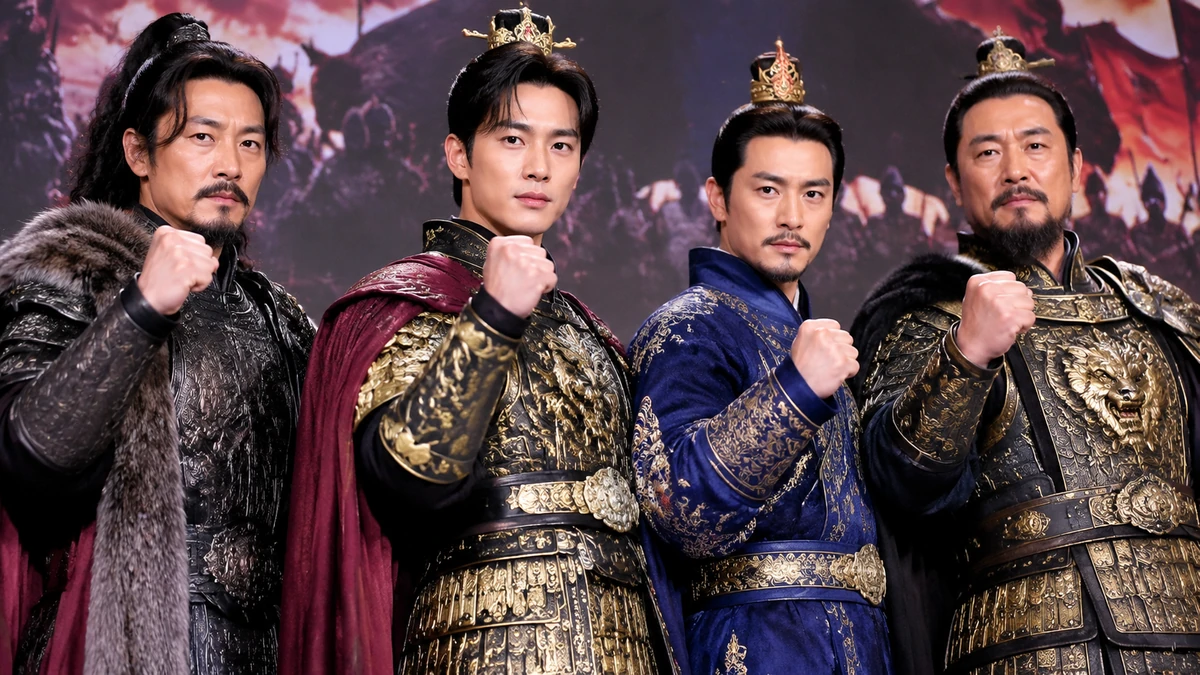
Lee Hyun-wook plays Kim Beop-min, with Jang Hyuk as Goguryeo military leader Yeon Gaesomun, Kim Kang-woo as Kim Chun-chu and Park Sung-woong as Kim Yu-sin. The cast also includes Jung Woong-in, Kim Do-hyun and Baek Sung-hyun.
Executive producer Lee Ho said the drama was designed to inspire pride in Korean history while exploring a less familiar part of the unification story: how Silla defeated the much larger Tang empire. He said Silla worked with displaced people from Goguryeo and Baekje, used diplomacy when it was weak and acted collectively when an opportunity emerged — themes he believes resonate in an era marked by conflict.
Actors take on major historical figures
Lee Hyun-wook, who played another Korean monarch in the streaming series “The Queen Who Crowns,” said the relative lack of previous screen portrayals of King Munmu gave him room to explore the role. He described Kim Beop-min as a master of restraint and said he drew on similar qualities in himself.
Jang Hyuk said he felt pressure portraying Yeon Gaesomun, a figure long associated with strength and previously played by prominent veteran actors. He said he sought to create his own interpretation while filling in the gaps between fragmentary historical records.
Kim Kang-woo, who plays the father of Lee Hyun-wook’s character despite being seven years older than his co-star, said he visited King Muyeol’s tomb in Gyeongju and repeatedly asked the ancient ruler to appear in his dreams and explain the thinking behind his achievements.
AI expands the battlefield
KBS used artificial intelligence to create large-scale battle and fire sequences. The broadcaster established a generative AI production hub in August, and the technology was applied to three major battles depicted in the series: Mount Jupil, Maeseong and Gibeolpo.
The Mount Jupil sequence combined live-action footage shot in Mongolia with AI-generated imagery, while the Maeseong and Gibeolpo scenes relied more heavily on AI. Lee said the technology continued to improve during the roughly 18 months spent planning the production.
Lee said the scale required substantial spending to depict Goguryeo, Baekje, Silla and Tang China. He added that the production relied on historical records and included academic advisers in meetings to reduce the risk of inaccuracies.
KBS touts return of its historical epic
KBS President Park Jang-beom attended the production presentation in Seoul’s Guro district on the 12th. He said the series fulfilled his pledge to produce another major historical drama after legislation restored stability to the collection of South Korea’s public broadcasting license fee.
Invoking the history of unification and resistance to Tang rule, Park said he hoped politicians would also watch the drama.
Comments
Post a Comment