Image to help understand the article
A historic bronze medal for a newly independent nation
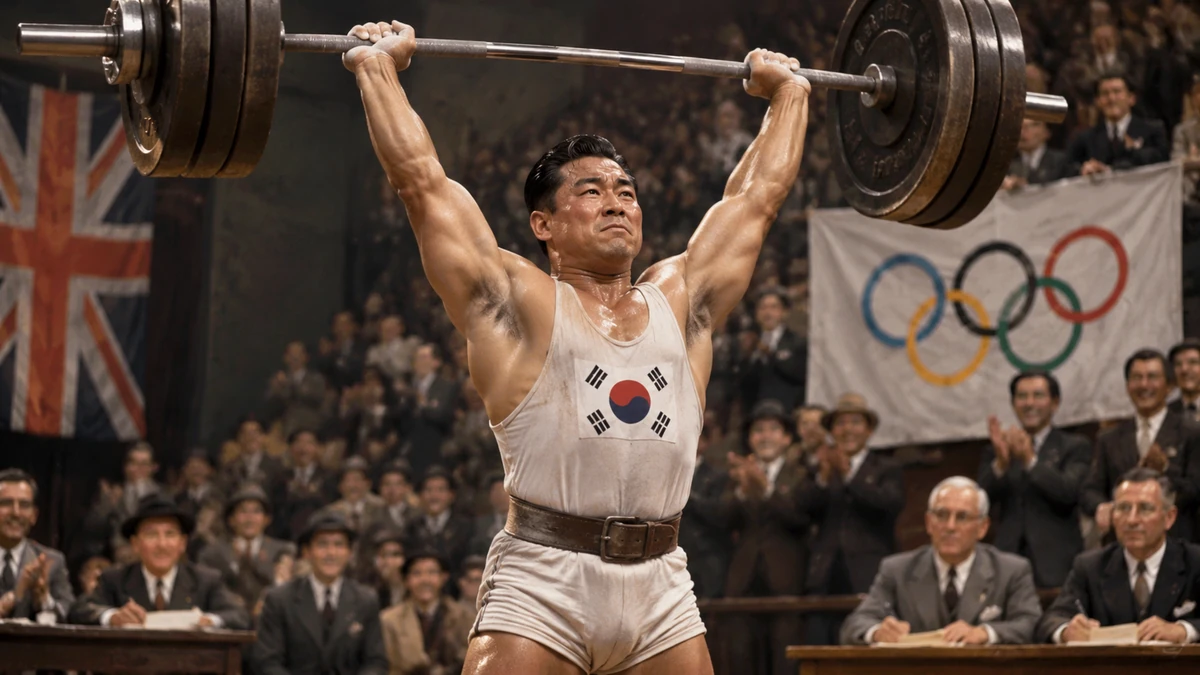
Kim Seong-jip (Jan. 13, 1919-Feb. 20, 2016) holds a landmark place in South Korean sports history. He won a bronze medal in the middleweight weightlifting competition at the 1948 London Olympics, becoming the first athlete competing under the Republic of Korea flag to win an Olympic medal. Four years later, he earned another bronze in the same division at the 1952 Helsinki Olympics, becoming the first South Korean athlete to win medals at two consecutive Olympic Games.
From a Seoul schoolboy to a weightlifting champion
Born in Pilun-dong, in what is now central Seoul's Jongno district, Kim was the second of two sons born to Kim Sun-jeong and Song Seok-nyeo. He attended Cheongun Elementary School and Whimoon High School before graduating from Boseong College.
His introduction to weightlifting came during his second year at Whimoon, when he met physical education teacher Seo Sang-cheon, widely regarded in South Korea as the father of the sport. Kim became interested after reading Seo's book, Physical Fitness Improvement. He subsequently joined the Central Physical Education Research Institute, founded by Seo, and began training with barbells. Seo promoted weightlifting as a way to strengthen national identity, and accounts say he initially embraced the sport as a form of resistance to Japanese colonial rule.
International success and a long sporting career
Kim's progress was rapid. By his fourth year of training, he was winning major competitions. In May 1936, he took first place at the Japanese Weightlifting Championships and an Olympic team selection competition for the Berlin Games. He also won the Olympic candidate selection competition and the All-Japan Weightlifting Championships in 1938.
Following his historic performances in London and Helsinki, Kim placed third at the World Weightlifting Championships in Philadelphia. He won gold in weightlifting at the second Asian Games, held in Manila in 1954. At age 38, he competed again at the 1956 Melbourne Olympics, finishing fifth. He retired from competition at 40.
Building South Korea's next generation of athletes
After retiring, Kim remained deeply involved in sports administration. He served as executive director and vice president of the Korea Weightlifting Federation, held positions including director and secretary-general at the Korean Olympic Committee's national sports organization, and participated in the Asian Games and Olympics as an official.
He led South Korea's Olympic delegations as head of mission at the 1972 Munich Games and the 1984 Los Angeles Olympics. From 1976 to 1990, he served as head of the Taereung National Training Center, the country's principal training facility for elite national athletes, helping develop future generations of competitors.
Kim later became an honorary adviser to the Korea Weightlifting Federation. In 2009, he received an achievement award from the Sogang Sports Awards.
Recognition of a sporting pioneer
Kim died of age-related causes on Feb. 20, 2016, at 98. The South Korean government awarded him the Order of Civil Merit, Moran Medal, and the Cheongnyong Medal of the Order of Sport Merit.
In November 2019, a memorial burial ceremony was held in his honor at the Daejeon National Cemetery. About 40 people attended, including family members and Shin Chi-yong, head of the Jincheon National Training Center.
Comments
Post a Comment