Image to help understand the article
A quiet story about poetry and a devastating family secret
Released May 13, 2010, Poetry is the fifth feature film directed by South Korean filmmaker Lee Chang-dong, who also wrote the screenplay. The 139-minute drama stars veteran actress Yoon Jeong-hee as Yang Mi-ja, a woman in her mid-60s who enrolls in a poetry class while struggling with poverty, family responsibilities and a growing personal crisis.
The film was produced by Lee’s company, Pinehouse Film, with investment and funding from Uni Korea, which had previously worked with the director on Oasis.
Mi-ja lives in a small city in Gyeonggi province, near the Han River, where she raises her middle-school-aged grandson, Jong-wook, in an aging apartment building. Her finances are so limited that she qualifies for government assistance. Her only income comes from caring for an elderly man, Kang, who has suffered a stroke.
Despite her circumstances, Mi-ja takes pleasure in colorful clothes, flower decorations and the small details of everyday life. Her daughter, who lives in Busan, describes her as someone who loves flowers and says unusual things, adding that her mother seems like a poet.
Learning to see the world differently
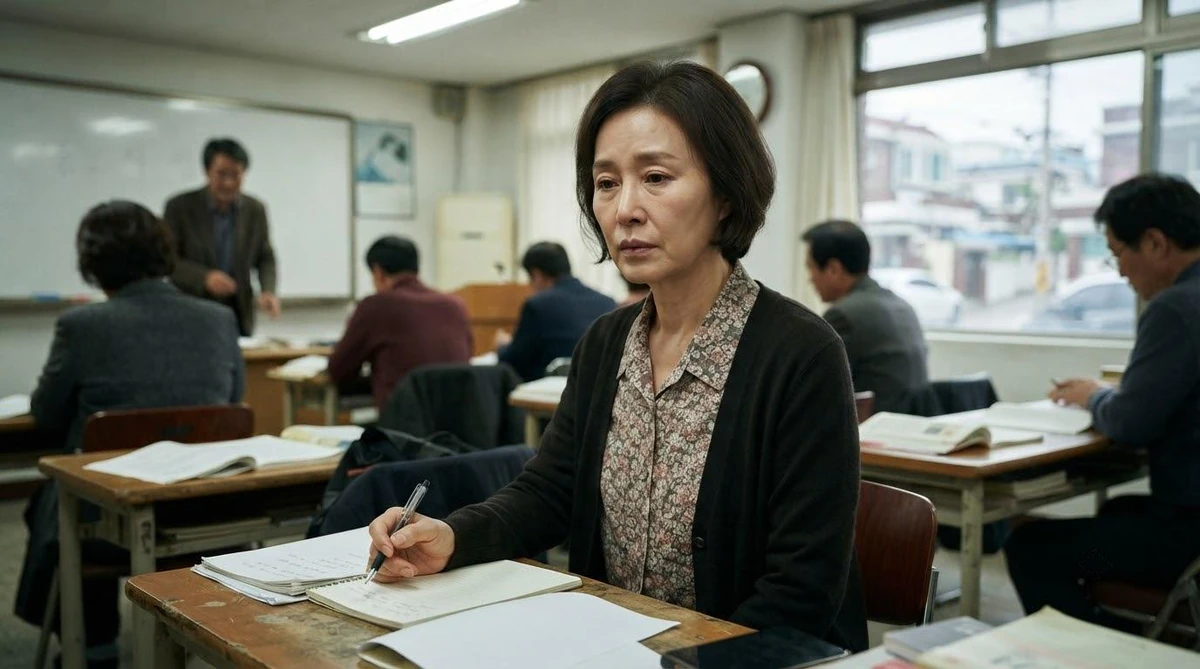
Mi-ja signs up for a poetry class at a neighborhood cultural center. The instructor, poet Kim Yong-taek, teaches students that writing poetry begins with learning to see things properly. He assigns each participant the task of producing a poem before the final class.
Carrying a small notebook, Mi-ja begins recording words and observations. Ordinary moments that she once overlooked take on new meaning as she tries to understand the world through poetry.
But her new pursuit of beauty collides with a disturbing family reality. She discovers that her grandson participated with other students in the sexual assault of a female classmate. The girl, a middle-school student, died several days before Mi-ja learned the truth.
The boys’ fathers agree to negotiate with the victim’s single mother in an effort to settle the matter and keep it from becoming public. Each family is expected to contribute 5 million won. At the same time, Mi-ja receives an Alzheimer’s diagnosis at a major hospital, adding another crisis to her already precarious life.
17 awards, including Cannes screenplay honors
Poetry won the Best Screenplay award at the 2010 Cannes Film Festival and collected 17 awards in South Korea and internationally.
At South Korea’s Grand Bell Awards in 2010, it won Best Picture, Best Screenplay, Best Actress for Yoon Jeong-hee and Best Supporting Actor for Kim Hee-ra. The Korean Film Awards also recognized it with Best Picture, Best Director and Best Screenplay.
Its international recognition continued in 2011. The film won the Grand Prix and Critics’ Award at the Fribourg International Film Festival. It also received Best Picture and Best Screenplay from the Korean Association of Film Critics, Best Actress at the Blue Dragon Film Awards, and directing and acting honors at the Asia Pacific Screen Awards. The Asian Film Awards recognized Lee for directing and writing.
South Korean film professionals ranked it the country's best film of 2010, and film journalists also selected it as the year's top movie. Yet its critical success did not translate into a major domestic box-office performance: it attracted only about 220,000 moviegoers in South Korea.
International attention and a political controversy
The New York Times gave the Cannes-winning film significant attention, highlighting the conversations between Mi-ja and her poetry instructor and the idea that poetry emerges from an artist’s rigorous examination of the self.
Film professor Kim Young-jin of Myongji University described the movie as an intensive exploration of whether making art means embracing not only beauty and joy but also suffering.
When Poetry opened in France in 2010, it attracted 2,782 moviegoers. That was more than twice the roughly 1,000 people who attended the opening day of Lee’s earlier film Secret Sunshine in the country. On The Movie Database (TMDb), the film received an average user rating of 7.581 from 359 participants.
The film also became the center of a controversy involving South Korea’s Film Promotion Committee, the government-backed body responsible for supporting the domestic film industry. One of its programs provided production funding to films considered likely to receive recognition at international festivals.
During the selection process, committee judge Cho Hee-moon gave Poetry a score of zero, despite rules that prohibited such a score. He had previously assigned unexplained zero scores to other films. The decision disqualified Lee’s film from receiving support.
The controversy continued after the film won at Cannes. Questions were raised about whether political considerations had influenced the decision, including Lee’s previous service as a minister under former President Roh Moo-hyun. Evidence also emerged suggesting that the committee had deliberately changed its rules to prevent Lee’s film from receiving assistance.
French newspaper Le Monde criticized the contradiction, noting that a film given zero in the Korean film committee’s screenplay evaluation had gone on to win the screenplay prize at Cannes.
A poem linked to South Korea’s former president
Another layer of political significance surrounded a poem featured in the film, titled Agnes’s Song. Because Lee wrote the screenplay around the time of former President Roh Moo-hyun’s death, he was asked whether the poem was intended as a tribute to the late president.
Lee acknowledged that the connection could not be denied, referring to the shock and circumstances surrounding Roh’s death. After receiving the Cannes screenplay award, the director visited Roh’s gravesite to pay his respects.
With its portrait of an elderly woman searching for beauty while confronting painful truths, Poetry remains one of Lee Chang-dong’s most internationally recognized works — a film whose artistic reputation far exceeded its domestic box-office reach.
Comments
Post a Comment