Image to help understand the article
Lee Si-young, a statesman born into one of Korea’s most prominent official families, gave up wealth and status to help build an armed independence movement against Japanese rule. He later managed legal and financial affairs for Korea’s government-in-exile and became the Republic of Korea’s first vice president.
Born Dec. 3, 1868, in Seoul during the Joseon Dynasty, Lee came of age as Korea faced growing pressure from imperial powers. His career spanned the final decades of dynastic rule, Japan’s colonization of Korea, the independence struggle in China and the turbulent creation of South Korea. He died April 17, 1953.
From Government Official to Independence Activist
Lee was raised in a family that had produced senior civilian and military officials for generations. Educated first in the Confucian classics, he passed the preliminary civil service examination in 1885 and later advanced through the state bureaucracy, holding posts in the royal secretariat, palace administration, courts and ministries.
After leaving office in 1895, Lee studied modern subjects with reform-minded intellectuals including his brother Lee Hoe-young and independence activist Lee Sang-seol. The shift reflected a broader effort among Korean elites to understand the institutions and technology that had strengthened Japan and Western powers.
In 1905, while serving in the Korean government’s foreign affairs administration, Lee opposed the treaty that stripped Korea of its diplomatic sovereignty and made the country a Japanese protectorate. He urged Foreign Minister Park Je-sun to reject Japan’s demands, resigned when the agreement was accepted and canceled a planned marriage between his family and Park’s.
As governor of South Pyongan province beginning in 1906, Lee supported modern schools and the patriotic enlightenment movement, which promoted education and civic organization as tools for preserving Korean sovereignty. He later joined Ahn Chang-ho, Lee Dong-nyung, his brother Lee Hoe-young and others in organizing Shinminhoe, a clandestine association dedicated to recovering national independence.
A Family Fortune Devoted to Military Education
Japan formally annexed Korea in 1910 and appointed Lee to an advisory body under the colonial government. He refused to serve. Instead, he and five brothers liquidated family property to finance resistance activities and moved their households to western Manchuria, a region of China that became a major base for Korean independence activists.
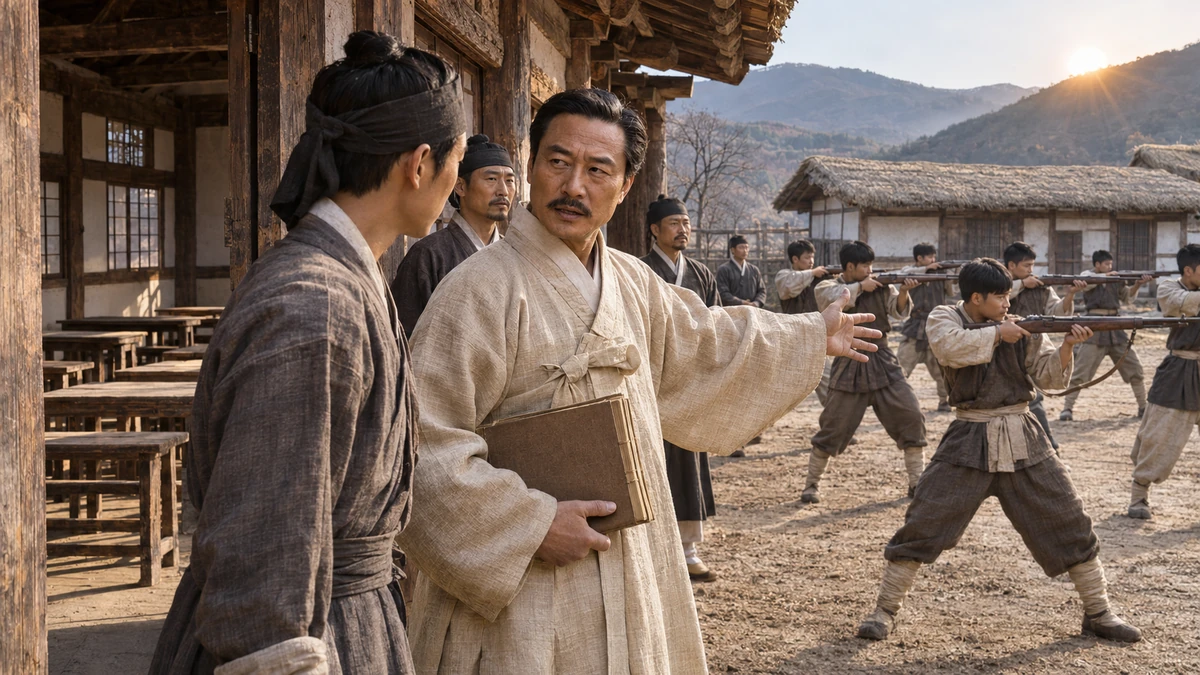
In April 1911, Lee and other exiles helped establish organizations intended to settle Korean migrants, educate their children and train an independence army. One of those institutions began as Shinheung Training School and was expanded under Lee’s leadership into Shinheung Military Academy in 1912.
The academy taught military theory, tactics and strategy. Enrollment grew sharply after the March 1 Movement of 1919, a nationwide uprising against Japanese colonial rule, and reached about 600 students. By the time the school closed in August 1920, it had trained roughly 3,500 officers. Graduates later played important roles in Korean armed resistance, including the Battle of Cheongsanri, a major 1920 clash between independence forces and the Japanese military in Manchuria.
Shinheung became one of the principal training centers for Korean independence fighters during the 1910s. Its creation also became the defining example of Lee and his brothers’ decision to exchange the privileges of an aristocratic household for exile and revolutionary work.
Financing a Government in Exile
Lee sought cooperation with the Chinese government in Beijing in 1913, but efforts to establish a Korean-Chinese united front ended after Chinese leader Yuan Shikai died. Following the March 1 Movement, Lee joined other activists in supporting the protests from Beijing before traveling to Shanghai to help create the Korean Provisional Government.
The provisional government, established in 1919, operated outside Korea and claimed to represent an independent Korean republic during Japanese rule. Lee served first as its justice minister and then as finance minister after rival provisional organizations were consolidated that September.
Through about 1926, he remained a senior Cabinet member responsible for raising money to sustain the government’s operations. When independence leaders split over whether to preserve, restructure or replace the organization, Lee sided with Kim Ku and Lee Dong-nyung in arguing that it should continue.
Lee helped establish additional political and military groups during the 1920s and joined the Korean Independence Party in 1930 as head of its inspection committee. In 1931, he arranged a refuge in Hangzhou for provisional government officials facing danger. Two years later, he worked with Kim Ku and other leaders in Jiaxing to rebuild the government’s activities and again took responsibility for legal affairs.
In 1934, Lee published a book emphasizing the independent development and agency of Korean history. He later helped organize the Korean National Party, which supported the provisional government.
As the Second Sino-Japanese War forced Korean leaders to move repeatedly across China, Lee continued serving as a Cabinet member, finance minister and legislator. After the provisional government settled in Chongqing, he handled budgets and finances and participated in drafting its 10-article provisional charter. He was appointed chairman of its inspection commission in 1944.
Building Schools in a Liberated Korea
Lee returned to Korea in November 1945 alongside Kim Ku, Kim Kyu-sik and other provisional government leaders after Japan’s defeat ended 35 years of colonial rule. He took leadership roles in educational, political and religious organizations and initially tried to revive Shinheung Military Academy.
When restoring the military school proved impossible, Lee redirected the effort toward civilian education. In February 1947, he established the Seongjae Educational Foundation and operated Shinheung Professional Academy, which produced two graduating classes. The institution continued after the Korean War and became part of what is now Kyung Hee University.
Lee resigned from the provisional government’s Cabinet in September 1947. Amid bitter disagreement over whether to create a separate government in the U.S.-administered southern half of the Korean Peninsula, he supported holding elections in the South to establish a government.
South Korea’s First Vice President
On July 20, 1948, the Constituent National Assembly elected Lee as the new republic’s first vice president. He won 133 votes in the second round of balloting and served under President Syngman Rhee. Lee urged Rhee to appoint some veterans of the provisional government to the new administration. He received South Korea’s highest class of the Order of Merit for National Foundation in 1949.
The Korean War forced Lee and the government to flee Seoul for Busan. There, he became deeply disillusioned by disorder and corruption, particularly the National Defense Corps scandal involving troops organized during the war.
On May 9, 1951, Lee issued a public statement accepting responsibility for the country’s political turmoil and social corruption and submitted his resignation to the National Assembly. He stepped down rather than remain part of an administration he believed had betrayed the standards expected of public officials.
Lee ran for president in 1952 as the Democratic Nationalist Party’s candidate but lost. When Rhee later offered him about 20,000 pyeong of land — roughly 16 acres — near Lee’s former home in Seoul, Lee refused. He said he had not spent years wandering Manchuria in the independence movement simply to recover his own house.
Lee died at a temporary residence in Busan on April 17, 1953, reportedly lamenting that he would not live to see Korea fully reunified. His funeral was held as a nine-day national ceremony. He was initially buried in Seoul’s Jeongneung area, and his remains were moved to a cemetery in Suyu-ri in 1964.
A Legacy of Public Duty
Lee’s life traced Korea’s passage from monarchy and colonization to independence and republican government. Born into inherited privilege, he rejected a position under Japanese rule and joined his brothers in spending their fortune on schools and military training for an independence movement whose success was far from certain.
He then spent decades keeping the provisional government functioning through political divisions, financial hardship and repeated displacement in China. As vice president, he broke with Rhee’s government rather than overlook corruption and the concentration of power.
Korean historical accounts remember Lee for frugality and personal integrity as much as for the offices he held. His career came to represent an ideal of noblesse oblige: that wealth, education and political standing carried an obligation to serve the public rather than enrich oneself.
Comments
Post a Comment