Image to help understand the article
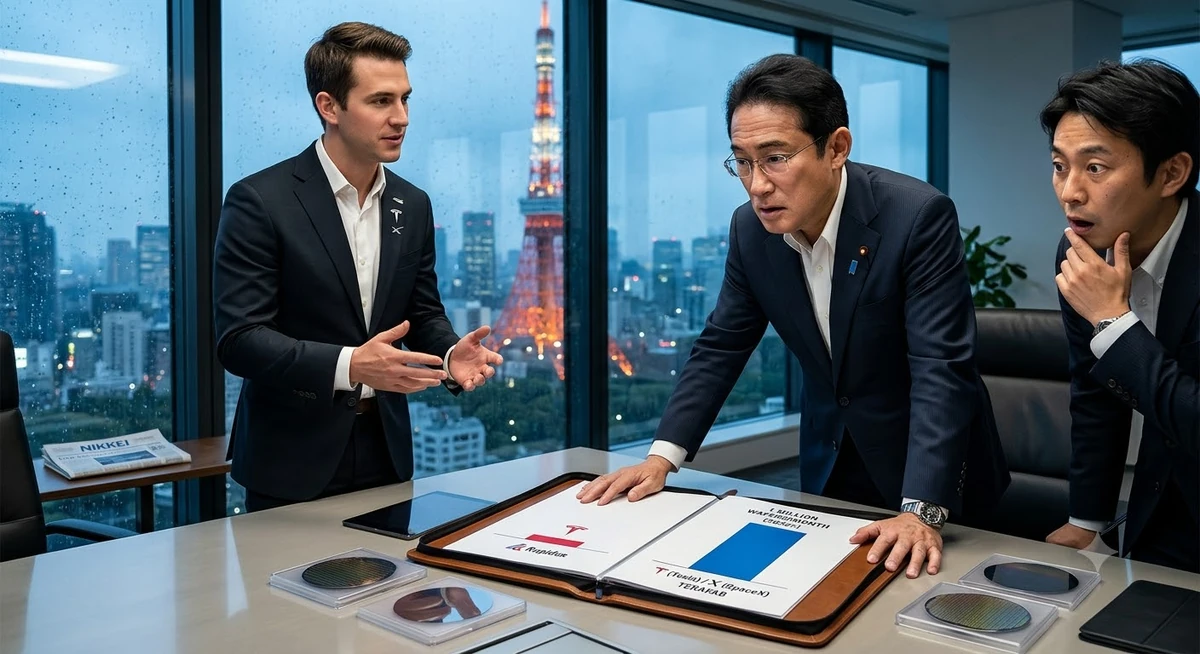
Elon Musk’s ambitious Terafab semiconductor project has told Japanese equipment manufacturers it aims to produce 1 million silicon wafers per month after 2032, according to a Nov. 9 report by Japan’s Nikkei newspaper. The plan signals a potentially enormous expansion of manufacturing capacity for chips used in artificial intelligence, robotics and space infrastructure.
A Texas semiconductor project on an unprecedented scale
Terafab is a joint semiconductor manufacturing initiative involving Tesla and SpaceX. The companies plan to build a factory in Grimes County, Texas, with a target of supplying computing chips equivalent to 1 terawatt of annual computing power. The chips are intended for Tesla’s autonomous vehicles and humanoid robots, as well as SpaceX’s proposed space-based data centers.
Texas officials have put the first phase of investment at more than $16.8 billion. SpaceX estimates that the combined future chip requirements of the two companies could exceed 1 terawatt in computing power.
Musk also disclosed at an investor event Nov. 6 that Tesla is building a research semiconductor facility at its Gigafactory in Austin. He said the facility aims to reduce the development cycle for new chips from roughly one year to one month. Manufacturing technologies validated there are expected to be transferred to Terafab.
Monthly production target dwarfs Japan’s planned Rapidus capacity
Of the proposed 1 million wafers per month, approximately 700,000 would be allocated to memory chips for data storage and more than 300,000 to logic chips used for computing, according to people familiar with the plan.
That would amount to 40 times the planned monthly wafer capacity of Japanese chipmaker Rapidus’ factory in Chitose, Hokkaido, which is targeting 25,000 wafers per month. The comparison is based strictly on wafer input volumes, as the two facilities are intended to manufacture different types of products.
Several Terafab procurement officials reportedly traveled to Japan secretly earlier this month to meet equipment suppliers and discuss machinery requirements and delivery schedules. The project has reportedly requested accelerated deliveries, although the companies involved, specific equipment orders and quantities have not been disclosed.
Kyodo News previously reported that Terafab had begun ordering products from Japanese equipment and materials suppliers for a pilot production facility.
Aggressive construction schedule raises industry concerns
Musk has set a target of beginning mass production in the second half of 2028. During a SpaceX third-quarter earnings call last month, he said the goal was to start full-scale production around the third quarter of 2028, while acknowledging that the schedule was highly ambitious and could extend into the fourth quarter.
Established semiconductor manufacturers typically need more than three years to develop advanced factories and bring them into production. That has prompted skepticism about whether companies without extensive experience operating large-scale chip fabrication facilities can meet Terafab’s timetable.
One senior executive at a major equipment manufacturer described the 2028 production target as being on an entirely different scale. Another Japanese equipment maker said the orders were unreasonable but that it would have to respond as much as possible.
Some suppliers have reportedly received delivery requests with deadlines only a few months away. Japanese industry officials have expressed concern about whether suppliers can meet the requested volumes and whether equipment installation and factory construction can proceed without delays.
From industry skepticism to a potential new customer
When Musk first introduced Terafab in March, many semiconductor industry participants questioned whether Tesla and SpaceX could secure the technical expertise, specialized workforce and capital needed to operate such a large-scale manufacturing project.
However, concrete equipment procurement discussions have begun to change perceptions among Japanese suppliers, particularly amid continuing demand for semiconductor manufacturing capacity. One supplier executive said Musk had become the industry's biggest talking point, ahead of established Japanese projects such as Kioxia and Rapidus.
Advantest CEO Douglas Lefever also expressed optimism about the broader business opportunity during the Japanese semiconductor testing equipment company's earnings presentation last month, saying the project was becoming a realistic business prospect that could grow into a meaningful opportunity. He did not specifically name Terafab.
U.S. chipmaker Intel is participating in the project, potentially opening the door for its manufacturing technology to be used in future production. Taiwan Semiconductor Manufacturing Co. Chairman and CEO C.C. Wei also said last month that discussions were underway about how to utilize Terafab's production capacity.
The major uncertainty is whether the factory can maintain sufficient demand after construction. Toshiya Suzuki, a consulting director at market research firm Omdia, said the scale of future semiconductor demand from SpaceX remains unclear, making it important to watch whether the facility can fill its production capacity once completed.
Potential implications for Samsung’s Tesla chip business
Terafab could also reshape Tesla's relationship with South Korea's Samsung Electronics. The two companies have a $16.5 billion semiconductor supply agreement, and Samsung is seeking additional orders for Tesla's next-generation artificial intelligence chips.
Musk has said Tesla's next-generation AI6 chip will be manufactured at Samsung's facility in Taylor, Texas. Samsung plans to begin producing Tesla chips there in the second half of 2027 using its 2-nanometer manufacturing process.
If Terafab eventually achieves stable mass production, Tesla could shift some manufacturing of chips succeeding the AI6 generation to its own facilities. Even if it continues outsourcing production, having in-house manufacturing capacity would give Tesla greater flexibility in allocating orders and negotiating prices with external chipmakers.
Comments
Post a Comment