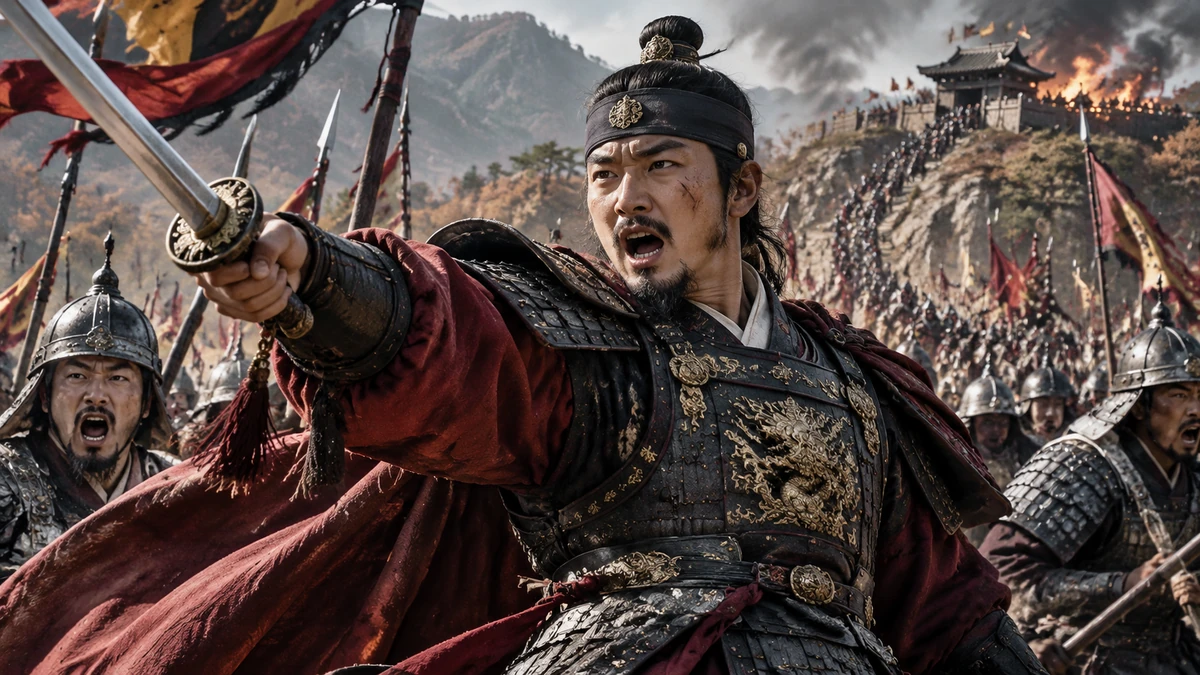
Image to help understand the article
A young military commander rises to the top
Nam-i (1443-1468), a military commander during Korea's Joseon Dynasty, rose to one of the kingdom's highest government positions at just 27 before being executed on charges of treason. His dramatic career unfolded during the reigns of King Sejo and King Yejong, a period marked by military campaigns and intense political rivalries within the royal court.
Nam-i distinguished himself in 1467 when he led troops in suppressing the Rebellion of Yi Si-ae, an uprising in the northeastern province of Hamgyong. His military achievements earned him first-class status among the kingdom's meritorious subjects and the title of Prince Uisan. He later participated in a campaign against the Jurchen, a people living along Joseon's northern frontier, further strengthening his reputation as a military leader.
In 1468, King Sejo appointed him minister of military affairs, one of the government's most senior posts. Nam-i was only 27 years old.
Royal connections and a powerful family background
Nam-i belonged to the Uiryeong Nam clan, a family with longstanding ties to the royal court. His great-grandfather, Nam Jae, had helped establish the Joseon Dynasty, while his grandmother, Princess Jeongseon, was a daughter of King Taejong and Queen Wongyeong. Through her, Nam-i was a grandson of the royal family.
His first wife was a daughter of Kwon Ram, a powerful official and supporter of King Sejo who had participated in the 1453 political coup that brought Sejo to power. The marriage initially connected Nam-i to an influential political network. However, his wife died young, followed by Kwon Ram in 1465, leaving Nam-i without an important family protector.
A political downfall and execution
After King Sejo's death in 1468, Nam-i faced growing opposition from established court officials, including Han Myeong-hoe and Shin Suk-ju. They viewed the military figures who had risen through the suppression of the Yi Si-ae rebellion as potential threats to their influence. Nam-i was removed as minister of military affairs and reassigned to a less prominent military position.
His political rival Yu Ja-gwang seized the opportunity to accuse him of plotting a rebellion. According to the historical account, Yu reported a remark Nam-i had made after seeing a comet while serving overnight at the palace. Nam-i reportedly said the celestial event signaled the removal of the old and the arrival of the new. Yu presented the statement as evidence of seditious intentions and implicated Nam-i in an alleged conspiracy involving senior official Gang Sun.
Nam-i was arrested, interrogated and sentenced to death by dismemberment. He and Gang Sun were executed on Oct. 27, 1468, in a public marketplace near the royal military equipment office. The purge extended to their families and associates. Nam-i's second wife and mother were also executed, while his daughter and two concubines were reduced to servitude. His relatives were subjected to political and legal repercussions.
Rehabilitation and a lasting cultural legacy
For generations, the case was officially treated as a legitimate treason prosecution. Over time, however, alternative historical accounts increasingly portrayed Nam-i as the victim of a political conspiracy orchestrated by Yu Ja-gwang. Some officials, including reform-minded figures during King Jungjong's reign, had argued that Nam-i deserved rehabilitation, but their efforts failed after a political purge removed their faction.
In 1818, during the reign of King Sunjo, Nam-i's official honors were restored following a petition by his descendant Nam Gong-cheol, then a senior government official. He was posthumously given the honorific title Chungmu.
Nam-i is also remembered for a poem expressing youthful ambition and military patriotism. Its famous lines describe sharpening a sword against the stones of Mount Baekdu and exhausting the waters of the Tumen River by watering a horse, before declaring that a man who cannot bring peace to the country by age 20 cannot be called a great man by future generations. The poem later appeared on protest and uprising materials, and Korean independence leader Kim Gu reportedly presented a handwritten version to supporters of an anti-trusteeship demonstration after World War II.
His legacy extends beyond written history. Stories about his childhood military training survive in local traditions, and Nam-i is worshipped as a general deity in some Korean shamanic practices. His life has also inspired films and historical television dramas, reflecting the enduring fascination with a young commander whose rapid rise ended in one of Joseon's most notorious political purges.
Comments
Post a Comment