Image to help understand the article
OpenAI draws a cautious comparison with Google
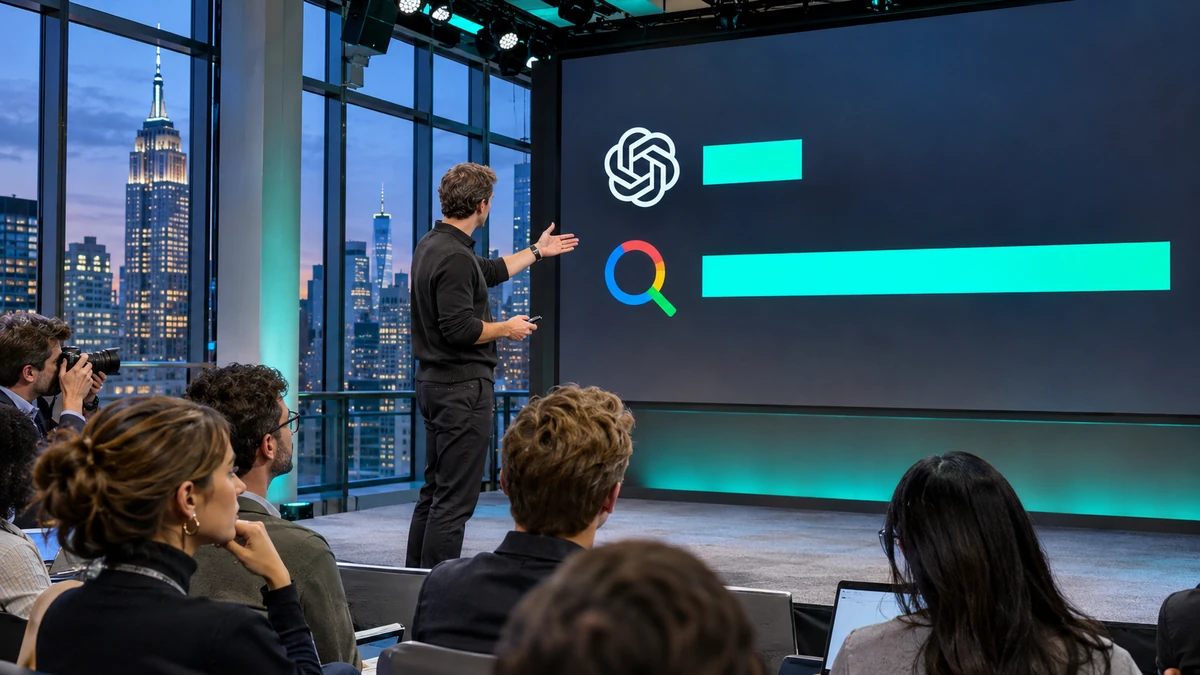
OpenAI says the number of ChatGPT prompts that trigger a live web search has reached roughly one-fifth of Google’s total search volume, offering a new glimpse into how quickly consumers are adopting artificial intelligence as an alternative way to find information online.
Adam Fry, OpenAI’s head of consumer products for ChatGPT, disclosed the figure at an event in New York on the 3rd. The comparison covers only ChatGPT questions that cause the service to search the web. Requests that can be answered without checking online sources, such as explanations of common terms or general instructions, are excluded.
The roughly 20% figure does not represent ChatGPT’s share of the search market, nor does it include every prompt submitted to the chatbot. OpenAI also did not disclose the source of its Google data or explain precisely how it calculated the comparison. Google has said it handles more than 5 trillion searches worldwide each year.
ChatGPT’s audience passes 1.2 billion weekly users
ChatGPT now has more than 1.2 billion weekly active users, up from 1 billion two months earlier, according to OpenAI. The company did not say how many of those users turn to ChatGPT specifically for information searches.
OpenAI said 250 million people use ChatGPT’s voice features each week, while users generate 1.5 billion images weekly. The figures reflect growing use of the service beyond its early popularity as a writing and coding assistant.
ChatGPT Search debuted on Oct. 31, 2024, initially for paying Plus and Team subscribers and people on the SearchGPT waitlist. OpenAI expanded it to all logged-in users in supported regions on Dec. 16, 2024, and made it available without registration in those regions beginning Feb. 5, 2025.
AI search gains traction among Americans
A Pew Research Center survey released this summer found that 42% of U.S. adults had used AI to look for information, making search the most common use of generative AI. Among employed respondents, 38% said they had used AI at work. Forty-four percent of those surveyed had tried ChatGPT, compared with 24% who had used Google Gemini.
Google, meanwhile, is adding generative AI to its core search product through features including AI Overviews, personalized results and visualizations. Alphabet CEO Sundar Pichai has said Google’s search volume continued to rise even as chatbots expanded, arguing that the competition is not necessarily a zero-sum contest.
Microsoft CEO Satya Nadella said during Google’s 2023 antitrust trial that Bing held about 3% of the search market, despite more than a decade of efforts to challenge Google. That history underscores why OpenAI’s query comparison is notable, even though it is not a conventional market-share measurement.
Competition shifts toward interfaces and advertising
OpenAI is presenting conversational, interactive displays inside chatbot answers as a possible future for search. Fry described the concept, which the company calls an “intelligent UI,” as a way for users to interact with a digital canvas through conversation.
The search rivalry is also expanding into advertising and business models. OpenAI announced last month that ChatGPT would display images of sponsored products and services, building on ads that previously showed company names, logos and product links. Fry said the ads had not hurt product use or engagement and that most users did not appear significantly bothered by them.
Comments
Post a Comment