Image to help understand the article
Park Gyu-su, a scholar and senior official during the final decades of Korea’s Joseon dynasty, stood at the crossroads of two intellectual eras. Drawing on the reform-minded scholarship of his grandfather, Park Ji-won, he argued that Korea should preserve its own intellectual and moral traditions while selectively adopting useful Western technology.
Park, who lived from 1807 to 1877, served in some of the dynasty’s highest offices, including as chief inspector, governor of Pyongan province and right state councilor. His students included Kim Ok-gyun, Park Yeong-hyo and other figures who later led Korea’s early modernization movement.
An Heir to Northern Learning
Born in Seoul to a family of limited means, Park was educated mainly by his father and several other scholars. He was the grandson of Park Ji-won, a leading figure in the Northern Learning school, an intellectual movement that urged Koreans to study the advanced technology and commercial practices of Qing China.
As a young man, Park became close to Crown Prince Hyomyeong and discussed the Chinese classic known as the “Book of Changes,” as well as affairs of state. The prince held Park’s scholarship in high regard, but Park withdrew from public life after the successive deaths of the crown prince and his parents. He spent about 20 years immersed in study, repeatedly reading his grandfather’s writings and exchanging ideas with other scholars.
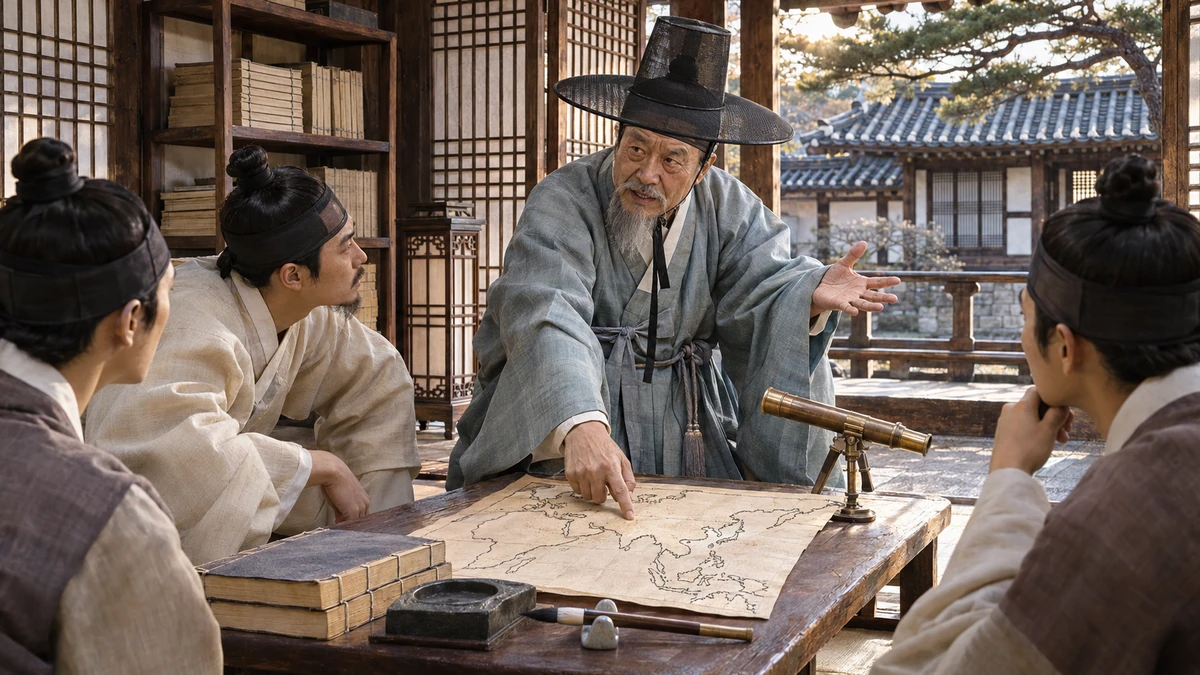
His interests extended beyond classical texts. Using Chinese world maps and astronomical materials, Park produced a world map and a celestial chart. He also drew maps of Gyeonggi and Pyongan provinces and wrote works on the classics, scholarship and poetry. Many of his writings and artifacts were destroyed during the 1950-53 Korean War.
A Career Shaped by Rebellion and Foreign Pressure
Park entered government after passing the civil service examination in 1848. He held a succession of local and central posts, including service as an undercover royal inspector charged with investigating provincial administration and punishing corrupt officials.
During a roughly six-month diplomatic mission to Qing China in 1861, Park observed the international upheaval that followed the British and French occupation of Beijing and Tianjin and China’s signing of the Convention of Peking. He also formed relationships with more than 80 Chinese writers and scholars.
After returning home, Park became the head of Sungkyunkwan, the Joseon dynasty’s state Confucian academy. He also worked on foreign correspondence, including Korean responses to American questions and demands for trade.
When a major uprising spread from the southern city of Jinju in 1862, Park was sent to investigate. He concluded that corruption among local officials and elites, along with abuses in taxation and military administration, had driven ordinary people into hardship and revolt. He called for tax relief, emergency aid and a government body to pursue broader reform.
A Violent Encounter With an American Ship
Park’s record also includes one of the earliest armed encounters between Korea and the United States. While serving as governor of Pyongan province in 1866, he directed the attack on the General Sherman, an armed American merchant ship that sailed up the Taedong River after Korea refused its attempt to open trade. After the vessel became stranded, Korean forces set it on fire and destroyed it.
Park nevertheless took a comparatively restrained position during the Catholic persecution that unfolded the same year. He argued that harsh administration and failures in public education had helped drive people toward Catholicism, and he favored guidance over punishment. No one in his jurisdiction was executed in the persecution. He also reduced taxes, assisted farms damaged by poor harvests and taught local scholars preparing for government examinations.
His stance toward foreign powers was not consistently conciliatory. One scholarly interpretation cited in the Korean historical record notes that Park supported the isolationist policies of the regent Heungseon Daewongun and favored fighting U.S. forces during the 1871 American expedition to Korea. Other accounts emphasize that he voiced his commitment to opening the country more publicly only after a second visit to China.
Selective Modernization, Not Submission
Park returned to Qing China in 1872 and studied the Self-Strengthening Movement, China’s effort to respond to Western military and technological pressure. The experience helped shape his argument that Korea could retain Eastern learning and morality while selectively adopting useful Western methods and technology.
He became justice minister and then right state councilor in 1873, but resigned the following year after the government rejected his position on opening the country. Park did not advocate surrendering to foreign coercion. In considering Japan’s approach, he argued that Korea should not attack first if Japanese representatives claimed to seek friendly relations, but should use force if an unexpected threat emerged.
He also urged officials to look beyond disputes over terminology in Japanese diplomatic documents and focus on practical relations and Korea’s national interests. After Japan provoked the 1875 Unyo incident, Park and others worked to persuade government officials to negotiate. He became involved in the 1876 Treaty of Ganghwa, which opened Korea to Japanese trade. But the unequal agreement, concluded under Japanese military pressure, ultimately diverged from Park’s vision of an opening conducted on Korea’s own terms.
Teacher to a New Generation
After stepping away from front-line politics, Park taught younger visitors in the reception room of his home, a traditional space where Korean scholars gathered for discussion. He introduced them to his grandfather’s writings, books about foreign countries, mechanical clocks, Western paintings, machinery and international affairs.
Among those influenced by his teaching were Kim Ok-gyun, Park Yeong-hyo, Kim Hong-jip, Kim Yun-sik, Yu Gil-jun, Park Jeong-yang, Hong Yeong-sik, Seo Jae-pil and Yun Chi-ho — figures who would play prominent roles in Korea’s modernization movement. Park also placed character above social status, maintaining relationships with interpreters, intellectuals outside the established elite and a Buddhist monk.
Park died in 1877 while serving as governor of Suwon. He was posthumously honored the following year. His official titles were stripped after some of his students participated in the failed 1884 Gapsin Coup, then restored in 1894.
In Korean intellectual history, Park is remembered as a link between Silhak, or “Practical Learning,” and the later movement to modernize and open the country. His career reflected the contradictions of an era in which Korea faced domestic unrest, pressure from imperial powers and an increasingly urgent debate over how to engage with the outside world without surrendering its independence.
Comments
Post a Comment