Park Yong-man: The Korean Independence Activist Who Built Military Training Schools in Nebraska and Hawaii
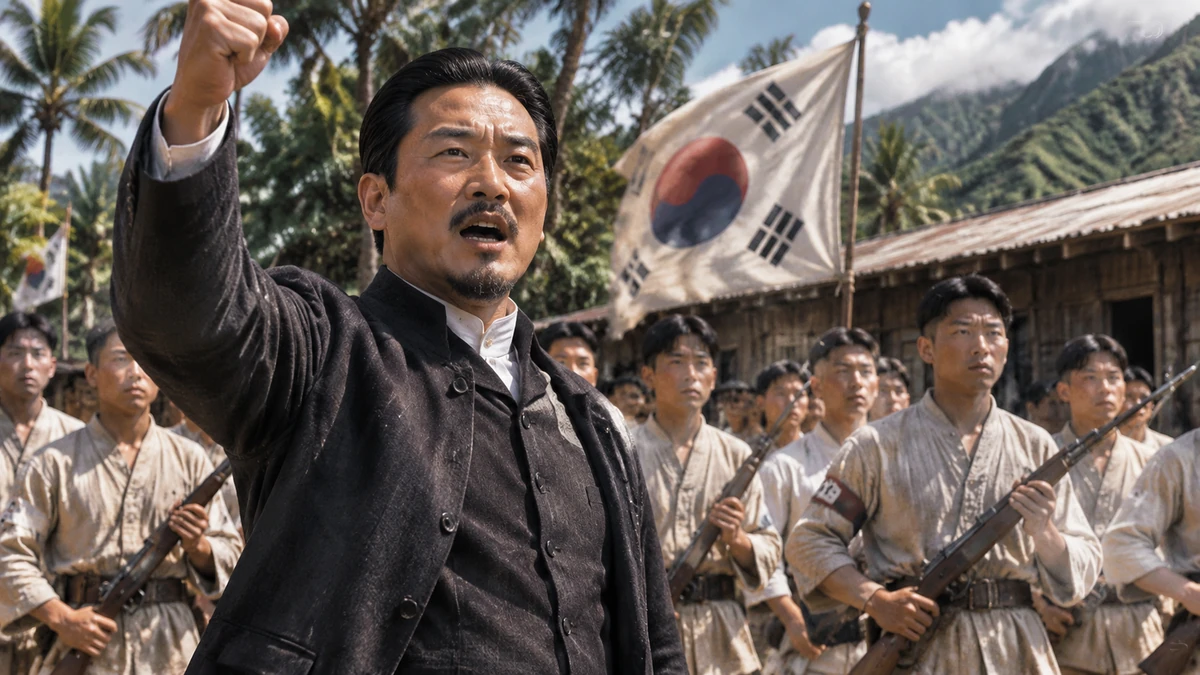
Image to help understand the article
Long before Korea's independence movement became an international diplomatic campaign, Park Yong-man was pursuing a more direct strategy: training Korean immigrants to fight for their country's liberation. An educator, journalist and independence activist, Park established a military school in Nebraska in 1909 and founded the Great Korean National Corps in Hawaii in 1914, seeking to prepare an armed force for a future war against Japanese colonial rule.
From imprisonment in Korea to activism in America
Park was born on Aug. 26, 1881, into a commoner family in Cheorwon, in what is now South Korea's Gangwon province. Although historical accounts offer several alternative birth years, 1881 is generally accepted. His pen name was Useong.
His political activism began in 1904, when Japan sought rights to develop Korea's uncultivated land. Park joined the opposition campaign led by the Bohanhoe organization and was imprisoned in Seoul. There, he developed relationships with other prominent activists, including Syngman Rhee, later South Korea's first president, as well as Lee Dong-nyeong, Lee Sang-jae, Lee Si-yeong and Jeong Sun-man. Park, Rhee and Jeong reportedly formed a sworn brotherhood.
After his release, Park taught at a private school in Suncheon, South Pyongan province, before leaving for the United States. He arrived in San Francisco in 1905, studied at Lincoln High School in Nebraska and earned a bachelor's degree in political science from Hastings College in 1906. He also helped operate an employment agency for Korean migrant workers in Denver, Colorado.
Building a military school in Nebraska
Park's central ambition was to train Koreans who could eventually take part in an armed struggle for independence. In 1908, he proposed establishing a Korean military school at an overseas Korean leaders' conference in Denver. The proposal was approved.
After transferring to the University of Nebraska in September 1908, Park studied political science, took military science as a minor and completed an ROTC program. He and fellow activist Jeong Han-gyeong negotiated with Nebraska state and local authorities to secure permission to operate a Korean military school, despite the institution having no explicit constitutional basis.
The Young Korean Military School opened in 1909 on a Korean-owned farm in Kearney, Nebraska. It trained young Korean men in military skills and graduated its first class of 13 students in 1912. In 1910, the school moved to the campus of Hastings College following an agreement with the institution. Park entrusted day-to-day management to Kim Jang-ho while traveling to raise financial support.
His wider activities also included supporting Korean independence efforts abroad. In 1907, he sent Yun Byeong-gu and Song Heon-ju to The Hague to assist Korean envoys seeking to raise international awareness of Japan's actions. In 1908, he helped collect legal defense funds for Jang In-hwan and Jeon Myeong-un, who had shot and killed a former Japanese adviser to Korea.
A journalist who argued for armed independence
Park used newspapers and political writing to advance his cause. In February 1911, he became editor-in-chief of Shinhan Minbo, the newspaper of the Korean National Association, a major Korean immigrant organization in the United States. He edited issues 217 through 252 and advocated establishing a provisional government to represent Korea's independence movement.
He also published military and political works, including National Conscription Theory in 1911 and A Soldier's Handbook in 1912. In August 1913, he took charge of the Hawaiian branch's newspaper, initially called Shinhan Gukbo, and renamed it Gukminbo. He later founded Pacific Times in Honolulu in 1918 and published Daedong in Beijing in 1921. In 1915, he also translated and published The American Revolution in Korean.
The Great Korean National Corps takes shape in Hawaii
Park arrived in Hawaii in December 1912 and continued organizing Korean immigrant communities. He helped bring Rhee to the islands in February 1913 and supported the publication of Rhee's writings, including his book The Spirit of Independence.
In May 1913, Park obtained special police authority from the Hawaiian government and established a police department within the Korean National Association, an effort to create a system of community self-government. Later that year, Korean leaders meeting at the Honolulu YMCA agreed to establish the Great Korean National Corps and an accompanying military academy.
Support from the Korean community included substantial contributions of land and agricultural resources. In April 1914, Park Jong-su transferred all his land-use rights to the organization, while three other supporters donated a pineapple farm they had cultivated. Park arranged for young Korean immigrants to work together on rented agricultural land, helping support the movement's activities.
The Great Korean National Corps was formally established in June 1914 in the Ahuimanu area of Kahulu, Hawaii. Its military academy held an opening ceremony on Aug. 29. Through military training, the organization assembled a force of more than 130 people intended to prepare for a future independence war.
Park also sought to expand the network beyond Hawaii. He dispatched Lee Ju-yeon to Vladivostok and sent Jang Il-hwan back to Korea. In March 1915, a secret organization called the Korean National Association was established in Pyongyang as a domestic counterpart to the military movement.
A growing split over how Korea should win independence
Park's relationship with Rhee deteriorated as their strategies diverged. Rhee questioned the effectiveness of armed resistance and favored international diplomacy, while Park believed independence required unifying Korean forces and achieving liberation through military action.
In 1915, Park proposed merging his military school with the school operated by Rhee, but the proposal was rejected. Disputes between their supporters, combined with competition involving followers of independence leader Ahn Chang-ho, fractured Korean communities in Hawaii and the continental United States into three rival camps between 1915 and 1918. Financial disputes further weakened the Hawaiian branch of the Korean National Association, which effectively ceased operating in October 1916.
Park continued his political work despite the divisions. In 1917, he joined figures including Shin Gyu-sik and Cho So-ang in issuing the Declaration of National Unity, which included plans for a provisional government. He also attended a League of Small and Oppressed Nations meeting in New York.
Following Korea's March 1, 1919, independence uprising against Japanese colonial rule, Park established the Great Korean Independence Corps in Honolulu and published English-language material explaining the uprising and its declaration of independence.
He was selected as foreign minister of both the Korean provisional government proclaimed in Seoul in April 1919 and the unified Korean Provisional Government established in Shanghai that September. However, he did not take office, largely because of his fundamental disagreement with Rhee over the independence strategy. Park subsequently joined Shin Chae-ho, Shin Suk and other critics of Rhee's approach in Beijing to establish a military unification organization. At the 1923 National Representatives' Conference in Shanghai, he led efforts to challenge the provisional government's legitimacy.
His final years, assassination and legacy
In 1926, Park established the Daebon Corporation in Beijing. The venture aimed to purchase and cultivate undeveloped land in China, creating a base for independence activities and generating funds to train Korean fighters. The following year, he opened Useong School, a Korean-language school in Honolulu's Palama district, and prepared educational materials, including the first two volumes of Joseon Language Reader.
Park was shot and killed in Beijing on Oct. 17, 1928, by Lee Hae-myeong while pursuing the agricultural development project. The circumstances surrounding his assassination remain controversial. Members of the Korean Patriotic Corps accused him of betraying the independence movement and working as a Japanese informant, but no documentary evidence establishing that allegation has emerged. Even political rivals Rhee and Ahn Chang-ho reportedly rejected the claim that Park had collaborated with Japanese intelligence. Journalist Song Geon-ho, however, criticized what he considered ambiguities in Park's conduct.
His killing is regarded as an example of the deep divisions that weakened Korea's independence movement during the colonial period. Park's activities received renewed attention beginning in the early 1960s. South Korea awarded him the Order of Merit for National Foundation, Independence Medal, in 1962, and elevated the honor to the Presidential Medal in 1995.
Comments
Post a Comment