Image to help understand the article
Stress, depression and anxiety widely reported
Seven in 10 South Koreans experienced at least one mental health problem during the previous year, according to a government survey that also found most people did not seek help.
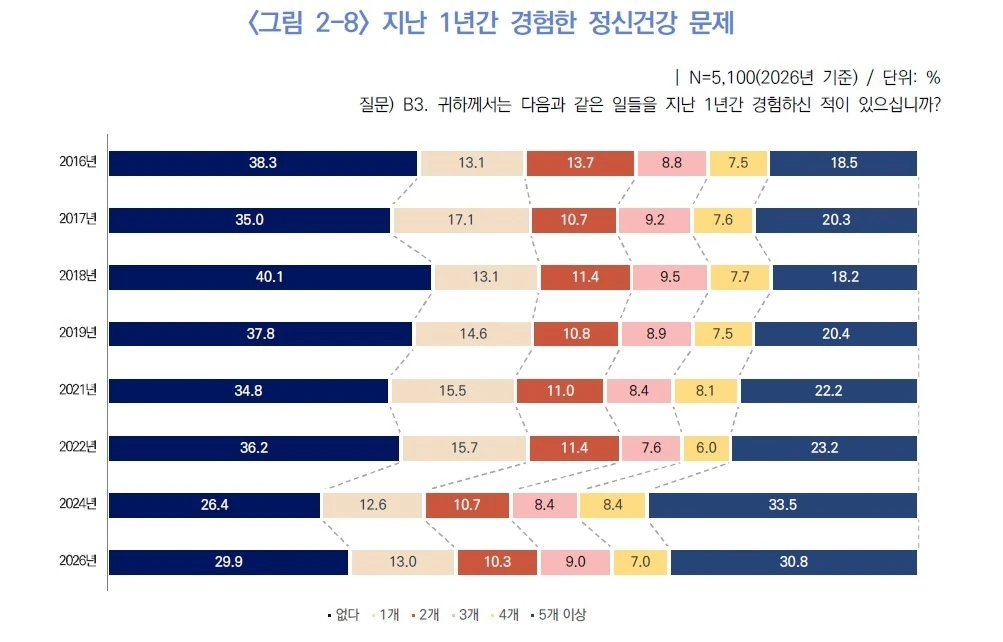
The National Center for Mental Health, an agency under South Korea’s Ministry of Health and Welfare, surveyed 5,100 people ages 15 to 69 nationwide from June 12 to 26, 2026. The online survey had a margin of error of plus or minus 1.37 percentage points at a 95% confidence level.
The share reporting mental health problems was 70.1%, down slightly from 73.6% in 2024. Nearly one-third of respondents, 30.8%, said they had experienced five or more types of problems. The report said the findings showed that a growing number of people were dealing with multiple mental health challenges at the same time.
Severe stress was the most common issue, reported by 47.7% of respondents. Unexplained physical discomfort was cited by 37.5%, while roughly 3 in 10 reported depression lasting several days, insomnia or anxiety. Addiction-related problems, including gaming, were reported by 18.8%, and 16.2% cited uncontrolled expressions of anger such as violent behavior. Another 14.1% said they had seriously and specifically considered suicide.
Most respondents did not seek help
Mental health problems caused significant or severe disruption to work or school for 25.4% of respondents, the highest rate among the areas measured. About 21.5% reported comparable disruption to daily or family life, up from 15.6% in the previous survey, while 21.4% reported major effects on social activities and personal relationships.
The share of people who received counseling, spoke with someone or visited a hospital reached 30.4%, the highest level since the survey began in 2016. Still, about 70% did not seek help. The report called for easier access to mental health services and further efforts to reduce stigma.
On a five-point scale, respondents’ understanding of mental health fell to 3.93 from 4.05 in the previous survey. Acceptance of people with mental illness slipped to 3.18, while negative perceptions remained unchanged at 3.12. The survey, conducted every two years since 2022, is intended to guide national mental health policy.
Treatment rises as regional spending varies
In a separate report, the center said 6,367 people per 100,000 population received treatment for mental illness in 2025, continuing an annual increase from 5,520 in 2022, 5,824 in 2023 and 6,113 in 2024.
Average local community mental health spending was 9,722 won per resident. North Jeolla province spent the most at 17,309 won per person, while South Gyeongsang province spent the least at 7,379 won, leaving a more than twofold gap between regions.
Comments
Post a Comment