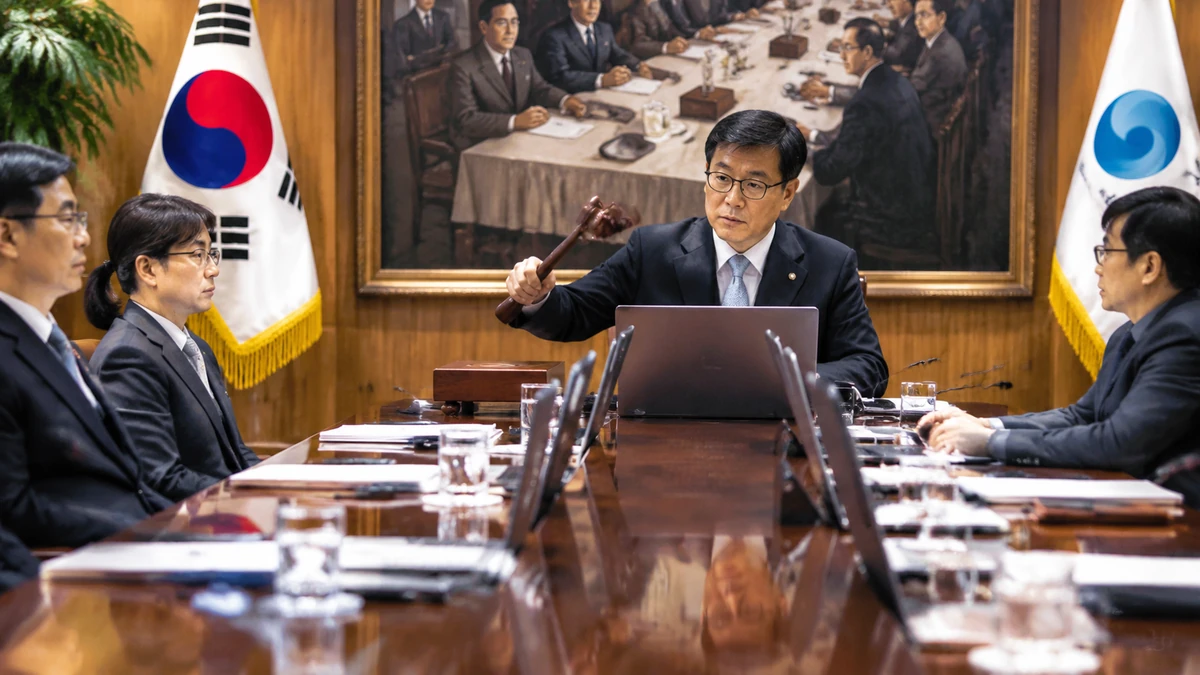
Image to help understand the article
More than half of South Korea's bond market participants expect the Bank of Korea to raise interest rates at its Nov. 26 policy meeting, reflecting growing concerns about inflation and the possibility of further monetary tightening in the United States.
According to the Korea Financial Investment Association's December 2026 Bond Market Survey Index (BMSI), released Nov. 24, 54% of respondents anticipate a rate increase, while 46% expect rates to remain unchanged. The survey covered 100 bond-related professionals at 54 institutions between Nov. 13 and 18. The share expecting an increase rose from the previous survey.
The association attributed the shift largely to inflation pressures and expectations that the U.S. Federal Reserve could raise interest rates in December. South Korea's benchmark rate currently stands at 3.00%.
Bond market sentiment deteriorates
The overall BMSI fell 20.4 points from the previous month to 78.7. The index measures market participants' outlook, with readings above 100 indicating favorable sentiment and readings below 100 signaling deteriorating conditions.
The association cited stronger expectations of a December Fed rate increase, following U.S. inflation and employment data, as well as concerns about rising domestic interest rates amid continued household loan growth.
The interest rate outlook index dropped 51 points to 72.0. The proportion of respondents expecting market interest rates to rise increased to 39%, from 17% in the previous survey. Meanwhile, the share anticipating a decline fell to 11%, from 40%.
Inflation and currency concerns add pressure
The inflation outlook index declined nine points to 84.0. Seventeen percent of respondents expected inflation to accelerate, up from 10% previously. Factors included higher-than-expected U.S. consumer price inflation in October and continued uncertainty over oil prices amid tensions between the United States and Iran.
The currency outlook index slipped four points to 94.0. Twelve percent expected the exchange rate to rise, down one percentage point, while the share anticipating a decline fell five percentage points to 6%. The association pointed to reduced dollar supply factors following the completion of South Korea's inclusion in the World Government Bond Index and expectations of higher U.S. interest rates.
Bank of Korea faces a stronger economic backdrop
The Nov. 26 meeting is the Bank of Korea's final monetary policy decision of 2026. A quarter-percentage-point increase would lift the benchmark rate from 3.00% to 3.25%.
The central bank raised rates twice in July and August, returning the benchmark to the 3% range for the first time since February 2025. It subsequently held rates at 3.00% at its Oct. 22 meeting, allowing time to assess the effects of the consecutive increases.
Economic indicators have added to the policy challenge. South Korea's consumer prices rose 2.8% in October from a year earlier, above the central bank's 2% target. Core inflation also increased 2.8%. Meanwhile, gross domestic product expanded 1.0% in the third quarter from the previous quarter, exceeding the Bank of Korea's August forecast of 0.3%.
The International Monetary Fund projects South Korean economic growth of 3.9% this year and 3.3% next year. The Korea Development Institute forecasts growth of 3.8% this year and 3.9% in 2027.
Attention will also turn to the U.S. Federal Reserve, whose next Federal Open Market Committee meeting is scheduled for Dec. 8-9. Expectations surrounding that decision are already influencing South Korean bond market sentiment ahead of the Bank of Korea's final rate decision of the year.
Comments
Post a Comment