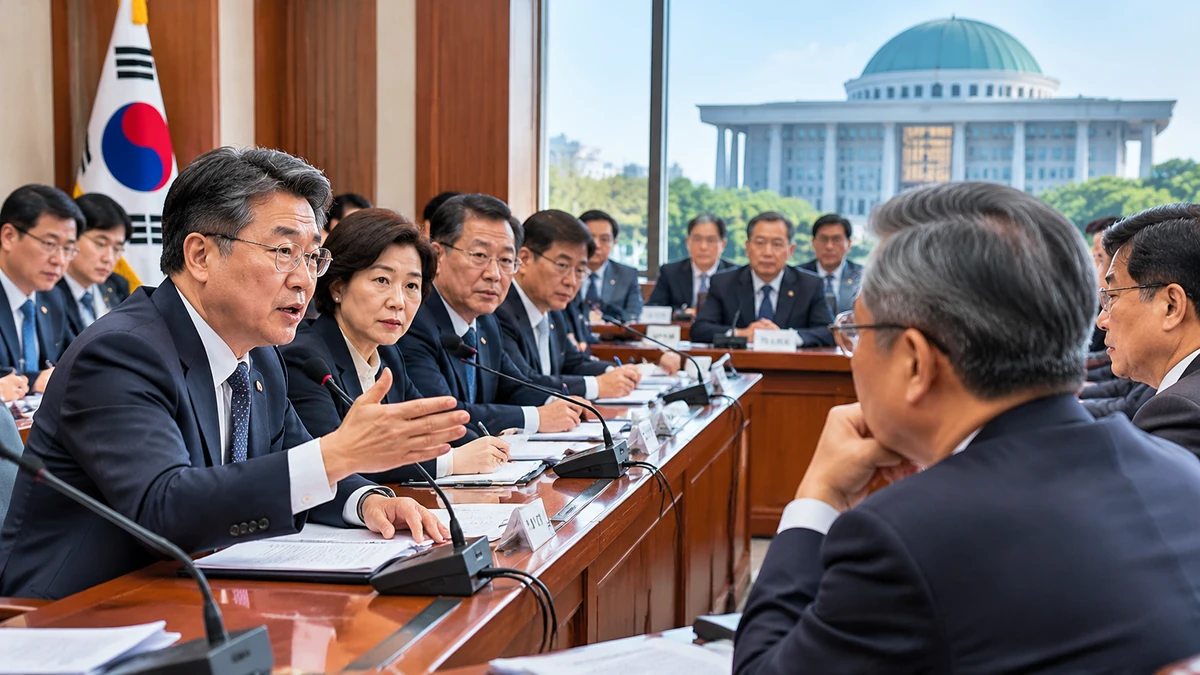
Image to help understand the article
South Korea is facing a growing debate over whether to raise its statutory retirement age from 60 to 65, with lawmakers, labor representatives and industry groups offering competing proposals over how to protect older workers without limiting opportunities for younger generations.
Two major discussions took place Nov. 10: a parliamentary forum examining income gaps for retired public employees and an automotive industry conference focused on the relationship between extended careers and youth employment. The Korea Enterprises Federation also urged lawmakers to approach the proposed change cautiously.
Five-year income gap raises pressure for reform
South Korea's current Elderly Employment Promotion Act requires employers to set a retirement age of at least 60. Even if an employer specifies a lower age, the legal retirement age is treated as 60. Raising it to 65 remains under legislative discussion, with neither an implementation date nor the categories of workers covered yet finalized.
A central concern is the gap between retirement and pension eligibility. Under South Korea's reformed public pension system, officials appointed from 1996 onward face progressively later pension eligibility. From 2033, eligible retirees will begin receiving their pensions at 65, potentially leaving those who retire at 60 without employment income or pension payments for as long as five years.
At a parliamentary forum organized by public-sector labor groups and attended by lawmakers from both major political parties, Chae Jun-ho, a professor of business administration at Jeonbuk National University, presented survey findings from 2,657 serving public employees and 158 retirees. The survey was conducted from Aug. 13 through Sept. 30.
More than nine in 10 serving public employees expected an income gap after retirement and before pension payments began. Among retired respondents, 39.9% said they had already experienced such a gap or were experiencing one. Some 94.9% of serving employees expected severe or very severe financial pressure, compared with 85.7% of retirees who said they had actually experienced that level of pressure.
Retirement benefits were the most frequently cited source of living expenses during the gap, selected by 58.9% of serving employees and 58.7% of retirees. Extending the legal retirement age was the most popular proposed solution, supported by 58.6% of serving employees and 48.7% of retirees.
Respondents also emphasized income continuity as the leading principle for designing a new system. Support stood at 92.6% among serving employees and 88% among retirees. More than half also favored prioritizing protection for people who had already experienced an income gap.
There was some willingness to accept changes to employment conditions. A majority showed a tendency to support limiting post-retirement positions or adjusting pay according to job responsibilities. When asked about reemployment under conditions similar to those before retirement, respondents identified approximately 80% of their previous compensation as the minimum acceptable level.
Automotive industry divided over youth employment
The debate took a different direction at the 48th Automotive and Mobility Industry Development Forum in Seoul. Organized by the Korea Automotive and Mobility Association, the event examined whether extending older workers' careers could coexist with hiring younger employees.
One alternative discussed was allowing individual companies to choose reemployment arrangements rather than imposing a uniform retirement age of 65. Figures presented at the forum indicated that South Korea's average retirement age was 53, seven years below the statutory threshold of 60. Only 13.2% of workers reportedly left their jobs through formal retirement at the legal age.
Lee Sang-ho, head of the economic division at the Korea Enterprises Federation, argued that prolonged economic stagnation and stronger competition from China were reducing companies' capacity to create jobs for younger workers. He questioned whether extending retirement was fair to young job seekers and said higher labor costs could force businesses to reduce new recruitment.
Lee also opposed mandatory reemployment, arguing that companies should retain the freedom to decide how to maintain employment and manage their workforces.
Park Wan-soon, publisher of the labor publication Chamyeo-wa Hyeoksin, challenged the idea that retirement-age reform was primarily responsible for declining youth employment. He cited a fall in new hiring at South Korean commercial banks from 3,121 employees in 2018 to 1,280 in 2025, pointing instead to branch closures and digital transformation as important factors.
Park also highlighted a gender disparity: formal retirement accounted for 6.2% of departures among women, compared with 21.4% among men. He proposed introducing the extended statutory retirement age first at businesses with fewer than 50 employees, where labor shortages are a concern, while allowing larger companies and unions to negotiate continued-employment arrangements such as reemployment.
Hanyang University professor Jeon Young-soo argued that extending retirement and creating jobs for younger workers should not necessarily be treated as competing objectives. He cautioned against political framing that turns the issue into a generational conflict. Moon Sang-kyun, a researcher at the Korea Research Institute for Vocational Education and Training, suggested that experienced employees rehired after retirement by large companies could serve as mentors in government-sponsored youth work-experience programs.
Employers urge lawmakers to proceed cautiously
The Korea Enterprises Federation submitted 19 policy recommendations to the National Assembly on Nov. 10 as part of its proposals for the second half of 2026. Among them was a request for careful consideration of statutory retirement-age extensions.
The business group argued that raising the retirement age uniformly could increase labor costs and reduce companies' capacity to recruit new employees, potentially narrowing employment opportunities for younger people. It recommended post-retirement reemployment as an alternative.
South Korea's National Human Rights Commission has recommended raising the retirement age to 65, and the government has said it intends to pursue legislation for a gradual extension. The broader discussion also involves how to restructure wage systems, whether the change should apply uniformly or in stages, and how to limit potential effects on younger workers.
For now, the proposed age of 65 remains a policy objective under discussion, not an enacted nationwide requirement. The central challenge for lawmakers is balancing longer working lives and pension income security against employers' labor costs and the employment prospects of younger generations.
Comments
Post a Comment