Image to help understand the article
New reservoir planned for semiconductor industry
South Korea plans to build a new dam near the existing Dongbok Dam to supply industrial water to a semiconductor cluster in the Honam region, the country’s southwest. The project would sharply expand reservoir capacity while forcing about 500 residents from their homes.
Dongbok Dam, located in Hwasun County, is a major source of drinking water for Gwangju and surrounding South Jeolla Province. The government plans to complete a new dam about 570 meters, or roughly 1,870 feet, downstream by 2030. Officials chose a separate structure after determining that raising the existing dam could create safety concerns.
The project would raise the maximum inundation elevation from 171 meters to 186 meters. Storage capacity would increase from 99 million metric tons to 245 million metric tons, with 300,000 tons of water a day designated for the semiconductor complex. Local authorities say household water supplies would remain at current levels.
About 280 households face relocation
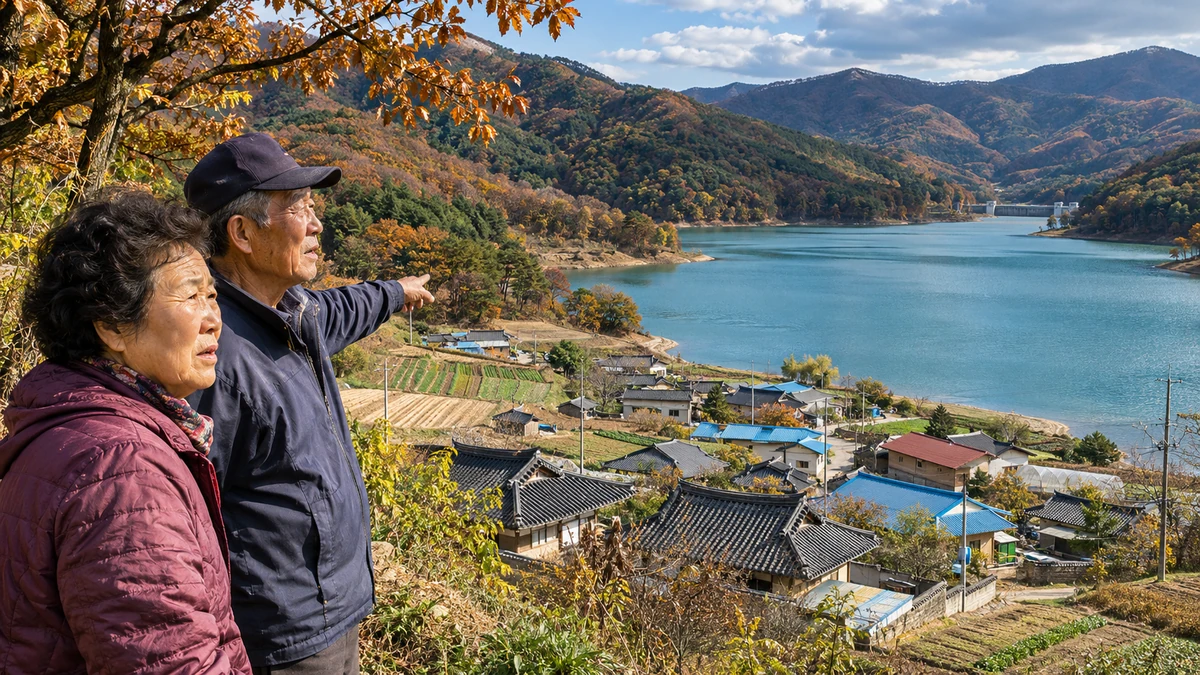
The expanded reservoir would submerge areas in 15 villages across Hwasun and neighboring Damyang County. About 280 households, representing more than 500 people, would be required to relocate.
The compensation zone covers about 5.7 square kilometers, or 2.2 square miles, across four townships. It includes 6,030 parcels divided almost evenly between public and private land.
Compensation proceedings are expected to begin in the second half of 2027, after the government approves and formally announces the dam construction plan. If at least 10 affected households request it, the government says it will develop a relocation community in an area selected by residents. A family of four that does not move to the new community would receive 60 million won to 70 million won.
Residents say land payments and new housing alone would not resolve the loss of their livelihoods. They are seeking monthly payments based on household size, described as a “mutual growth pension,” as well as free rental housing for low-income residents.
Government considers sharing solar revenue
Public interest in Dongbok Dam surged after the Ministry of Climate, Energy and Environment held a meeting with residents scheduled for relocation on Nov. 11 at the Hwasun Eoullim Center.
Minister Kim Sung-hwan said the government would discuss compensation that affected residents could accept. Rather than providing direct pension-style payments, he said officials were considering distributing revenue from solar power generation to residents.
Regional television reports and online videos about the project drew attention to the expected flooding and compensation dispute. One video released Nov. 11 had 37,463 views as of Nov. 14, while a short video about Kim’s meeting with residents, released the following day, had 13,544 views.
Budget and cultural access questions
Online searches focused on the dam’s expansion, the areas expected to be submerged and relocation compensation. The project’s budgeting has also faced scrutiny in South Korea’s National Assembly because feasibility study funding, design costs and initial construction spending were allocated together.
The dam is also connected to access to the Hwasun Red Cliffs, a scenic area known for steep rock formations and autumn views. Construction of the original Dongbok Dam in 1986 placed the Norumok and Bosan cliffs inside a protected drinking-water zone, restricting public entry. Visitors can now see the area through tours requiring advance reservations.
Comments
Post a Comment