Image to help understand the article
Jin Hyeong-gu, a former senior prosecutor and the father-in-law of independent lawmaker Han Dong-hoon, died Nov. 15 at the age of 81, prompting an outpouring of condolences from politicians across South Korea's political spectrum.
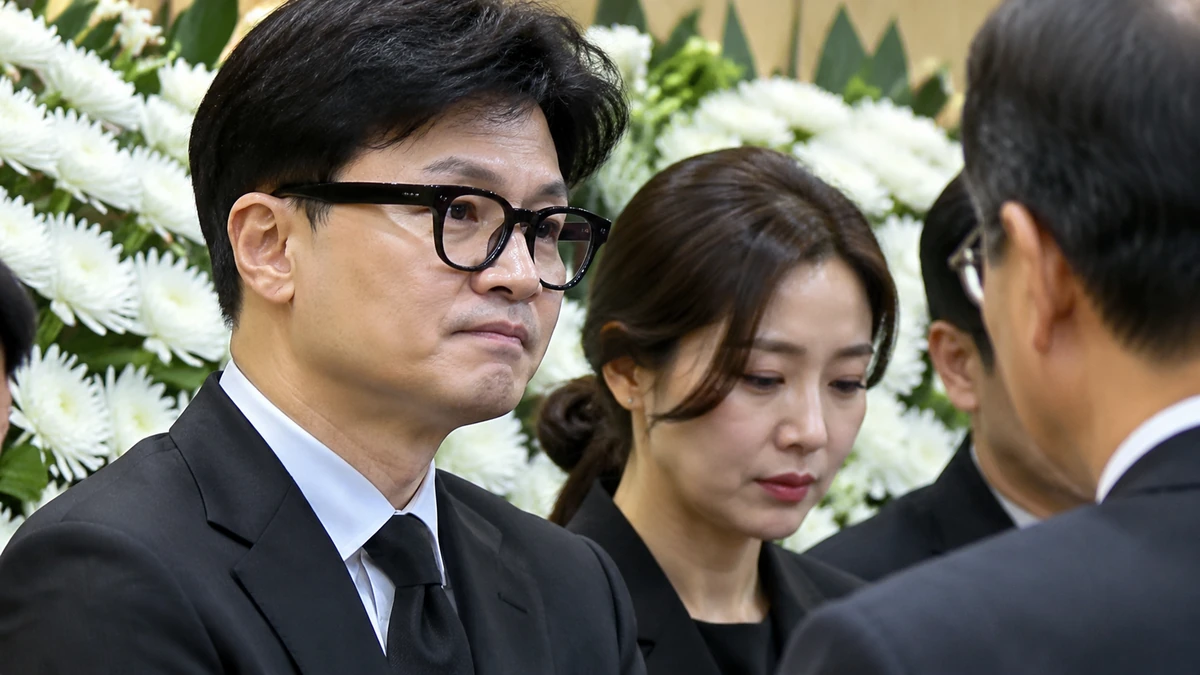
A funeral hall was established Nov. 16 at Seoul St. Mary's Hospital in Seoul's Seocho district. Han and his wife, Jin Eun-jeong, began receiving mourners at 2 p.m. The funeral procession is scheduled for 8:30 a.m. Nov. 18.
Why the term 'bingbusang' became a trending search
The funeral also prompted a surge in online searches for the Korean term 'bingbusang' (빙부상), a formal expression used when a person's father-in-law dies. The related term 'bingmosang' refers to the death of a mother-in-law. Korean also uses distinct expressions for the death of a spouse's parents and terms such as 'mochinsang' for the death of one's own mother.
These expressions frequently appear in Korean obituaries and workplace announcements. For example, an announcement describing someone as experiencing a 'bingbusang' means that the person's wife's father has died. Searches related to condolence payments, funeral visits, workplace leave and messages of sympathy also increased following Jin's death.
Conservatives and political allies visit funeral hall
A large number of lawmakers from the conservative People Power Party attended the funeral on its first day, including politicians aligned with Han. Among those paying their respects were Ko Dong-jin, Kim Geon, Kim Seong-won, Park Jeong-ha, Bae Hyun-jin, Seo Beom-soo, Yoo Eui-dong, Yoon Jae-ok and Cho Kyung-tae.
Seoul Mayor Oh Se-hoon arrived at approximately 4:47 p.m. with Kim Byung-min, head of the Seoul Tourism Organization. After offering flowers and observing a moment of silence, Oh spoke briefly with Han before leaving about 10 minutes later. Asked by reporters about prospects for conservative political unity, Oh declined to comment, saying it was not the day to discuss the issue.
Former Labor Minister Kim Moon-soo, who competed against Han in the People Power Party's presidential primary, also visited. Other mourners included former presidential chief of staff Chung Jin-suk, former party emergency committee member Kim Kyung-yul and prosecutor Park Sang-yong, who led an investigation into allegations involving illegal remittances to North Korea by the Ssangbangwool group.
Condolences extend beyond Han's political camp
Lee Ki-in, an interim leader of the minor Reform Party, attended on behalf of his party. Its lawmaker Lee Jun-seok was unable to attend because he was in Europe for engagements related to the Asian Parliamentary Assembly.
Unification Minister Chung Dong-young also visited. Several senior political figures who did not attend in person sent condolence wreaths, including President Lee Jae-myung, Prime Minister Han Seong-sook, National Assembly Speaker Cho Jung-sik, Democratic Party leader Kim Min-seok, People Power Party leader Jang Dong-hyuk and the party's floor leader, Chung Jum-sik.
Whether Jang and other senior figures from the People Power Party's leadership would attend had attracted particular attention before the funeral hall opened, reflecting the political interest surrounding Han's relationships within the conservative camp.
Funeral coverage draws significant online attention
Videos covering the death and the political figures visiting the funeral hall attracted substantial online audiences on Nov. 15 and 16. A broadcast video about the death posted Nov. 15 recorded 391,031 views. A video examining whether Jang would attend received 102,226 views, while another focusing on internal People Power Party tensions and the stream of mourners drew 182,978 views. Footage from the funeral hall itself recorded 41,188 views.
Comments
Post a Comment