Image to help understand the article
Lee calls for closer coordination with ruling party
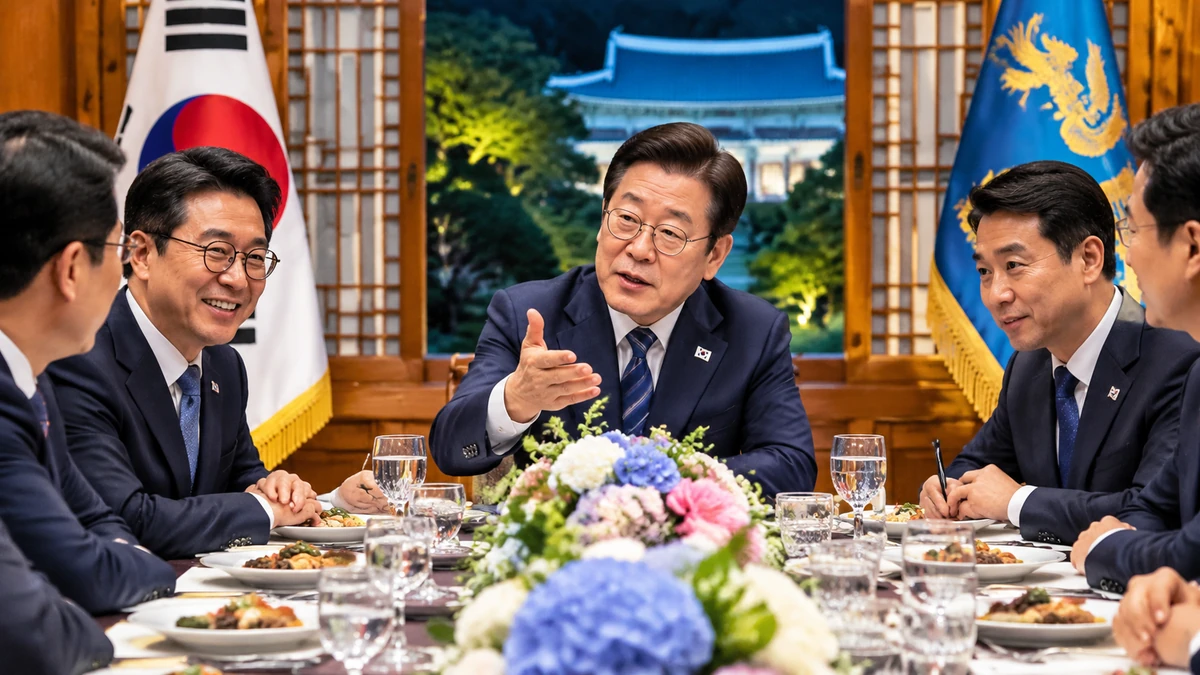
South Korean President Lee Jae Myung urged his administration and the ruling Democratic Party to work in unison during a dinner with senior party officials at the Blue House on Nov. 11, emphasizing the need for coordinated action to improve people's lives.
Kim Min-seok, the party's leader, called on the government to take bold and swift measures to address economic inequality and revive consumer spending. Lee agreed that the government and ruling party should act with a common purpose and asked lawmakers to cooperate actively in passing next year's national budget.
Lee also instructed presidential chief of staff Lim Kwang-hyun and senior political affairs secretary Choi In-ho to maintain close communication with the National Assembly, South Korea's legislature.
Property tax dispute was not discussed
The dinner lasted from 6:30 p.m. to 9:20 p.m. and included Democratic Party floor leader Han Byung-do, senior floor operations deputy Chun Joon-ho and party leader's chief of staff Kim Tae-sun. It was the first time in 78 days that Lee had invited the party leadership to the presidential residence for dinner.
Before the meeting, political observers had speculated that participants might discuss the country's comprehensive real estate holding tax, a levy on high-value property, or a proposed special counsel investigation into allegations of fabricated indictments. But the presidential office said neither subject came up. One senior official said the tax was not mentioned at all, adding that the gathering was not intended to negotiate specific policy proposals.
Disagreement over property tax remains unresolved
The property tax issue has exposed differences between the presidential office and some members of the ruling party. The government supports keeping the basic deduction at 1.2 billion won ($830,000) for owners of a single home who do not live in the property. Some Democratic lawmakers representing Seoul have argued that the deduction should rise to 1.4 billion won ($970,000), matching the level for owner-occupied single homes.
The proposal surfaced during a high-level government-party consultation on Nov. 8. A presidential office official rejected calls to reduce the tax burden on nonresident homeowners, saying the president's position was to retain the 1.2 billion won threshold. The official also stressed that the higher deduction was the position of some Seoul lawmakers, not an established party-wide policy.
Civic groups have criticized the government and ruling party over what they describe as potential tax cuts for the wealthy. Against that backdrop, some political observers interpreted Lee's emphasis on unity as a signal that disagreements over property taxation and other policy issues should not develop into a public confrontation between the presidential office and the party.
Comments
Post a Comment