Image to help understand the article
Lee calls for firm enforcement in stalled redevelopment dispute
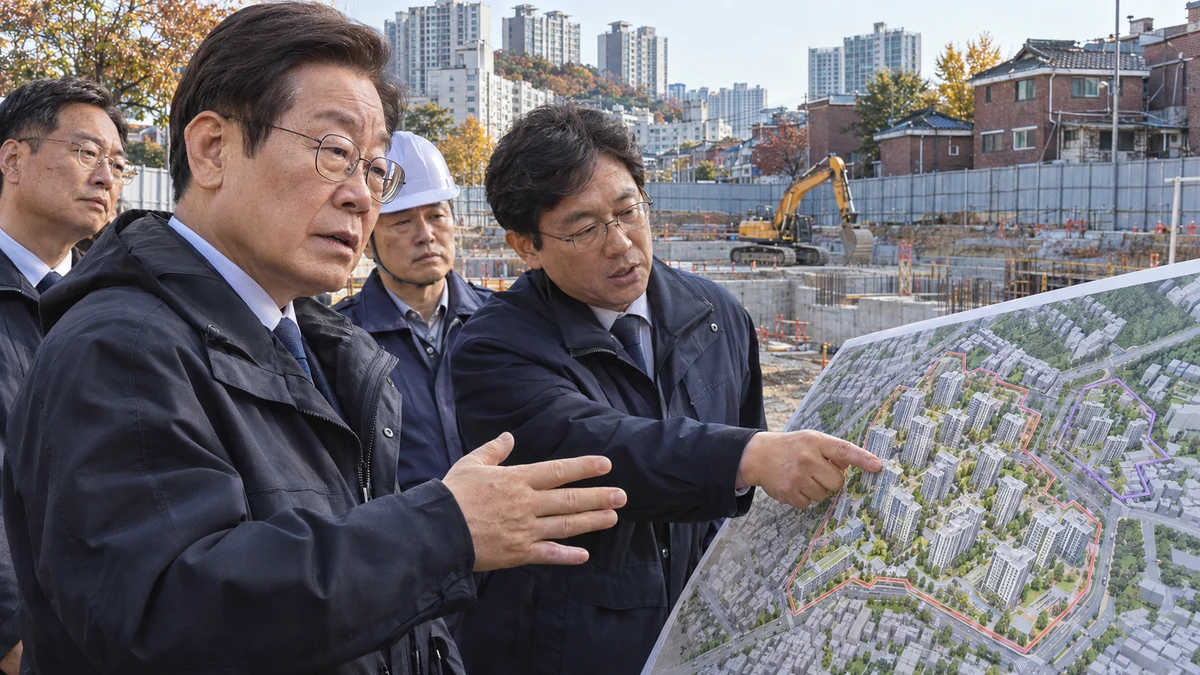
South Korean President Lee Jae Myung called for faster housing redevelopment in the Seoul metropolitan area during a Nov. 4 visit to Jangwi-dong, a neighborhood in northern Seoul where several projects have faced years of delays.
Lee inspected the Jangwi 9 district, a public redevelopment site in Seoul’s Seongbuk district, before holding a meeting on efforts to expand housing supply. He also received a briefing on the nearby Jangwi 10 project, where a dispute involving Sarang Jeil Church has disrupted redevelopment.
Lee criticized the church for resisting a court-ordered eviction and demolition. “In a country governed by the rule of law, how can anyone think they can prevail by resisting with force?” he said. He argued that authorities had ultimately changed the redevelopment plan to exclude the church because they were unable to carry out the order.
“There is no world in which people can break the law and simply hold out,” Lee said, urging Seongbuk District Mayor Lee Seung-ro to enforce future orders thoroughly.
Sarang Jeil Church responded in a statement after the president’s remarks, saying, “Then he should stand trial himself first.”
Church dispute reshaped Jangwi 10 project
Jangwi 10 was designated as an urban renewal district in 2008, and its redevelopment plan received a key administrative approval in 2017. The project was delayed after Sarang Jeil Church, which was located within the redevelopment area, sought compensation above the appraised value of its property.
The redevelopment association sued to take possession of the site and won. South Korea’s Supreme Court ordered the church’s forcible removal, but church members resisted both the ruling and attempts to enforce it.
With the project stalled, Seongbuk district authorities changed the development plan in June of last year to leave the church outside the project area. Lee called that outcome unreasonable and said stronger government action was needed when individual properties obstruct plans affecting an entire neighborhood.
Public redevelopment promoted as faster and less vulnerable to corruption
Lee said public redevelopment could accelerate aging neighborhood projects and help increase housing supply across the Seoul metropolitan area. In South Korea, such projects place a public agency in a leading role and can provide participating property owners with regulatory or financial incentives.
Drawing on his experience as mayor of Seongnam, a city south of Seoul, Lee said redevelopment projects routinely take at least a decade and can stretch for 20 or even 30 years.
He called for streamlined administrative procedures and stronger incentives for projects that move quickly, including relaxed floor-area-ratio rules, which determine how much building space can be constructed on a site, and expanded financial support.
Lee said public-led projects also carry a lower risk of corruption and internal disputes than private redevelopment associations. The government plans to provide incentives intended to improve both the speed and financial viability of public redevelopment.
Other Jangwi projects illustrate years of delays
Lee also reviewed the Jangwi 14 district, where a privately led redevelopment project has been underway for 18 years. After hearing about the timeline, he asked the association’s leader whether the project would consider switching to public development.
In Jangwi 4, opposition from commercial property owners along a major road resulted in those properties being excluded from the redevelopment area. Lee said removing resistant parcels could leave neighborhoods with an awkward urban layout.
He raised similar concerns in Jangwi 3, where an existing apartment complex was excluded from the development zone, saying such cases demonstrated the need for administrative intervention.
New housing supply may not arrive until 2028 or 2029
Lee said housing permits had fallen sharply beginning in 2022, creating the prospect of a shortage in new supply. Although the pace of permitting has recently recovered, he said officials at the site estimated that the increase would not have a practical effect until 2028 or 2029 at the earliest.
Stabilizing housing prices in the Seoul metropolitan area is among the government’s most important policy priorities, Lee said.
Lee was accompanied by Land, Infrastructure and Transport Minister Hong Ji-seon, Korea Land and Housing Corp. President Lee Sung-hoon, Democratic Party lawmaker Kim Nam-geun and senior presidential aides.
Comments
Post a Comment