Image to help understand the article
A landmark in Korean cinema
Released in 1961, The Coachman (Mabu), directed by Kang Dae-jin and written by Lim Hee-jae, became the first South Korean film recorded as winning an award at a major international film festival. The black-and-white drama received the Silver Bear Special Jury Prize at the 11th Berlin International Film Festival, where it was also nominated for the Golden Bear.
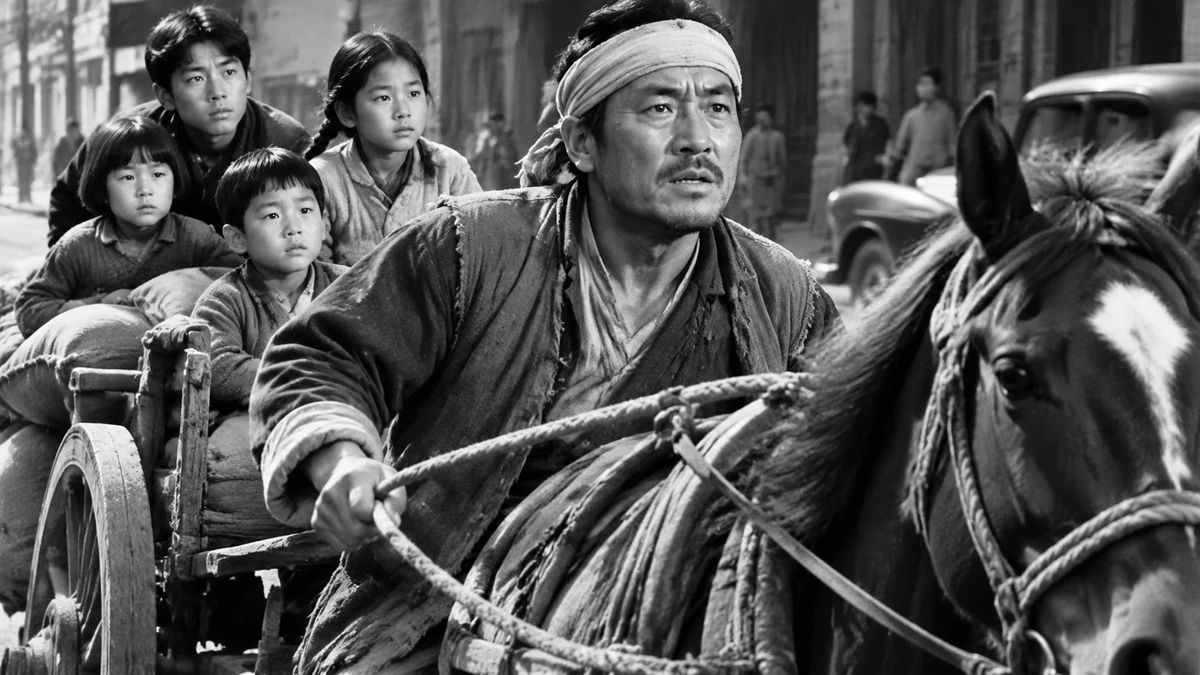
The film premiered in South Korean theaters on Feb. 15, 1961. Produced by Hwaseong Film Co., it runs 97 minutes, according to the Korean Film Archive's database. Veteran actor Kim Seung-ho stars as Ha Chun-sam, a widowed father who earns a living driving a horse-drawn freight cart.
A family struggling to survive in a changing Seoul
Set in a Seoul still bearing the scars of the Korean War, The Coachman follows Chun-sam as he tries to raise four children with an aging horse and cart. The city is changing, with automobiles increasingly appearing on its streets, leaving traditional livelihoods such as his under growing pressure.
His eldest son, Su-eop, played by Shin Young-kyun, repeatedly fails the highly competitive civil service examination. His eldest daughter, Ok-nyeo, played by Cho Mi-ryeong, is unable to speak and repeatedly returns to her father's home after enduring abuse from her husband. Another daughter, Ok-hee, played by Eom Aeng-ran, conceals her family's poverty and hopes marriage will improve her circumstances. The youngest son also causes trouble in the neighborhood.
Amid these difficulties, Chun-sam finds companionship in Suwon-daek, played by Hwang Jeong-sun, a woman working for the owner of his horse. Their relationship develops quietly, offering the struggling father a measure of warmth and emotional support.
Italian neorealism and Kim Seung-ho's performance
Critical assessments have compared the film's approach to postwar Italian neorealism, a cinematic movement known for depicting ordinary people and the hardships of everyday life. Rather than relying solely on an uplifting family story, The Coachman looks directly at poverty and social change while retaining a sense of human compassion.
Kim's performance as Chun-sam has been singled out for particular praise. He had previously won a Best Actor award at the Asia Film Festival for another Kang Dae-jin film, Mr. Park (Park Seobang). The Berlin award for The Coachman was shared with Jean-Luc Godard's A Woman Is a Woman.
Capturing South Korea at a turning point
The film portrays a society caught between the hardships of the postwar period and hopes for a more prosperous future. Chun-sam wants to give his children better opportunities, but the economic and social transformation around him increasingly threatens the place of his horse-drawn cart and the livelihood it represents.
Critic Hayley Scanlon, writing for koreanfilm.co.uk, described the film as a portrait of South Korea in 1961: a country still struggling with postwar poverty while attempting to move toward a brighter economic future.
Restoration brings the classic to new audiences
The Korean Film Archive restored The Coachman in 2021. The film also reached American audiences through Film at Lincoln Center's program The Golden Age of Korean Cinema: The 1960s, which screened it at the Walter Reade Theater on Sept. 5 and Sept. 16.
The Korean Film Archive has also made the film available through its Korean Classic Film Theater YouTube channel, part of an initiative with YouTube to release about 70 classic Korean films produced between 1949 and 1996 for free viewing.
More than six decades after its release, The Coachman remains a landmark in South Korean film history, documenting both the struggles of an ordinary family and the country's first major international film festival award.
Comments
Post a Comment