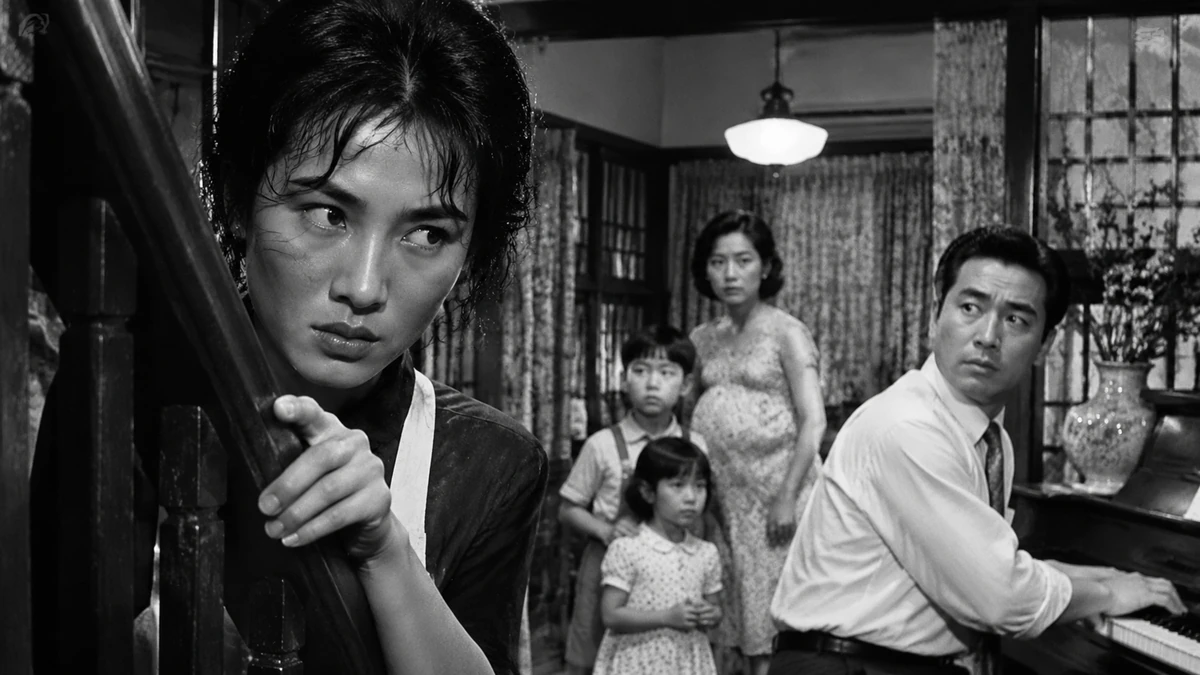
Image to help understand the article
A domestic thriller that helped shape modern Korean cinema
More than six decades before Bong Joon Ho’s Oscar-winning film Parasite, South Korean director Kim Ki-young explored the explosive tensions between domestic workers and wealthy families in The Housemaid, a 1960 psychological thriller now regarded as one of the masterpieces of Korean cinema.
Written, produced and directed by Kim, the film follows a middle-class household that gradually falls apart after hiring a live-in housemaid. Kim Ki-young Productions made the film, starring Kim Jin-kyu as the husband, Dong-sik, and Lee Eun-shim as the housemaid, Myung-sook. Its story was inspired by an actual murder case in Geumcheon, South Korea.
When the film opened at the Myeongbo Theater in 1960, it attracted 100,000 moviegoers, generating considerable attention. It remains one of Kim's signature works.
A family disrupted by a new arrival
Dong-sik is a music teacher who accompanies a choir at a textile factory employing many female workers. He moves with his pregnant wife and their two children into a two-story house considerably larger than their previous home.
His wife, who contributes to the household income through sewing work, becomes increasingly exhausted. Dong-sik asks Cho Kyung-hee, a female factory worker who takes piano lessons from him, to find a housemaid. Kyung-hee brings another woman employed at the factory into the household, setting the story in motion.
The new housemaid immediately displays unsettling behavior. She catches a mouse with her bare hands, smokes cigarettes and secretly watches the members of the household. After becoming involved with Dong-sik, she begins undermining the family's established order, setting off a chain of events that threatens to destroy the home.
International recognition and awards
The Housemaid was submitted to the eighth Asian Film Festival in 1961. In South Korea, it won the Best Director award at the second Film Arts Awards that same year. The awards were organized by Weekly Entertainment Newspaper and Film Arts.
In December 1961, the film also received honors at the 1960 Korean Best Film Awards, organized by the Ministry of Public Information. Kim won Best Director, while Lee Eun-shim received Best New Actress. The production also earned top awards for cinematography, art direction and editing.
The film received another international milestone in 2008, when it was invited to the Cannes Film Festival's Cannes Classics section and screened as part of the program dedicated to preserving cinematic history.
How a missing 20 minutes were restored
The film's return to international attention was made possible by a major restoration project in 2008, supported by the World Cinema Foundation (WCF) and carried out by the Korean Film Archive.
The archive's initial film materials were missing approximately 20 minutes of footage. To reconstruct the absent section, archivists recovered the negative film from an English-subtitled print in their collection and used it to fill the gaps.
The Korean Film Archive released the restored version on DVD in June 2009. The edition included Korean, English, French and Japanese subtitles, along with audio commentary by film critic Kim Young-jin and director Bong Joon Ho.
The restored film returned to theaters on June 3, 2010. Its original classification, which had prohibited viewing by minors, was changed to a rating allowing audiences aged 15 and older. Mirovision handled marketing and distribution.
The beginning of Kim's Housemaid trilogy
The Housemaid was the first installment in what became known as Kim Ki-young's Housemaid trilogy. It was followed by Woman of Fire in 1971 and Woman of Fire '82 in 1982. Both sequels retained the central storyline while adapting it to the social circumstances of the 1970s and 1980s, respectively.
Director Im Sang-soo released a remake, also titled The Housemaid, on May 13, 2010. The new version starred Jeon Do-yeon, Lee Jung-jae, Yoon Yeo-jeong and Seo Woo. As of June 6, 2010, it had drawn a cumulative audience of 2,230,417.
For Lee Eun-shim, who played Myung-sook in the original, the film was her first leading role. She appeared in only two additional films afterward. A rumor circulated that audiences had disliked her so intensely in the role of the housemaid that it damaged her acting career. The account was untrue: she reportedly received considerable praise for her performance.
International critics rediscover a Korean classic
Koreanfilm.org, a website specializing in South Korean cinema, describes The Housemaid as an undisputed choice among the three greatest films in Korean movie history.
In a 2003 article, Jean-Michel Frodon, then editor of the French film magazine Cahiers du Cinéma, described the Western world's discovery of the film more than 40 years after its original release as a 'marvelous feeling.' He said audiences had discovered an extraordinary image-maker in Kim and a body of work that was entirely unpredictable.
Frodon compared Kim to Spanish filmmaker Luis Buñuel, praising his ability to delve deeply into human desires and impulses while examining details with a cynical eye. He also described the film's impact as both disturbing and pleasurable.
The film's critical reputation extends to the United States. On the review aggregation website Rotten Tomatoes, all five critics' reviews listed for the film are positive.
From ‘The Housemaid’ to ‘Parasite’
Bong Joon Ho has explicitly credited The Housemaid as an inspiration for his 2019 film Parasite, which also examines the collision between social classes through the relationship between a lower-income household and a wealthy family. Both films depict a character from a lower social class threatening the security and stability of an affluent household.
Bong discussed Kim's film in the 2013 edition of the Criterion Collection, the U.S.-based home-video label known for its curated releases of significant international cinema.
The Academy Museum of Motion Pictures is also dedicating a two-year exhibition, Director's Inspiration: Bong Joon Ho, to the filmmaker. As part of the exhibition, the museum's 2026 screening series, A Lifetime of Inspiration: Bong Joon Ho, includes nine films personally selected by Bong. The Housemaid is among them.
South Korea also highlighted the film during celebrations marking the centennial of Korean cinema. Beginning in October 2019, public broadcaster KBS and the Korean Film Archive presented 12 representative films from different eras under the program title 100 Years of Korean Cinema: The Classics. The Housemaid was the first film broadcast, airing on Oct. 11, 2019.
Its continuing presence in international retrospectives and its acknowledged influence on Parasite demonstrate how Kim Ki-young's 1960 thriller remains an important reference point for understanding the evolution of Korean cinema.
Comments
Post a Comment