Image to help understand the article
Tokenized Treasurys lose ground
The market value of tokenized government debt fell 6.8% from the previous week to $8.16 billion as of 9:30 a.m. Nov. 8 in South Korea, according to CoinGecko category data. Tokenized private credit moved in the opposite direction, rising 1.7% to $28.10 billion during the Nov. 2-8 tracking period.
Tokenization uses blockchain-based digital tokens to represent claims on conventional assets, including U.S. Treasury securities, stocks, private loans and gold. Because individual assets can appear in multiple categories, the sector figures cannot be added together to produce a reliable total market value.
Tokenized money market funds recorded the steepest weekly decline, falling 9.5% to $2.56 billion. The market value of tokens associated with real-world asset protocols dropped 8.1% to $11.08 billion, while tokenized real estate slipped 1.6% to $107.6 million.
Several categories advanced. Tokenized gold rose 4.6% to $5.65 billion, tokenized commodities increased 4.1% to $5.94 billion, and tokenized stocks climbed 3.1% to $2.85 billion. Tokenized private credit gained 2.9% over the latest 24-hour period, while tokenized stocks fell 2.1% during that shorter window.
U.S.-linked products dominate Treasury rankings
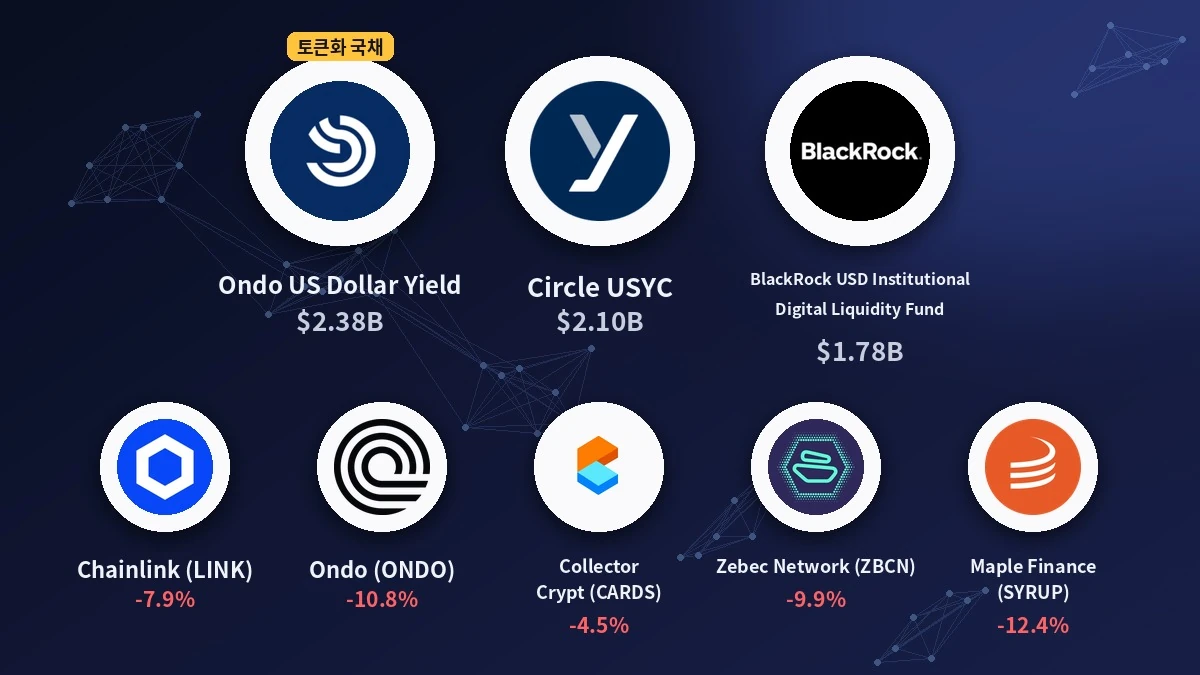
Ondo US Dollar Yield was the largest tokenized government-debt product, with a market value of $2.38 billion. It was followed by Circle USYC at $2.10 billion and BlackRock’s USD Institutional Digital Liquidity Fund at $1.78 billion.
Other leading products included Invesco’s Short Duration US Government Securities Fund at $641.8 million, Spiko’s EU T-Bills Money Market Fund at $476.7 million, Ondo’s Short-Term U.S. Government Bond Fund at $317 million, Spiko’s US T-Bills Money Market Fund at $173.8 million and Theo’s Short Duration US Treasury Fund at $117.1 million.
RWA.xyz ranked Ondo Finance first among decentralized tokenization platforms excluding stablecoins, with $4.07 billion in real-world assets across 484 assets and 568,129 holders. That total included $2.4 billion in Ondo USDY and $922.4 million in tokenized stocks represented by 431 tokens. Securitize ranked second with $3.97 billion across 50 assets and 1,493 holders. RWA.xyz tracked about $40 billion across the decentralized real-world asset market at the time of the ranking.
Protocol tokens broadly decline
Most tokens tied to real-world asset protocols fell during the week. Chainlink declined 7.9% to $10.80, while Ondo dropped 10.8% to 36 cents. Maple Finance fell 12.4%, Plume lost 15.1% and RE declined 18.7%. Rnt was the only listed gainer, rising 1.9% to 36 cents.
NYSE and Securitize expand tokenization plans
The New York Stock Exchange added Broadridge Financial Solutions, Computershare, Equiniti and Superstate as transfer-agent partners for its planned tokenized securities platform. Along with existing partners Securitize and tZERO, the project now has six such partners. No launch date has been set, and the platform still requires regulatory approval.
Securitize expanded its tokenized stock lineup to 25 companies, adding 13 names including ExxonMobil, GameStop, Salesforce and Disney. The tokens trade on the Solana blockchain and are backed one-to-one by actual shares.
StoneX analyst Mark Palmer maintained a buy rating and an $18 price target on Securitize shares, which trade under the ticker SECZ. Palmer said the Depository Trust & Clearing Corp.’s permissioned tokenization system and Securitize’s public-blockchain model target different markets, and that the DTCC’s entry validates the sector. SECZ traded near $7.30 and was down 24% since its July 2025 listing.
Tokenized private credit on Solana reached $1.44 billion. Lending markets including Kamino are accepting credit tokens issued by Securitize and Maple as collateral.
Gold reserves and Asian regulation advance
TG Commodities S.A. reported that reserves backing Tether Gold totaled 827,418 troy ounces, or about 25.74 metric tons, in an attestation released Nov. 4. The holdings consisted of 2,057 gold bars valued at $3.44 billion. Physical gold reserves were up 59% from 16.2 metric tons at the end of 2025, while user holdings had increased 73% since January.
Hong Kong’s Securities and Futures Commission said it had approved 17 tokenized retail products, including money market funds, gold products and exchange-traded funds. Their combined assets under management totaled about $1.3 billion, up 78% from 12 months earlier. Hong Kong’s first tokenized money market fund also began secondary trading on a licensed platform, and SFC Executive Director Elisa Ng said a tokenized gold ETF could be the next pilot project.
In South Korea, Democratic Party lawmaker Lee Kang-il said the Financial Services Commission plans to submit the government’s proposed Digital Asset Basic Act to the National Assembly in November 2026. His party is seeking passage in December. The legislation would establish rules for issuing, distributing, disclosing and listing digital assets.
The figures reflect market values at the stated observation time and are not investment recommendations. Tokenized products differ in structure, investor eligibility and regulatory treatment, and investors can lose principal.
Comments
Post a Comment