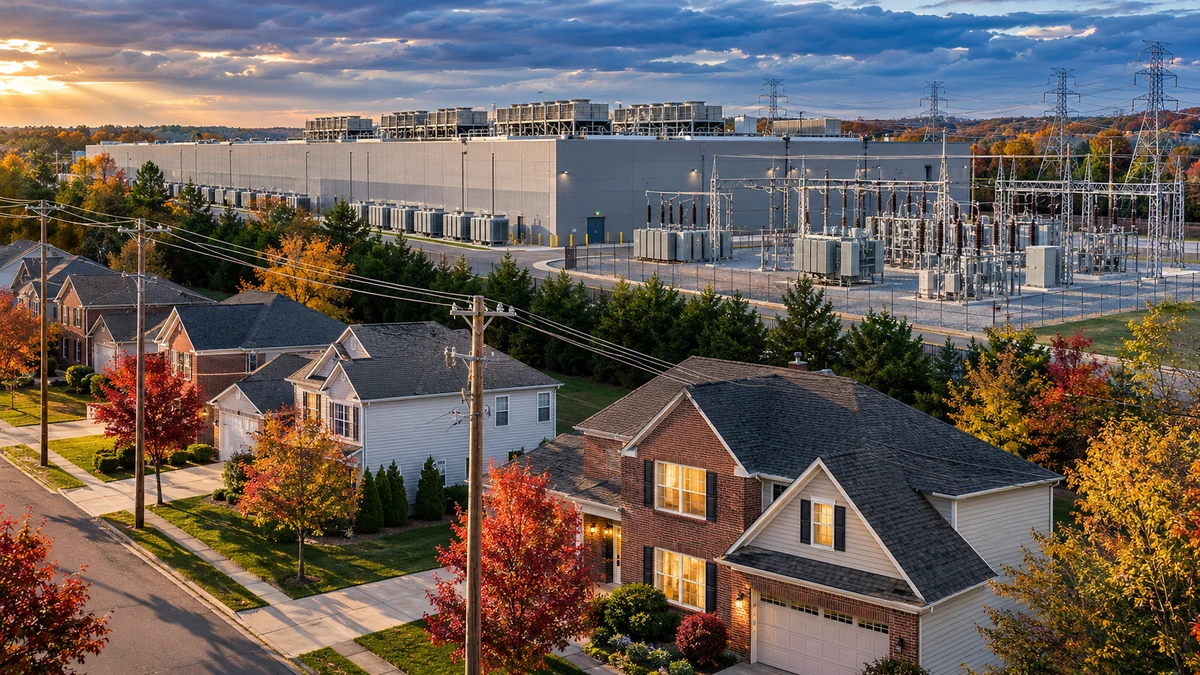
Image to help understand the article
A new working paper argues that data centers accounted for just 4% of the increase in U.S. residential electricity rates from 2020 through 2025, a finding highlighted by The Washington Post as voter opposition to new data center construction emerged as an issue in recent midterm elections.
The study, however, is a preprint that has not undergone peer review, the academic process in which independent experts evaluate research before publication. Presenting such preliminary findings as established evidence is unusual for a major news organization.
Researchers Call the Effect ‘Significant but Small’
Vishrut Rana and Serguei Netessine of the University of Pennsylvania’s Wharton School and Christian Capps of Harvard Business School examined the relationship between U.S. electricity prices and data centers from 2020 to 2025. They concluded that data centers were responsible for 4% of the increase in residential power rates and 15% of the increase in industrial rates.
The authors described the residential impact as “significant but small.” They argued that public discussion has overstated data centers’ overall effect on electricity prices and that the impact is concentrated among colocation developers, which lease computing space to multiple customers, and certain utilities. Netessine said the findings were somewhat surprising even to him.
The paper, titled “The Cost of Intelligence: The Impact of AI Data Centers on U.S. Electricity Prices,” was posted on the Social Science Research Network. It is dated Sept. 30, was first posted last month and was most recently revised last month.
Questions Over Preliminary Research and Amazon’s Stake
The Washington Post presented the study under a headline saying data centers are widely blamed for expensive electricity even though other factors are responsible, with a subheadline stating that data centers had only a slight effect on residential rates.
The newspaper is owned by Amazon founder Jeff Bezos. Amazon generated 63% of its operating income in the third quarter from Amazon Web Services, its data center-based cloud computing business.
The Post also cited other research that it said found no strong relationship between the broad trend in U.S. electricity prices and data centers in recent years. An analysis by Massachusetts Institute of Technology researchers estimated that data centers raised average residential electricity rates by 2.1% from 2010 through 2024. That analysis is also an unreviewed working paper, posted in June on the website of MIT’s Center for Energy and Environmental Policy Research.
Voters Push Back Against New Construction
The findings come amid substantial public opposition to data centers. Democratic candidates who promised to restrict or reconsider data center construction won numerous races in the recent midterm elections.
Exit polling found that 76% of respondents opposed new data center construction in their communities, while 56% said candidates’ positions on data centers were a “critical or major” factor in their votes. Negative views were more pronounced among voters who said they supported Democratic candidates.
Of 41 data center-related ballot measures held alongside the midterm elections, 40 resulted in restrictions or bans on new construction. The sole exception was in Harwood, North Dakota.
Comments
Post a Comment