Image to help understand the article
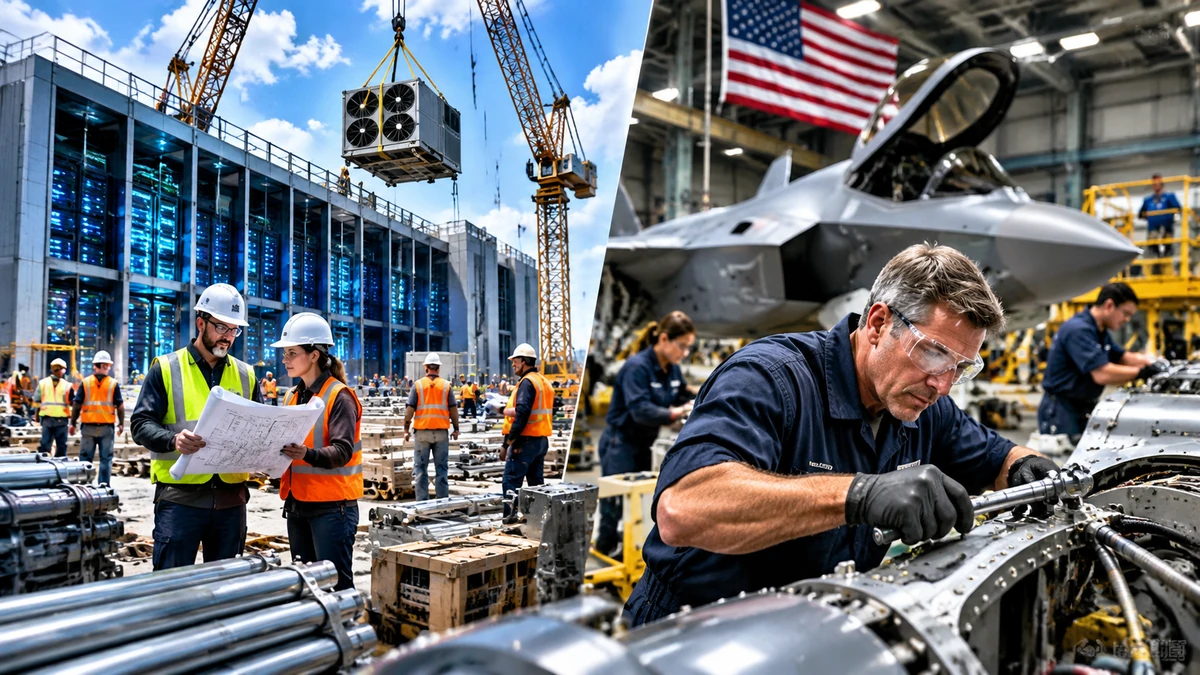
The rapid expansion of artificial intelligence data centers in the United States is creating serious production bottlenecks for the country's aerospace and defense industries, as technology companies compete for the same workers, raw materials and components needed to build aircraft and military equipment.
The growing competition illustrates what industry leaders are calling the "AI crowding-out effect": rather than simply boosting productivity across the economy, massive investments in AI infrastructure are absorbing resources that other industries depend on, potentially slowing their growth.
Aerospace industry chief warns of soaring costs
Eric Fanning, CEO of the Aerospace Industries Association (AIA), said aggressive investment by major technology companies in AI data centers is driving costs sharply higher across the industry.
"Hyperscaling is sucking up everything in the market, including labor, land and energy," Fanning said, referring to the rapid expansion of massive data center facilities.
"The AI industry has become a real competitive problem for our industry," he said. Fanning added that the seemingly unlimited financial resources of major technology companies were intensifying pressure on an aerospace and defense sector already struggling with surging air travel and increased defense spending.
Record backlogs, but manufacturers cannot increase output
U.S. aerospace and defense companies are struggling to accelerate production despite holding record order backlogs. Boeing, one of America's leading aerospace and defense manufacturers, has more than 6,300 commercial aircraft awaiting delivery, a backlog near an all-time high.
Major defense contractors are also experiencing production difficulties as they try to meet Pentagon demands for increased ammunition output amid the war between Ukraine and Russia and the war between the United States and Iran.
The current bottlenecks reflect decades of industry practices in which aerospace and defense manufacturers relied on single suppliers for thousands of components to reduce costs. Inflation that intensified after the COVID-19 pandemic, shortages of skilled workers and efforts to bring manufacturing facilities back to the United States have compounded the problem. The AI data center construction boom is now emerging as an additional major source of pressure.
Companies building large new aerospace and defense factories are reportedly losing out to data center developers in the competition for contractors and suppliers of essential infrastructure, ranging from steel and electronic switches to heating, ventilation and air conditioning systems.
Nearly $1 trillion in annual sales has not translated into purchasing power
Fanning said the aerospace and defense industry's purchasing power remains relatively weak despite its enormous overall economic scale.
"The U.S. aerospace and defense industry generated nearly $1 trillion in revenue in 2025, but our production volumes themselves are small, which limits our purchasing power," he said.
He added that the industry cannot buy in the massive quantities seen in consumer electronics, data centers or automotive manufacturing, leaving it structurally unable to dominate supply markets.
Memory semiconductors, whose prices have recently surged because of AI demand, are a prominent example. Fanning said semiconductor manufacturers are redirecting even production lines that previously made older-generation chips for aerospace and defense applications toward AI and other advanced technology markets.
Ron Epstein, an analyst at Bank of America, also highlighted the extent of the overlap between the industries' supply chains. Hyperscalers — large cloud computing companies that operate extensive data center infrastructure — compete with aerospace and defense manufacturers for critical components such as turbine blades and castings, as well as less visible products including circuit boards.
Growing concern over AI's crowding-out effect
Industry concerns are increasingly focused on whether AI investment will ultimately stimulate growth across the economy through productivity improvements or constrain other sectors by securing scarce resources first.
The so-called "AI crowding-out effect" describes the risk that major technology companies, backed by enormous capital investments in AI infrastructure, will absorb not only financial resources but also electricity, raw materials and skilled labor, pushing other manufacturers out of the market for essential inputs.
Market observers warn that excessive concentration of resources in AI infrastructure could create bottlenecks across manufacturing supply chains, raise production costs and weaken the foundations of growth throughout the broader real economy.
Comments
Post a Comment