Image to help understand the article
A powerful general who challenged China's Tang dynasty
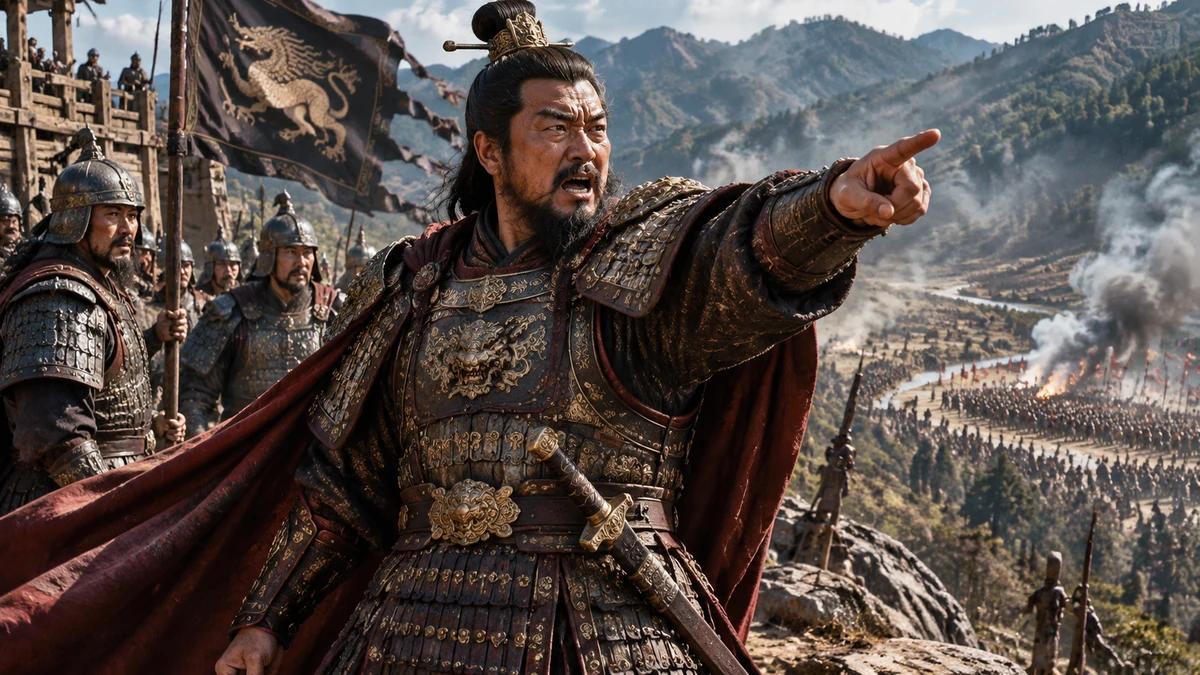
Yeon Gaesomun, one of the most influential and controversial figures in ancient Korean history, led the kingdom of Goguryeo through some of its fiercest confrontations with China's Tang dynasty. His military leadership helped repel a major Tang invasion in 662, including a devastating defeat of a Tang force at the Battle of Sasu. But his rise to power began with a bloody coup that reshaped Goguryeo's political leadership.
Born in an unknown year, Yeon served as a general and political leader during the final decades of Goguryeo, one of the three major kingdoms that dominated the Korean Peninsula during the Three Kingdoms period. He seized power in 642 by killing King Yeongnyu and installing the king's nephew, Bojang, on the throne. Yeon subsequently assumed the position of chief military and political official, exercising effective control over the kingdom until his death in 665.
From aristocratic rivalry to a bloody coup
Yeon inherited his father's position among Goguryeo's eastern aristocracy but initially faced resistance from powerful nobles who distrusted his ambitions and temperament. He eventually secured their approval and was appointed chief supervisor of the construction of the Cheonri Jangseong, a major defensive wall along Goguryeo's western frontier. The fortification extended from Buyeo Fortress toward the entrance to the Gulf of Bohai and was intended to protect the kingdom against Tang expansion.
As Yeon's influence grew, King Yeongnyu and senior officials reportedly began plotting to eliminate him. After learning of the plan, Yeon summoned leading aristocrats to a military inspection outside the southern walls of Pyongyang in 642. He ordered their execution. Historical accounts disagree on the number killed: the Korean chronicle Samguk Sagi records more than 100 officials, while Japan's Nihon Shoki gives a figure of approximately 180.
Yeon then entered the royal palace, killed King Yeongnyu and placed the king's nephew, Bojang, on the throne. He assumed the position of makniji, the kingdom's leading official, and established the higher title of daemakniji. His family subsequently maintained political dominance through his sons, particularly Yeon Namsaeng and Yeon Namgeon, until Goguryeo's fall in 668.
Some modern interpretations connect the coup to dissatisfaction with King Yeongnyu's relatively accommodating policy toward the Tang court. The Tang envoy Chen Dade had reportedly investigated Goguryeo's internal affairs and overseen the destruction of a monument commemorating the kingdom's victory over the Sui dynasty. Yeon's supporters may have viewed the king's failure to respond forcefully as a sign of weakness.
Religion, diplomacy and resistance to Tang expansion
In 643, Yeon encouraged the adoption of Taoism, welcoming eight Taoist priests from Tang China and bringing the Tao Te Ching, a foundational Taoist text, into Goguryeo. The policy was partly intended to counter the influence of Buddhism. A Buddhist monk named Bodeok, who opposed the promotion of Taoism, subsequently left Goguryeo for Baekje in 650.
Yeon also pursued an uncompromising foreign policy toward neighboring Silla. When Kim Chun-chu, a leading Silla political figure who later became King Muyeol, visited Goguryeo seeking military assistance against Baekje, Yeon demanded the return of territories north of the Jukryeong and Joryeong mountain passes. Silla had taken those lands during the reign of King Jinheung. Kim refused and was imprisoned. He secured his release after submitting a letter promising that Silla would return the territory, although the promise was not genuine.
In 644, Yeon rejected another diplomatic demand, this time from Tang, to halt military operations against Silla. Goguryeo forces had already captured two Silla fortresses, and Yeon insisted that the kingdom would not stop fighting until it recovered approximately 500 ri of territory previously taken by Silla.
His diplomatic ambitions extended beyond the Korean Peninsula. When Tang forces invaded in 645, Yeon sought cooperation with the Xueyantuo, a powerful group based in the Mongolian steppe, to threaten Tang's rear. He also dispatched envoys to Kang, a state centered in the region of present-day Samarkand, Uzbekistan. A mural at the Afrasiab archaeological site near Samarkand depicts a Goguryeo diplomatic delegation believed to have been sent during this period.
The Battle of Sasu: A major Tang defeat in 662
Goguryeo faced repeated military campaigns by Tang and Silla after 645. Following the fall of Baekje to the Tang-Silla alliance in 660, Tang forces advanced toward Pyongyang, Goguryeo's capital.
Yeon sent his eldest son, Yeon Namsaeng, to the Yalu River to confront Tang commander Qibi Heli. Tang troops crossed the frozen river and attacked, inflicting heavy casualties on Goguryeo. Approximately 30,000 Goguryeo soldiers were killed, while Yeon Namsaeng narrowly escaped. Qibi Heli subsequently left the campaign to suppress a rebellion among the Tiele people.
The military situation shifted dramatically in 662. Yeon's forces surrounded the army of Tang general Pang Xiaotai near the Sasu River and annihilated the force. According to the historical account, approximately 100,000 Tang soldiers were killed. Pang Xiaotai also died alongside his 13 sons. The engagement became known as the Battle of Sasu.
Meanwhile, Tang commander Su Dingfang, whose forces were besieging Pyongyang, eventually withdrew. After receiving military provisions delivered by Silla forces under Kim Yushin, Su cited heavy snowfall as the reason for retreating. The Tang campaign against Goguryeo failed. Korean historical accounts describe the Battle of Sasu as a decisive demonstration of Yeon's military capabilities and note that Tang did not launch another invasion of Goguryeo while he remained alive.
Family divisions and the fall of Goguryeo
Yeon died in 665, leaving his eldest son, Yeon Namsaeng, to inherit his position. His other sons, Yeon Namgeon and Yeon Namsan, also held significant power. Rivalries among the brothers soon escalated into a struggle for control.
Yeon Namsaeng was driven out of the capital region and eventually surrendered to Tang, later helping the Chinese forces attack his former kingdom. Yeon's younger brother, Yeon Jeongto, defected to Silla. The family divisions weakened Goguryeo as Tang and Silla continued their campaign.
In 668, Pyongyang fell and Goguryeo surrendered. Yeon Namsan capitulated alongside King Bojang. Yeon Namgeon, who continued defending the kingdom, was captured after one of his subordinates betrayed him. He was exiled to Geomju, where he eventually died.
A contested legacy in Korean history
Yeon Gaesomun's reputation has changed considerably over the centuries. The Samguk Sagi, a major medieval Korean historical chronicle, condemned him as a traitor for murdering his king. The Samguk Yusa, another influential historical collection, included a legend portraying him as the reincarnation of a Sui general who had returned to destroy Goguryeo. Some modern interpretations regard that story as a distortion shaped by Buddhist opposition to Yeon's Taoist policies.
Other historical figures offered a more favorable assessment. The Chinese Song dynasty statesman Wang Anshi reportedly attributed Tang Emperor Taizong's failure to conquer Goguryeo to Yeon's exceptional abilities. Japan's Toji Kaden also placed him alongside Tang statesman Wei Zheng and Silla general Kim Yushin as a figure of outstanding historical importance.
Modern Korean historians have offered a more nuanced assessment. The Korean National Encyclopedia of Korean Culture recognizes his broad diplomatic outlook and military leadership but also points to strategic weaknesses. His confrontational approach toward Silla left Goguryeo vulnerable to pressure from both north and south. His preference for direct engagements on open ground, rather than relying consistently on established fortress defenses, also contributed to military setbacks.
In the 20th century, Korean nationalist historians Shin Chae-ho and Park Eun-sik reassessed Yeon as a symbol of resistance and independence. Shin portrayed him as a revolutionary figure, while Park praised his commitment to national autonomy. A local tradition in Ganghwa Island identifies the area as his birthplace, and a commemorative monument was erected there in 1993. However, the site has not undergone a detailed archaeological investigation.
Historical drama brings Yeon back to television
Yeon Gaesomun has remained a recurring character in Korean historical dramas, films and novels. His story is receiving renewed television attention through KBS 2TV's historical drama "Munmu," which premiered Nov. 14, 2026. Actor Jang Hyuk portrays Yeon in the series.
The production marks KBS's return to a major historical drama three years after "Goryeo-Khitan War." Actor Lee Hyun-wook plays Kim Beop-min, later King Munmu of Silla, while Kim Kang-woo portrays Kim Chun-chu. The series revisits a turbulent period when military ambition, aristocratic rivalries and shifting alliances helped determine the fate of the ancient kingdoms on the Korean Peninsula.
Comments
Post a Comment