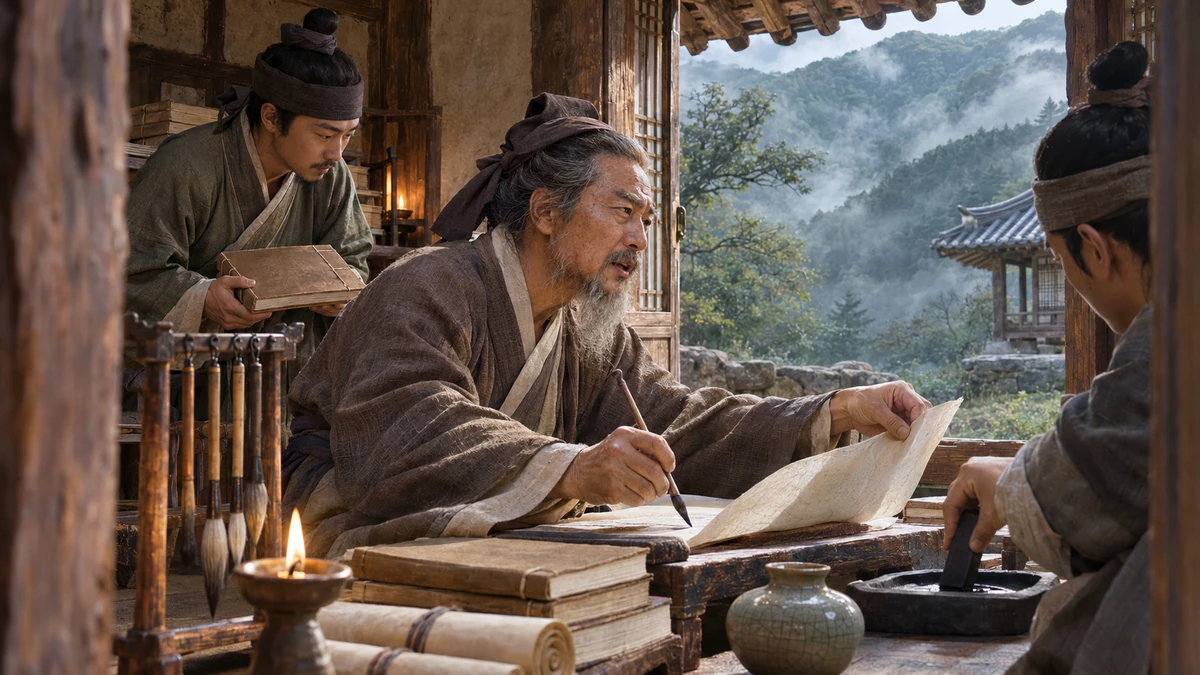
Image to help understand the article
A Scholar Shaped by War
Yi Seung-hyu, a government official and scholar of Korea’s Goryeo dynasty, built his legacy by confronting abuses of power and writing an ambitious account of Korean and Chinese history in verse.
Born in 1224, Yi began reading at age 9 and later studied Chinese classics including the “Zuo Zhuan” and the “I Ching.” After his father died, Yi was raised with help from a maternal relative.
His education unfolded during the Mongol invasions of Korea, which forced the Goryeo government to relocate to Ganghwa Island. Yi followed the court there and studied at a gathering place for scholars. He passed the civil service examination in 1252, but the continuing conflict soon disrupted his plans. While traveling to see his widowed mother, he became stranded by a Mongol advance and settled near Mount Duta in Samcheok, where he farmed to support her.
An Official Willing to Speak Out
Yi entered government service in the 1260s and later moved into posts in the central administration. During the 1270 uprising of the Sambyeolcho, a military force that resisted the government’s accommodation with Mongol rule, he sharply criticized policies that compounded civilian suffering through forced collections and construction demands.
In 1273, Yi drafted a petition arguing that people without meritorious service should not be elevated directly to high office. He was dismissed, though he soon accompanied a diplomatic mission to the Yuan dynasty court in China. His official writing reportedly impressed Kublai Khan and Yuan officials.
On another mission the following year, Yi urged Goryeo’s crown prince, then in Yuan territory, to wear Korean mourning clothes for the funeral of King Wonjong rather than conduct the rites in Mongol dress.
Under King Chungnyeol, Yi continued to criticize misconduct. He presented the king with 15 points concerning failures in government and, while serving as a regional inspector, impeached seven officials accused of taking bribes and confiscated their property. The action earned him enemies and a demotion. He subsequently adopted the pen name Dongan Geosa, meaning the Layman of Dongan.
In 1280, Yi and other inspectors submitted 10 criticisms of the king’s policies and the arbitrary behavior of royal associates. The protest again cost him his position.
History Written as Poetry
After his dismissal, Yi returned to the Mount Duta area and built a retreat called Yongandang, a name drawn from a work by the Chinese poet Tao Yuanming. Yi, who became increasingly devoted to Buddhism later in life, eventually renamed the retreat Ganjangsa.
There he wrote “Jewang Ungi,” commonly rendered in English as “Songs of Emperors and Kings,” and another work, “Naejeonnok.” “Jewang Ungi” recounts Chinese and Korean history through poetry written in lines of five and seven Chinese characters. The text is considered an important record of how a rising group of Goryeo intellectuals understood history during a period of intense Yuan political influence.
Scholars have offered competing interpretations of the work. Some view it as an assertion of Korea’s cultural achievements and historical tradition under foreign pressure. Others argue that its Confucian framework helped justify Goryeo’s subordinate relationship with the Yuan dynasty.
A Final Return to Government
King Chungseon recalled Yi to public service in 1298 as part of a reform effort. Yi received several senior scholarly and advisory appointments, but repeatedly sought permission to resign, arguing that granting high office to someone over 70 did not conform to state rules. He retired later that year.
Yi died Nov. 13, 1300, at age 77, according to the traditional reckoning preserved in the account. His writings were later compiled by his son, Yi Yeon-jong, in the “Collected Works of Dongan Geosa.”
As an official, Yi was remembered for repeatedly challenging policies that harmed ordinary people and for condemning abuses by powerful figures. As a scholar, he left a poetic history that continues to frame debate over how medieval Koreans understood their identity while living under the shadow of the Mongol-led Yuan empire.
Comments
Post a Comment