Image to help understand the article
From Confucian scholar to militia commander
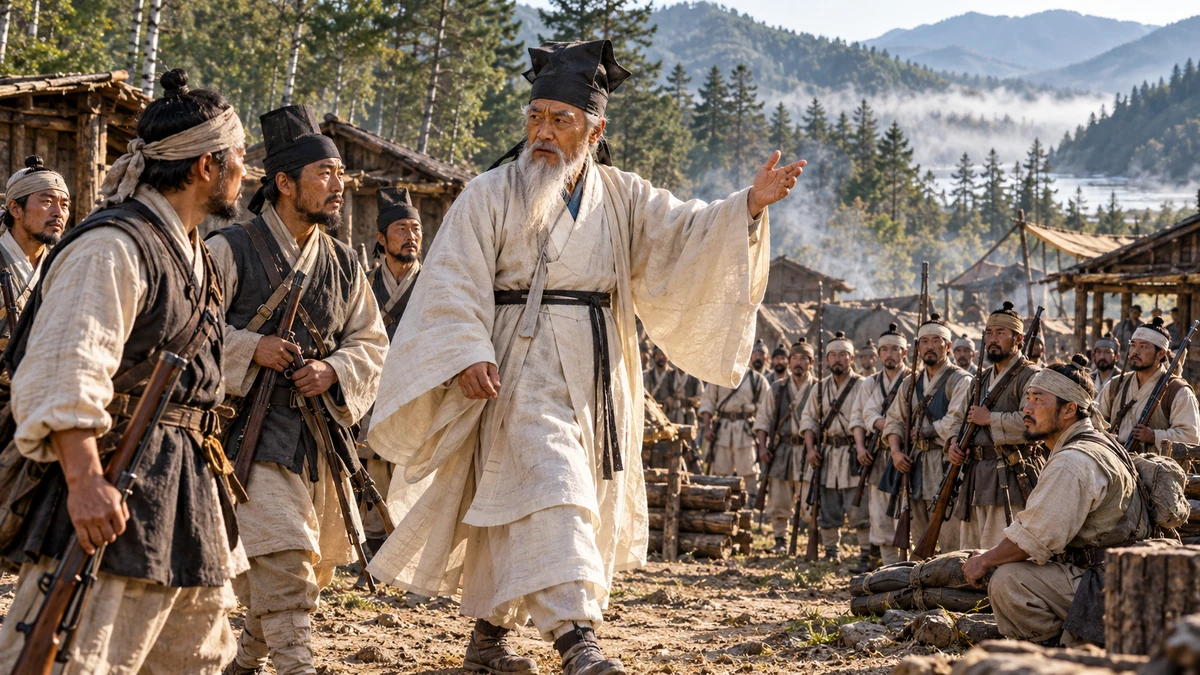
Yu In-seok was a prominent Confucian scholar who became a leader of Korea’s armed resistance as Japan expanded its influence over the Korean Peninsula in the late 19th and early 20th centuries.
Born Jan. 25, 1842, in Chuncheon, in what is now Gangwon Province, Yu studied under leading members of the Hwaseo school, an intellectual tradition that defended orthodox Neo-Confucian values and opposed foreign influence. After the deaths of his teachers Kim Pyeong-muk in 1891 and Yu Jung-gyo in 1893, he was recognized as an heir to the school’s scholarly lineage.
Yu’s beliefs shaped his politics. In 1876, after Korea signed the Treaty of Ganghwa and opened ports to Japan, he joined 46 Confucian scholars from Gangwon and Gyeonggi provinces in submitting a petition opposing the opening.
Resistance after the killing of Queen Min
The 1895 assassination of Queen Min, later given the posthumous title Empress Myeongseong, and a government order requiring Korean men to cut their traditional topknots helped trigger the Eulmi Righteous Army movement. The militias were known as “righteous armies,” civilian forces organized outside the regular military to resist policies they viewed as illegitimate and defend the country.
Yu began his campaign on the 24th day of the 12th lunar month in 1895. He rallied students and associates under the cause of avenging the queen and preserving traditional moral obligations, and issued a declaration urging communities across Korea to act.
His Hojo Righteous Army at one point exceeded 3,000 fighters. Operating around Jecheon, Chungju, Danyang and Wonju in central Korea, the force fought Korean government troops and Japanese soldiers. It also targeted officials accused of supporting Japan. In 1896, Yu’s troops captured Chungju and executed provincial Gov. Kim Gyu-sik.
The militias, however, relied largely on matchlock firearms and struggled against government and Japanese forces equipped with modern weapons. After losing Jecheon on May 26, 1896, Yu led the remaining fighters north through Hwanghae and Pyongan provinces. He later crossed the Yalu River seeking Chinese assistance but was disarmed by a local Qing official. Yu dissolved his force that July and settled in an area of China with a substantial Korean population.
Education, exile and renewed organizing
Yu briefly returned to Korea in 1897 after being summoned by King Gojong, but he soon went back into exile. After returning again in 1900, he traveled through northern Korea teaching writing and Neo-Confucian philosophy. His schools and ceremonial gatherings promoted opposition to Japan and the restoration of Korean sovereignty. Several future militia leaders emerged from those efforts.
Following the 1905 treaty that made Korea a Japanese protectorate, Yu appealed nationwide for people to join the resistance. He argued that those unable to fight should denounce Japan through speech and writing.
Yu concluded that continued organizing inside Korea had become untenable after Japan forced Gojong from the throne in 1907 and tightened its control over the government. He moved to Vladivostok in 1908 and worked with other independence activists to unite resistance groups scattered across Manchuria and the Russian Far East.
Leader of the Thirteen Provinces Righteous Army
In June 1910, resistance groups in Russia’s Maritime Province formed the Thirteen Provinces Righteous Army, named for Korea’s provincial structure at the time. Yu was selected as its top commander. He called for national unity and resistance until the last person remained.
The organization planned to cross the Tumen River and advance into Korea, but Russian authorities arrested Yu before the operation could begin. He was later released, and the plan was abandoned.
After Japan formally annexed Korea in 1910, Yu represented the Seongmyeonghoe, an organization created by Koreans in Vladivostok to publicize opposition to annexation. The group gathered 8,624 signatures from Koreans, Chinese and Russians and sent its declaration to the governments of the United States, Russia and the Republic of China, as well as to newspapers. The campaign sought to demonstrate internationally that Koreans had not consented to Japanese rule.
Japan pressed Russia to suppress the activists, leading to arrests and the collapse of the Thirteen Provinces Righteous Army. Yu agreed to dissolve the organization in exchange for the release of his associates and urged activists to move to the Jiandao region along the Korea-China frontier to preserve their cause.
A resistance leader with deeply conservative views
Yu turned the Hwaseo school’s doctrine of defending Confucian orthodoxy into an armed political movement. When fighting inside Korea became impossible, he pursued resistance through education, public declarations and attempts to unite anti-Japanese forces in China and Russia. His writings were collected in several works, including “New Compilation of the Defense of Righteousness,” published by his students in 1902.
His opposition to Japanese expansion did not extend to support for social equality. Yu remained committed to Korea’s traditional class hierarchy. During the militia campaign, he ordered the execution of commoner commander Kim Baek-seon and Kim’s son after Kim angrily confronted a commander from the aristocratic yangban class. Yu also rejected Western concepts of equality and freedom and opposed gender equality and schools for women.
Yu moved to western Manchuria in 1914 and died of illness on Jan. 29, 1915. After Korea’s liberation from Japanese rule, his remains were transferred to his hometown of Chuncheon. The South Korean government posthumously awarded him the Order of Merit for National Foundation in 1962.
Comments
Post a Comment