
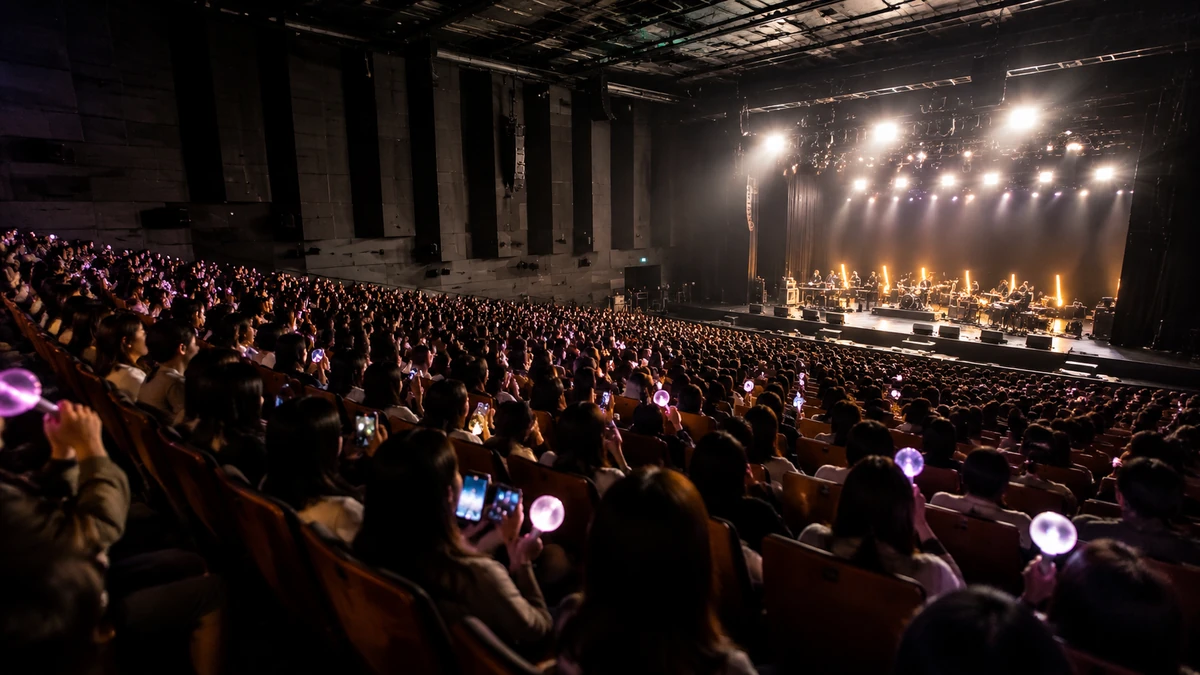
A festival in Seoul is making a pointed statement
At a moment when Korean pop culture feels everywhere in the United States — from sold-out arena tours and Coachella appearances to K-dramas dominating streaming queues — a new festival in Seoul is asking a deceptively simple question: Who gets centered on the stage when women are the ones doing so much to sustain the market?
From Sept. 12 to 14, the Mapo Cultural Foundation and the music company Your Summer are set to hold Yeonghee Festival, a women-musician-centered multidisciplinary arts event around Mapo Art Center in western Seoul. On the surface, it is another addition to South Korea’s crowded live music calendar, one that arrives during a sustained concert boom and the continuing global rise of K-pop and Korean popular culture. But the premise behind it is more ambitious than a typical lineup announcement.
The festival’s organizers are explicitly framing the event around an imbalance in the Korean music business: Female fandom has been central to the commercial engine driving concerts, fan culture and the Korean Wave, yet festivals that put women musicians, women’s narratives and women’s creative labor squarely at the center remain relatively rare.
That tension — between who powers the market and who is most fully spotlighted by it — is what makes Yeonghee Festival worth watching beyond South Korea. For American readers accustomed to debates in Hollywood, country music, rock and even sports about who gets visibility versus who generates value, the argument may sound familiar. Fans do not merely consume culture; they shape it. And when an audience becomes powerful enough to define a market, it inevitably raises questions about whose stories that market chooses to elevate.
In that sense, Yeonghee Festival is not just another local music event. It is a test case for where Korean popular music may be headed next: away from a narrow focus on chart speed, streaming totals and blockbuster idol brands, and toward a broader conversation about voice, representation and cultural authority.
Why the name “Yeonghee” matters
The most revealing thing about the festival may be its name. “Yeonghee” is one of those deeply recognizable Korean women’s names that, for generations, carried an almost textbook familiarity — something like “Jane” or “Mary” in an older American context, though no comparison is exact. For many Koreans, the name evokes the kind of standard female character that appeared in school materials and everyday examples, a shorthand for the ordinary girl or woman.
But the name also carries a second layer. The organizers say it draws on Chinese characters associated with “glory” and “joy,” giving the title an emotional and symbolic aspiration beyond simple familiarity. In other words, the festival is intentionally using a very common woman’s name to gesture toward women whose contributions may be common, foundational and omnipresent, but not always honored proportionately.
That is a notably Korean way of embedding meaning in a cultural event, and it helps explain why the festival reads less like a branding exercise and more like an argument. Names in Korea often carry literary, historical or character-based meanings that resonate beyond their sound. By choosing Yeonghee, the organizers are not merely picking something catchy. They are invoking the everyday woman and then insisting that “ordinary” women — including artists whose work can be overshadowed by flashier industry narratives — deserve recognition, celebration and, as the organizers put it, glory and joy.
Singer-songwriter Oh Ji-eun, who planned the event, has said she wanted to create a space where properly earned recognition could return to undervalued women across fields, not only musicians. That distinction matters. The festival is not framed as a niche showcase for a marginalized category of artists. It is presented as a corrective lens, one meant to reconsider the structure of value itself: Who gets called important? Whose labor becomes visible? Which stories are treated as central rather than peripheral?
For American readers, the closest analog may be less a conventional music festival than a cross between a women-centered cultural summit and an artist-curated stage with a clear editorial point of view. It is not simply “women performers are here.” It is “women have always been here; why has the industry so often treated their presence as secondary?”
The lineup is broad by design, not by accident
The headliners alone signal that Yeonghee Festival is not trying to reduce women musicians to one style, generation or commercial lane. The event features veteran and influential artists including Lee Sang-eun, Kim Yoon-ah and Sunwoojunga, with additional performers such as Irang, Yozoh, Kim Sawol, Naa and Ahn Shin-ae.
For readers outside Korea, those names may not all carry the instant brand recognition of Blackpink or BTS, but that is partly the point. Korean popular music is much bigger than idol pop, and one of the most important developments in how Americans understand the Korean Wave is recognizing that K-pop is only one branch of a much wider ecosystem. Korea’s contemporary music scene includes indie singer-songwriters, experimental artists, rock vocalists, jazz-influenced performers and genre-crossing creators who have built lasting careers outside the idol assembly line that often defines Korea in international coverage.
Kim Yoon-ah, for example, is widely known as the frontwoman of the rock band Jaurim and has long represented a kind of cerebral, emotionally intense musicianship in Korea. Sunwoojunga has built a reputation for adventurous songwriting and production that resists easy categorization. Lee Sang-eun has occupied an important place in Korean pop as an artist associated with longevity, musical sophistication and reinvention.
Putting those artists together does more than provide star power. It creates a map of women’s presence across Korean music. The curation suggests that there is no singular female sound, no single female audience and no one story of what a woman musician in Korea looks like. That may sound obvious, but industries often flatten women into a market segment rather than present them as a spectrum.
In the American music business, similar debates have played out for years. Women in country have objected to radio gatekeeping. Women in film and television have pushed back against an industry tendency to treat male experience as universal and female experience as specialized. Festivals like Lilith Fair once emerged in the United States not only to showcase women artists but also to challenge assumptions about what audiences would support. Yeonghee Festival lands in that lineage of cultural interventions, even though it grows out of a distinctly Korean context.
Its structure is especially important because it refuses to make women musicians legible only through celebrity. Rather than building the entire narrative around one or two megastars, the lineup appears designed to show difference within commonality — different sounds, different eras, different artistic vocabularies, all sharing the fact that they are women whose careers help define Korean music more than the industry sometimes acknowledges.
The festival’s real provocation is about fandom
The sharpest idea behind Yeonghee Festival is not simply that women deserve more stages. It is that female fandom has already been instrumental in building the stage economy that now powers Korean music, especially live events and the global expansion of the Korean Wave.
That observation cuts to the center of modern Korean entertainment. Fans in South Korea and abroad do far more than buy tickets. They stream songs strategically, organize online campaigns, purchase merchandise in large volumes, travel for concerts, produce fan art, translate content, amplify artists on social media and create the kind of sustained digital energy that can turn a release into a transnational event. In K-pop in particular, fandom is not a side effect of success. It is infrastructure.
And much of that infrastructure has long been built, maintained and emotionally animated by women. That does not mean all fans are women, nor that women support only women artists. But the Korean music business has for years relied on forms of participation in which female fans have been especially visible and influential. To state that plainly is to raise an uncomfortable follow-up: If women are helping uphold so much of the market, why do women-centered creative platforms still feel exceptional rather than routine?
In the United States, this dynamic would be recognizable to anyone who has watched the economics of pop fandom. Think of the way women and girls have historically driven record sales, concert attendance and online enthusiasm for pop stars, often while their tastes were dismissed as unserious by critics or industry gatekeepers. From Beatlemania to boy-band culture to Taylor Swift fandom, female fans have frequently been mocked even as they created enormous value. Korea’s music landscape has its own version of that contradiction.
Yeonghee Festival enters that contradiction directly. It is saying, in effect, that if women are central to the business model, then cultural institutions should be more willing to build platforms that reflect women’s artistry and women’s experiences with equal seriousness. That does not mean excluding men or turning music into a demographic checkbox. It means recognizing that a market’s most active participants inevitably shape expectations about what kinds of stories should be visible.
This is why the festival resonates beyond identity politics. It is also an industrial question. Korean pop is now mature enough as a global sector to confront not just how to export stars, but how to distribute recognition inside its own ecosystem. Fandom has scaled up. The question is whether representation will scale up with it.
More than a concert, it is a cultural format
The organizers describe Yeonghee Festival as a multidisciplinary culture and arts festival, not merely a run of concerts. That wording matters in a Korean setting, where many festivals are marketed primarily through lineup rankings, ticket sellouts and fan competition. By contrast, Yeonghee appears intended to create a broader frame around performance — one that includes atmosphere, conversation, sensibility and the social meaning of gathering.
That approach is significant in part because of where it is happening. Mapo, the broader district that includes areas such as Hongdae, has long been associated with youth culture, independent music, clubs, live houses and alternative arts scenes in Seoul. Holding a women-centered arts festival around Mapo Art Center links the event both to institutional culture and to a neighborhood history of experimentation. It suggests a bridge between public cultural infrastructure and the more fluid creativity of the independent music world.
For American audiences, it may help to think of the symbolism involved when a city-backed arts institution opens space for a conversation that has often lived in more informal or subcultural corners. This is not a one-night pop-up in a warehouse. It is a statement made within a recognized civic arts setting, in partnership with a private music company. That alone gives the event a kind of legitimacy and visibility that grassroots scenes do not always receive.
The festival format also expands the meaning of audience experience. Instead of treating concertgoers as people who arrive, consume a performance and leave, a multidisciplinary structure implies that people are also there to reflect, connect and absorb a point of view. The show is not only onstage. The framework around the show becomes part of the message.
That is important because the issue at stake is not merely whether more women can be booked. It is whether the culture surrounding live music can make room for different ways of seeing value. If “glory and joy” are core keywords for the festival, they are not just sentimental branding. They suggest a fuller experience of cultural participation — recognition, belonging, resonance and perhaps even correction.
What this says about the next phase of the Korean Wave
For years, international coverage of Korean music has revolved around measurable outcomes: Billboard rankings, YouTube views, stadium grosses, album sales and chart milestones. Those metrics matter, and they have helped Americans grasp the scale of Hallyu, or the Korean Wave — the broad global spread of Korean entertainment and culture that includes music, television, film, beauty and fashion.
But there comes a point in every cultural boom when the more interesting question is no longer, “How big is it?” but “What is it becoming?” Yeonghee Festival speaks to that second question.
The event suggests that Korean music may be entering a phase in which internal conversations about perspective, authorship and narrative space become more visible. In the early years of global expansion, the focus was understandably on proving that Korean acts could cross borders and compete in major international markets. Now that such proof exists in abundance, the field can afford to ask harder questions about what kinds of voices are centered as Korean music defines itself for the world.
This is especially relevant because international fans increasingly want a more layered understanding of Korea’s cultural scene. Many American listeners who first arrived through idol groups eventually branch into indie acts, OST singers, rock bands, R&B vocalists and singer-songwriters. They become curious not only about hit songs but about institutions, subcultures and social debates inside Korea. Yeonghee Festival offers a window into one of those debates.
It also complicates a common outside assumption that K-pop’s success automatically translates into broad equality or representation within Korean music. A globally successful industry can still have blind spots. A vibrant concert market can still reproduce familiar hierarchies. Rapid growth does not erase old structures; sometimes it simply scales them.
That is why the festival may matter even if it does not single-handedly transform the industry. Cultural shifts often begin not with sweeping reform but with a well-placed event that makes an absence impossible to ignore. One festival cannot fix systemic imbalance, but it can show audiences, institutions and promoters what has been missing — and how eager people may be to engage when that gap is finally addressed.
Why global audiences should pay attention now
Even before the first performance begins, Yeonghee Festival has become noteworthy because of what it implies about demand. It reflects an emerging belief that Korean music audiences, especially those shaped by powerful fan cultures, are ready for more intentional and more nuanced kinds of programming. Not programming that treats women as a niche add-on, but programming that starts from the premise that women’s creativity is foundational, not supplemental.
That matters for the future of festivals, touring and cultural branding in Korea. If Yeonghee Festival draws strong attention, it could encourage more promoters and public arts institutions to experiment with events organized around perspective rather than just scale. It could also push the conversation in K-pop-adjacent spaces, where debates about fairness, recognition and creative control are already common among dedicated fans.
For American readers, there is also a broader lesson here about how mature entertainment industries evolve. When a market grows, pressure builds not only for bigger acts and larger venues, but for deeper representation. The United States has seen versions of that in music, film and publishing. Korea is now negotiating similar questions in full view of a global audience.
The lasting significance of Yeonghee Festival may therefore lie in the question it leaves behind: In a music economy energized so strongly by women’s participation, what kinds of stages do audiences now want to see? If the answer includes more room for women musicians, more visibility for undervalued artists and more attention to stories once treated as peripheral, then this Seoul festival may end up representing something larger than a weekend event.
It may mark a subtle but meaningful shift in what the Korean Wave expects from itself. Not just bigger numbers, but a broader center. Not just louder fandom, but clearer recognition. Not just export success, but a more honest accounting of who has been carrying the culture all along.


0 Comments