A new rule in K-pop’s fiercest race
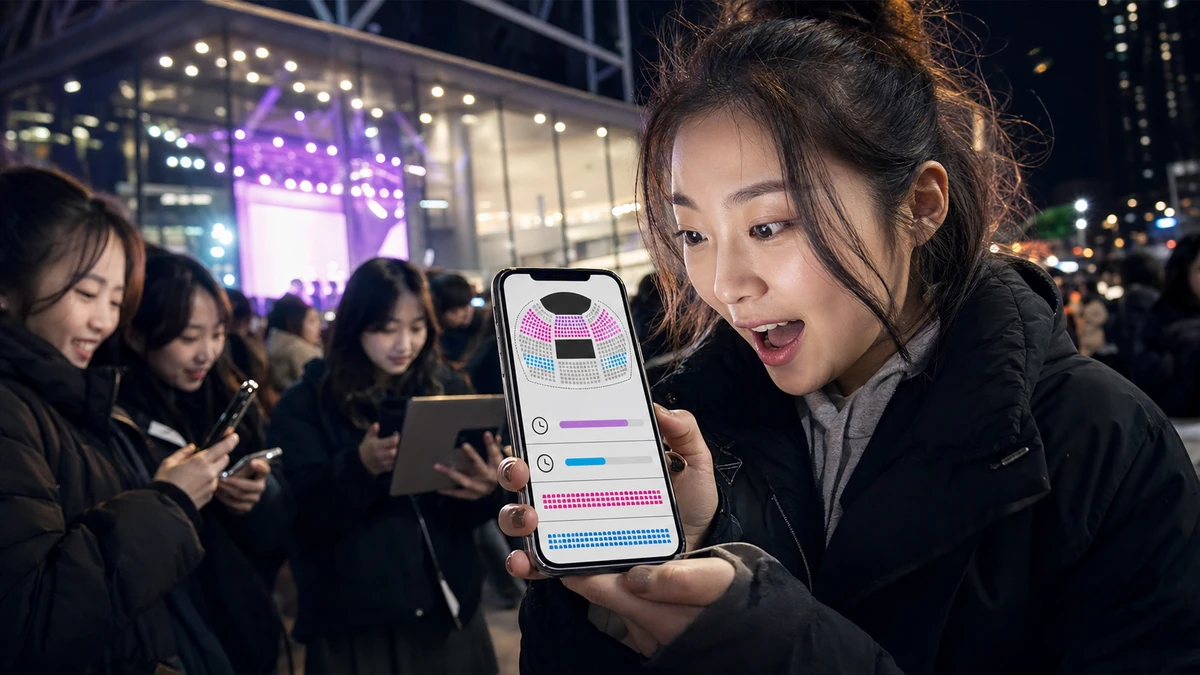
For years, buying tickets to a major K-pop concert in Seoul has felt less like a routine transaction and more like trying to score Super Bowl seats, Taylor Swift tickets and Comic-Con passes all at once. In South Korea, fans even have a word for it: “picketing,” a slang term that combines the Korean word for ticket with the idea of a high-stakes battle. It describes the frenzied rush when tickets for a top act vanish in minutes — sometimes seconds — as fans from Korea and around the world all compete for the same seats.
Now some of the biggest companies in K-pop are trying to change that equation. Major entertainment agencies in South Korea are increasingly giving Korean fans a head start when tickets go on sale for concerts held in Korea, especially in Seoul, the symbolic heart of the K-pop industry. The idea is not to shut out international fans, who have helped transform K-pop into a global business, but to carve out a protected lane for domestic fans who say they have been squeezed out of shows in their own backyard.
The shift may sound procedural — just another tweak in a ticketing system — but it speaks to a larger question facing K-pop as it matures into a worldwide entertainment force: When a local music scene becomes a global phenomenon, who gets priority at home? In the United States, the debate might be familiar to anyone who has watched local season-ticket holders fight for access while traveling fans, resellers and deep-pocketed consumers flood the market. In South Korea, the issue carries even more emotional weight because Seoul concerts are not merely tour stops. For many fans, they are the home stage, the place where idols debut, promote new music and sustain the fan culture that helped build K-pop long before it became a global export.
What is changing now is that some companies are beginning to formally recognize that symbolic difference. Instead of placing all fans into the same digital queue at the same moment, they are experimenting with separate presale windows, region-based verification and limited seat allotments that allow Korean fans first access to at least part of the house.
Why Seoul still matters in a global industry
To understand why this shift is resonating in South Korea, it helps to understand how central place remains to K-pop, even in an era of streaming, global fan platforms and world tours. K-pop is one of the world’s most internationalized music industries. Its stars headline festivals in the United States, sell out arenas in Europe and Latin America, and dominate social media across multiple languages. Groups can build massive fan bases before many members are even widely known outside the genre’s dedicated circles.
And yet Seoul still occupies a special place in the ecosystem. It is not just where most major agencies are headquartered. It is also where idol groups train, debut, appear on music shows and develop their earliest fan communities. Domestic fans often see Seoul concerts as the most meaningful live events on an artist’s calendar — akin to a hometown championship game, a Broadway opening night or a band’s Madison Square Garden show, except often all rolled into one.
That symbolism matters because K-pop fandom is unusually structured and participatory. Fans do not simply stream songs and buy tickets. They join official fan clubs, purchase memberships, follow elaborate comeback schedules, vote in online polls, attend events and coordinate support projects. In South Korea, that long-term investment can feel especially personal. Fans often support artists from pre-debut days and see themselves as part of the local culture that first sustained the group.
As K-pop became more global, however, many domestic fans began to feel that they were losing practical access to the very concerts that mattered most to them. When ticketing opens for a popular Seoul show, overseas fans — some of whom are willing to plan major international trips around a concert — can compete side by side with Korean fans. For blockbuster groups, the result is often a digital stampede. The companies now adjusting their policies appear to be responding to a growing sense that being geographically and culturally close to the scene no longer guarantees any advantage at all.
That tension is not unique to Korea. Sports leagues, music festivals and theater productions in the United States have all grappled with the problem of balancing local loyalty with broader demand. But in K-pop, where fandom is central to the business model, the way access is managed can shape not just sales but trust.
How the new presales work
One of the clearest examples comes from JYP Entertainment, the agency behind Stray Kids, one of the most internationally successful K-pop groups of the moment. For the group’s upcoming world tour stop in Seoul next month, JYP said Korean fan club members would get an earlier opportunity to buy tickets before a separate global sale opens. Rather than giving domestic buyers the entire venue upfront, the company is making only a portion of seats available in the Korean presale, then opening the broader sale afterward.
That distinction is important. This is not a full wall between Korean and overseas audiences. It is more of a tiered access system, with some inventory reserved for the first round and the remaining tickets later released through a wider global process. In theory, it allows Korean fans to secure at least part of the venue while still preserving access for the international audience that has become essential to K-pop’s growth.
Another key feature is verification. In many of these new systems, ticket access is tied not simply to nationality but to a fan club’s region-based pre-verification process. That means ticket buyers may have to register through a particular regional platform in advance, and those registered for domestic sales cannot simply be substituted with overseas participants living abroad. The distinction is subtle but significant. Companies appear to be trying to avoid framing the policy as a blunt “Koreans only” gate while still creating a mechanism that meaningfully prioritizes domestic concertgoers.
For American readers, the closest parallel may be a venue or promoter creating a local presale, a credit card presale or a membership-based window before general tickets are released. But the K-pop version is more layered because official fan club membership is not a side perk. It is one of the primary ways fandom is organized. In that sense, the presale is not just a commercial strategy; it is also an expression of how companies define and reward fan participation.
The details vary by label and artist, and the industry has not settled on a single model. Some acts may allocate different percentages of seats to domestic presale. Others may apply different verification requirements. But a pattern is becoming clear: South Korea’s biggest entertainment companies are testing ways to separate the domestic and international ticketing pipelines without turning them into mutually exclusive camps.
From JYP to HYBE to SM, a broader experiment is taking shape
What makes the trend notable is that it does not appear limited to one company trying out a one-off fix. Other major players in the K-pop business have moved in a similar direction. HYBE-affiliated labels have introduced domestic-first ticket access for some artists, and SM Entertainment has also used similar approaches for recent concerts by acts including Red Velvet, NCT Dream and aespa.
When the largest agencies in the market begin converging on similar practices, industry watchers pay attention. South Korea’s entertainment companies are highly competitive, but they also watch one another closely when it comes to concert operations, fan management and platform strategy. If several leading labels conclude that domestic-first presales reduce fan frustration without seriously damaging overseas demand, the model could spread more widely across tours and artists.
That would mark an important evolution in K-pop’s business logic. For much of the genre’s recent global rise, expansion was the overriding goal. Labels pursued international streaming, overseas touring, English-language visibility and fan acquisition in new markets. Ticketing systems naturally reflected that emphasis, often treating all demand as part of one giant global pool. But once global fandom reaches a certain scale, growth alone stops being the only management challenge. Companies also have to decide how to allocate scarcity.
There are practical reasons they may be acting now. Domestic fans are among the most engaged customers in K-pop, often buying albums, merchandise and memberships repeatedly over long periods. If those fans begin to feel alienated — especially if they feel locked out of live events in Korea — the damage can extend beyond one concert sale. In an industry that depends heavily on recurring fan participation, frustration is not just a customer-service problem. It is a long-term business risk.
At the same time, the companies cannot afford to alienate international fans either. Overseas audiences have become essential to the scale of K-pop’s success, particularly for groups with strong touring footprints in North America, Europe, Southeast Asia and Latin America. That is why the emerging systems are designed less as exclusions than as balancing tools. The message from the companies appears to be: Korean fans should not be crowded out of Korean shows, but global fans are still part of the picture.
The fairness debate inside a borderless fandom
The new presales are being welcomed by many Korean fans online, where reactions have included relief and hope that the policy becomes permanent. That response reflects more than simple self-interest. It also reveals a deeper sense that domestic fans have long carried a disproportionate burden in maintaining the day-to-day infrastructure of fandom while receiving no corresponding advantage when demand spikes.
Still, the policy raises an awkward question for a genre that markets itself as global and inclusive: Is it fair to privilege one group of fans over another based on where they live or how they are verified? There is no easy answer. International fans can make a strong case that their support — streaming music, buying albums, traveling long distances and helping artists build worldwide visibility — is every bit as real and financially important as local support. Many spend significant time and money just for a chance to experience K-pop in its country of origin.
But domestic fans have a case, too. Seoul concerts are not random stops on the itinerary. They are deeply tied to the industry’s roots, and Korean fans often view them as part of a shared cultural space. In that sense, the new presales resemble a recognition that not all venues mean the same thing, even in a global tour. An arena show in Seoul can be both an international event and a local one, and ticketing policy may increasingly reflect that dual identity.
American readers may recognize a version of this argument from debates over tourism, local access and hometown loyalty in other settings. Residents in major U.S. cities often complain when restaurants, cultural landmarks or sports events become so globally popular that locals struggle to participate. The complaint is not necessarily anti-visitor. It is about whether the people who sustain a place year-round retain some meaningful access once demand becomes international.
That seems to be the logic driving the K-pop shift. The question is not whether overseas fans belong. Clearly they do. The question is whether companies can acknowledge local stakes without triggering a zero-sum fight between Korean and global fandoms. So far, the agencies appear to be trying to thread that needle by separating access channels rather than drawing hard ideological lines.
The growing power of fan club verification
If there is one mechanism likely to shape the future of K-pop ticketing, it is fan club verification. In the West, fan clubs are often associated with newsletters, merchandise perks or occasional presales. In K-pop, official fan club membership can function more like an organized identity within the entertainment ecosystem. It links the fan to apps, membership kits, event access and now, increasingly, differentiated ticket rights.
That gives companies a powerful tool. By tying presale eligibility to official memberships and regional verification, agencies can sort demand more precisely than with a simple first-come, first-served queue. They can reward long-term engagement, filter who has access to certain sale windows and reduce some of the chaos that defines blockbuster on-sales.
It also gives the companies more responsibility. Verification systems have to be transparent, easy to understand and consistent across languages and platforms. If seat allotments are vague or rules change from artist to artist without clear explanation, the same system meant to reduce frustration could create a new wave of confusion and mistrust.
There are also practical concerns that remain unresolved. How many seats should be set aside for domestic fans? How should companies handle Korean nationals living abroad, or foreign residents living in Korea? What happens when fan club verification systems favor the most organized and digitally savvy participants while casual fans are left behind? And will these systems do anything to blunt scalping and resale pressures, or merely shift competition into different channels?
Those questions matter because ticketing is not a side issue in K-pop. A live concert is one of the few moments when artists and fans meet directly in the same physical space. In a genre built on intense emotional connection, those moments carry disproportionate importance. The rules governing access therefore become part of fandom itself, not just logistics.
What the Seoul ticket fight says about K-pop’s next phase
The larger story here is not just that some fans in South Korea may get better odds at buying concert tickets. It is that K-pop, after years of rapid international expansion, is entering a more complicated stage of global maturity. The central challenge is no longer simply how to reach the world. It is how to manage success once the world arrives.
In that sense, the domestic-first presale trend is a sign of an industry recalibrating. K-pop’s future will depend not only on attracting new audiences abroad but also on maintaining legitimacy at home. For major agencies, that means recognizing that Korean concerts occupy a special place in the fan imagination. Protecting some domestic access may be a way to preserve that meaning without abandoning the global ambitions that made K-pop so powerful in the first place.
Whether these policies become standard practice remains an open question. Fans are already asking the most important one: Is this temporary, or is it the beginning of a durable new norm? In ticketing, predictability can matter almost as much as access. Fans can accept rules they do not love if they understand them in advance. What they find hardest is uncertainty — a constantly shifting process that turns every tour announcement into a fresh guessing game.
If more companies follow the current model, the next test will be execution. Domestic-first presales will only work if agencies clearly explain who qualifies, how many seats are involved, when global sales begin and what protections are in place against manipulation. If the process is transparent, labels may be able to satisfy both audiences: Korean fans seeking recognition of Seoul’s special status, and international fans who still want a fair shot at experiencing K-pop in its home market.
For now, one thing is clear. The battle for K-pop tickets is not getting any less intense. But the rules of that battle are changing. And in one of the world’s most meticulously managed fan industries, even a small change in who gets in line first can say a great deal about where the business is headed next.
Comments
Post a Comment