At UNESCO in Paris, Seventeen’s Joshua turns K-pop star power into a message about youth, teamwork and global purpose
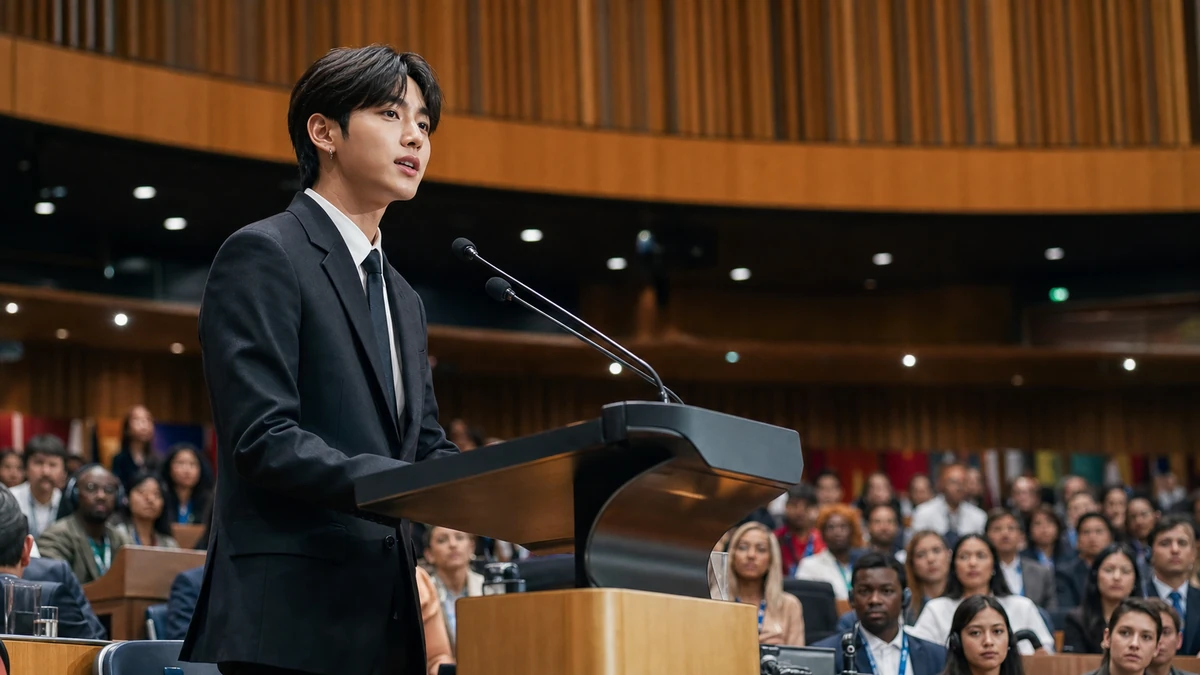
A K-pop speech in a room built for world affairs
When Joshua, a member of the South Korean boy band Seventeen, stepped onto the stage at UNESCO headquarters in Paris this week, the setting mattered almost as much as the speech itself. UNESCO, the United Nations agency focused on education, science and culture, is not a concert venue. Its main hall is a place more often associated with policy, diplomacy and arguments over how nations can work together than with pop idol appearances. That is precisely why the moment resonated so strongly for fans and for observers of South Korea’s growing cultural influence.
Speaking in English for about six minutes at a ceremony marking the global youth support program “Going Together — For Youth Creativity and Well-Being,” Joshua represented Seventeen in his role as part of the group’s broader work with UNESCO as youth goodwill ambassadors. The event celebrated the program’s completion while also outlining expanded support for standout youth teams. His message was straightforward and carefully framed for a global audience: young people facing uncertainty can still move forward through trust, collaboration and shared purpose.
For American readers who may know K-pop mostly through chart performances, viral dance clips or sold-out arena tours, the scene offers a wider lens on what Korean pop culture has become. K-pop is no longer just an entertainment export. It is increasingly part of a broader soft-power ecosystem that includes fashion, film, digital communities and, at moments like this one, international conversations about youth well-being and creativity. South Korea’s cultural rise has often been described through its commercial success, from Oscar-winning films like “Parasite” to Netflix phenomenon “Squid Game” and stadium-filling music acts. But events like the one in Paris show another dimension: the ability of Korean artists to move from consumer culture into civic and global spaces.
Joshua’s appearance also reflected a shift in how global fandom works in 2026. Fans are not only consuming music; they are watching how artists use their platforms, what causes they support and whether their public values align with the emotional communities that fandom helps create. In that sense, the UNESCO speech was not a side note to Seventeen’s music career. It was part of the story of why the group’s influence has grown far beyond the usual boundaries of pop promotion.
Why Seventeen carries unusual weight in K-pop
To understand why this speech drew attention, it helps to understand Seventeen’s place in Korean pop music. Despite the name, Seventeen has 13 members, a fact that has long puzzled new listeners and become one of those pieces of K-pop trivia fans enjoy explaining. The group’s name refers to a formula from its early branding: 13 members, three units and one team. Debuting in 2015, Seventeen built a reputation on self-production, tightly synchronized performances and a rare sense of internal cohesion for a large idol group. In an industry known for intense training, relentless scheduling and frequent turnover, maintaining a 13-member act over more than a decade is itself an accomplishment.
That history gave Joshua’s remarks particular credibility. He did not present Seventeen as a polished fairy tale of instant success. Instead, he acknowledged that the group had experienced uncertainty, too. For a K-pop act, that kind of framing matters. The global image of Korean idol groups is often one of dazzling control: perfect choreography, immaculate styling and carefully managed public personas. But behind that image is a demanding system that asks young performers to endure years of training, public scrutiny and competitive pressure. When Joshua spoke about uncertainty and the importance of leaning on one another, he was offering more than a slogan. He was drawing on one of the central realities of idol life: survival depends on teamwork as much as talent.
That message also fits Seventeen’s long-established identity. If BTS has often been framed in the United States as a group that helped open mainstream American doors for K-pop, Seventeen has emerged as a different kind of global force: less centered on crossover spectacle and more on consistency, craftsmanship and an unusually strong bond with fans. Their fandom, known as Carats, has followed not just the group’s music but its internal chemistry, humor and work ethic. So when Joshua condensed Seventeen’s message into a version of “Let’s keep moving forward together,” he was speaking in language that fans recognize as authentic to the group rather than borrowed from institutional talking points.
That matters in a space like UNESCO, where celebrity appearances can sometimes feel decorative. In this case, the speech drew power from the fact that Seventeen’s core narrative already centers on collective effort. Their story translates neatly into a youth-focused program built around creativity, mentoring and well-being.
The meaning of “together” in a Korean and global context
The key word in Joshua’s remarks was “together,” a simple term that carries particular weight in Korean culture and in K-pop. South Korean society is often described, sometimes too broadly, as emphasizing the collective over the individual. Team identity, mutual responsibility and social harmony can play a larger role in everyday life than many Americans are used to. In pop culture, that emphasis shows up in idol groups whose success depends on coordination, not just star turns. In a 13-member group like Seventeen, the idea of moving together is not metaphorical. It is embedded in the performance itself.
American audiences may instinctively compare that ethos to teamwork in sports, a high-functioning cast on a television ensemble or even the chemistry of a great band. But K-pop takes it further, turning coordination into both an artistic style and a social philosophy. Fans are often drawn not just to a song or a celebrity but to the visible proof that many different personalities can align toward a common goal. Seventeen’s brand has long rested on that ideal.
At UNESCO, Joshua translated that familiar K-pop language into something larger. He said that even though young people in different parts of the world live under different conditions, they can still build a path through trust and cooperation. That kind of message can sound generic in the hands of the wrong speaker. But it lands differently at a time when young people globally are navigating anxiety about jobs, war, climate change, social fragmentation and the mental health toll of always-online life. UNESCO’s focus on creativity and well-being taps into precisely those pressures.
There is also something culturally significant about the way Joshua framed uncertainty. In celebrity culture, especially online, public figures are often rewarded for projecting confidence and aspiration. K-pop, too, can be built on an image of flawless achievement. But some of the most effective youth messaging today comes from acknowledging instability rather than denying it. Joshua did not say young people should simply dream bigger or work harder. He suggested that uncertainty is normal and that solidarity is part of how people endure it. That is a more grounded and, in many ways, more modern message.
For English-speaking audiences, the speech also showed how Korean artists increasingly communicate without relying on layers of translation. Joshua delivered his remarks directly in English, which allowed him to speak to an international room in real time. That may sound like a small detail, but it matters in the global spread of Korean culture. The K-wave, or Hallyu, first expanded through subtitled dramas and translated interviews. Now, many of its biggest figures can switch between languages and registers, moving from fan platforms to diplomatic spaces with relative ease.
What the UNESCO partnership says about K-pop’s evolution
The “Going Together” program was described as a youth initiative providing resources, mentoring and opportunities so young people can turn their ideas into meaningful change. That framework is significant. It treats young people not as passive recipients of aid but as actors with agency, imagination and leadership potential. In the language of many international organizations, that is the difference between helping youth and empowering youth.
Joshua said Seventeen had been deeply moved by the passion and creativity of the young participants and that the group wanted to expand support so promising projects could have an even greater effect. That statement may sound like the standard rhetoric of philanthropy, but in the context of K-pop it points to a broader transformation. Korean idol groups are increasingly expected to operate not just as entertainers but as global public figures. Their work can extend into anti-bullying campaigns, educational initiatives, cultural diplomacy and mental health advocacy.
There is a clear strategic benefit for institutions, too. UNESCO gains access to the attention economy that pop stars command, especially among younger audiences who might never read a policy brief or watch an intergovernmental panel. A group like Seventeen brings reach, emotional connection and a ready-made international network. Fans who first arrive for the celebrity may leave with awareness of a youth program they otherwise would not have encountered.
For South Korea, these partnerships underscore the country’s remarkable success in turning pop culture into influence. American audiences are familiar with the concept even if they do not always use the term “soft power.” Hollywood did it for decades by exporting movies, stars and narratives that made American life seem dynamic, aspirational or globally central. South Korea, a far smaller country, has developed its own version through music, television, beauty, gaming and food. When a K-pop artist speaks at UNESCO, it is not only a celebrity booking. It is also a sign that Korean cultural products now carry enough legitimacy to enter spaces once dominated by Western institutions and personalities.
That does not mean every such partnership is purely altruistic, and it would be naive to treat it that way. Celebrity activism is always part message, part image management, part institution-building. But skepticism alone misses what is new here. The remarkable point is that a boy band can credibly participate in a global conversation about youth creativity and well-being and be taken seriously by audiences across continents. That would have seemed unlikely to many American observers even 10 years ago.
A speech that reached beyond fandom
One reason this event stood out is that Joshua’s remarks did not center on achievement in the narrow sense. He did not make Seventeen’s success the moral of the story. Instead, he described the group’s own experience — 13 people sharing one dream over many years, facing instability and moving forward through trust — as a framework young people might recognize in their own lives. That subtle choice matters. It avoids the trap of celebrity inspiration that effectively says, “We made it, so you can too,” even though the circumstances are wildly different.
Instead, Joshua emphasized process: staying connected, believing in one another and continuing to move forward together. In many ways, that is why the message can travel beyond the fan base. Young people do not need to be Carats, or even K-pop listeners, to understand the appeal of being told that instability does not invalidate ambition and that collective effort still matters in an era that often feels atomized.
That may be especially resonant in the United States, where young adults have spent much of the past decade cycling through crises: pandemic disruption, student debt, housing pressure, political polarization and a labor market that can feel both hypercompetitive and precarious. The language of individual hustle remains powerful in American culture, but it increasingly coexists with a desire for community, mutual aid and emotional honesty. Joshua’s comments, stripped of the K-pop context, fit neatly into that wider generational mood.
There is another reason the moment felt notable: symbolism. He wore a black suit, spoke in a formal international setting and framed his presence as an honor not just for himself but for Seventeen as a whole. Even while appearing alone, he kept the subject of the speech centered on the team and on global youth. That is classic K-pop behavior in one sense — individuals often represent the group while insisting on collective identity — but it also served the diplomatic atmosphere of the event. The individual star becomes a representative voice rather than the sole focus.
For fans, that symbolism carries emotional weight. The same group known for precise choreography and high-energy concerts was now using the language of teamwork in a completely different arena. The message did not change, only the setting did. The lightsticks and fan chants were gone; the idea of solidarity remained.
Why this moment matters in the bigger story of the Korean Wave
The broader significance of Joshua’s UNESCO speech lies in what it says about the current stage of the Korean Wave. Hallyu has already proven that Korean entertainment can succeed commercially around the world. What is happening now is more layered. Korean artists are not simply crossing borders as performers; they are increasingly being invited into global discussions about values, identity, education, wellness and civic participation.
That expansion is not accidental. K-pop fandoms are highly organized, transnational and digitally fluent. They raise money, coordinate campaigns, translate content and create communities that often function across language barriers. Institutions have taken notice. If you want to reach globally connected young people, a K-pop act may offer more direct access than traditional public diplomacy channels. In that sense, Seventeen’s partnership with UNESCO reflects both cultural prestige and practical communication logic.
It also reflects a changing understanding of what celebrity can do. In an earlier era, pop stars were often kept separate from serious global discourse unless they were outspoken activists. Today the lines are blurrier. Cultural influence itself is a form of public power, and artists who command sustained international attention are increasingly expected to use it in visible ways. The question is not whether entertainers belong in these spaces, but whether they bring clarity, authenticity and follow-through when they enter them.
By the account of the event, Joshua’s message did exactly what it needed to do. It connected Seventeen’s lived identity as a long-running team with UNESCO’s youth-centered mission. It framed creativity and well-being not as abstract goals but as conditions young people need in order to create meaningful change. And it offered encouragement without pretending that uncertainty can simply be outworked or wished away.
For readers in the United States and elsewhere, the takeaway is not merely that a K-pop singer gave a polished speech in Paris. It is that Korean pop culture continues to widen its reach into places where influence is measured not only by streams and ticket sales, but by the ability to shape conversations about how young people imagine their future. That is a different kind of global success, and perhaps a more durable one.
In the end, the heart of the message was simple enough to travel across languages and borders: young people from different countries may face different obstacles, but they are still part of the same larger effort to build a better world. Coming from a member of a group that has spent more than a decade proving the value of synchronization, patience and shared belief, the line carried unusual force. At UNESCO’s headquarters, Seventeen’s story briefly became a broader argument about what culture can do when it moves beyond entertainment and into common purpose.
Comments
Post a Comment