Austin Reaves’ reported $185 million Lakers deal would cap one of the NBA’s most unlikely rise stories
From overlooked prospect to cornerstone in Los Angeles
Austin Reaves was not supposed to become this kind of NBA story. He was not a lottery pick. He was not a five-star phenom with a shoe campaign waiting for him on draft night. In fact, he was not drafted at all in 2021, a detail that matters in basketball culture far more than casual fans may realize. In a league that turns the annual NBA draft into a made-for-TV coronation, going undrafted can brand a player as an afterthought before his professional career even begins.
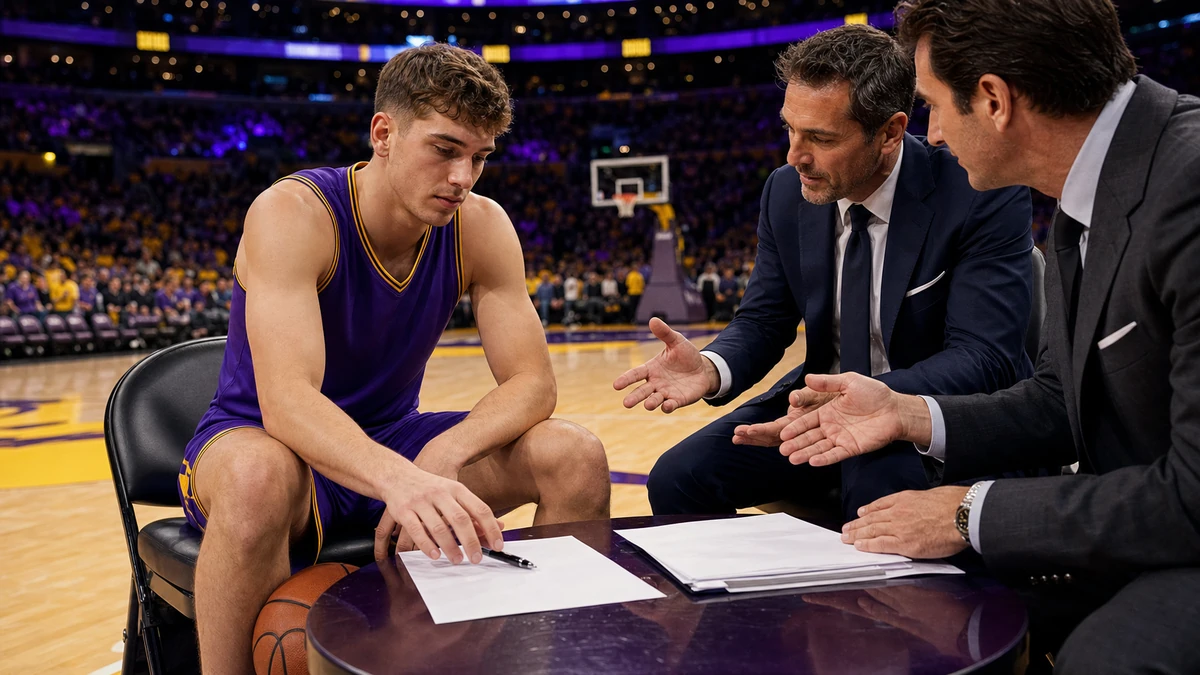
That is what makes the latest reporting around Reaves so striking. According to reports cited by The Associated Press and other outlets, the Los Angeles Lakers guard is expected to decline a player option worth $14.9 million for the 2026-27 season and move toward a new four-year contract worth $185 million. The deal has been described as imminent, not yet fully completed, but even at that stage it represents a remarkable shift in how Reaves is viewed inside one of the most scrutinized franchises in American sports.
For American fans, the Lakers are not just another NBA team. They are more like the Yankees, Cowboys or Dodgers of pro basketball: glamorous, polarizing, rich in history and permanently under a microscope. Every roster move becomes a national debate. Every role player can become a meme, a scapegoat or, in rare cases, a folk hero. For an undrafted guard to arrive in that environment and develop into a player on the verge of a contract worth $185 million is not just a basketball transaction. It is a statement about trust, performance and persistence in one of the harshest spotlight environments in sports.
Reaves’ story also travels well beyond Los Angeles. It resonates because it challenges one of the most entrenched ideas in modern sports: that early projections determine long-term worth. In college admissions, Wall Street recruiting and pro sports alike, Americans are used to systems that sort people early and often. Reaves has built a career that argues those judgments can be badly incomplete.
That broader theme helps explain why this development has drawn such attention internationally, including in South Korea, where NBA coverage remains robust and where stories of perseverance and underdog success often generate an especially strong response. But even without that global layer, the central appeal is easy to understand for any U.S. reader. A player who entered the league through the side door now appears to be cashing in like a franchise pillar.
Why declining a $14.9 million option matters
The most eye-catching figure in this story is the reported $185 million total, but the more revealing detail may be the choice to walk away from guaranteed money in the short term. Reaves reportedly is set to decline a $14.9 million player option for the 2026-27 season. For fans who do not follow NBA contract language closely, a player option is a clause that allows the player, not the team, to decide whether to stay under the current deal for that season.
Turning down an option like that does not mean rejecting money outright so much as betting that a much larger and longer commitment is available. It is the kind of move players make when both sides believe the relationship has outgrown the old contract. In plain English, it signals that Reaves is no longer being paid like a useful supporting piece. He is now being valued like a major part of the Lakers’ future.
That distinction is important. The NBA salary structure is full of tiers, and contracts often function as public declarations of status. Max deals belong to superstars. Midlevel contracts are for rotation players. Rookie-scale deals are for young prospects still proving themselves. When a team lines up a four-year commitment at this reported level, it is effectively saying the player has moved into a different class of organizational importance.
For the Lakers, the message would be especially clear. This is a franchise that has historically been associated with acquiring established stars, from Wilt Chamberlain and Kareem Abdul-Jabbar to Shaquille O’Neal, LeBron James and Anthony Davis. Homegrown success stories have existed, but they are not always the first image that comes to mind when Americans think about the Lakers. If the team finalizes this deal, it would amount to a major vote of confidence in a player it helped discover, shape and elevate.
There is also an element of mutual loyalty built into the story. Reaves could have allowed his path toward free agency to create greater uncertainty, but the reporting suggests he and the Lakers are instead moving toward a long-term alignment. In a league where fans often talk about player movement with the same language used for stock trades, a choice like this still carries emotional weight. It says both player and franchise see more value in continuity than in testing every possible market scenario.
The numbers behind the breakout
Sentiment alone does not produce a contract of this size. Reaves’ case rests on performance, and the reported figures from the 2025-26 season help explain why the Lakers appear prepared to make such a substantial investment. He averaged 23.3 points, 5.5 assists and 4.7 rebounds, numbers that place him well beyond the category of pleasant surprise.
Those statistics matter not only because of volume, but because of the kind of responsibility they imply. A player scoring more than 23 points a game while also handing out 5.5 assists is doing far more than finishing possessions. He is creating offense, reading defenses and serving as a stabilizing presence with the ball in his hands. Add nearly five rebounds per game and the profile becomes even more complete. Reaves was not simply getting hot from time to time. He was shaping games across multiple phases.
In American basketball language, Reaves has increasingly been described as a playmaker, a term that can sometimes sound vague or overused. But in this case it points to something real. A playmaker is not just someone who dribbles a lot or piles up flashy passes. It is a player who organizes chaos, makes efficient decisions and produces quality shots for himself and teammates. In the modern NBA, where possessions are dissected with film, analytics and endless social media clips, those skills are highly prized.
Reaves’ season reportedly included two injury interruptions, which makes the production stand out even more. American sports culture tends to romanticize toughness, sometimes to an unhealthy degree, but durability and recovery remain central parts of how teams evaluate players. A season in which a guard fights through injuries, returns effectively and helps lead a team into the playoffs carries weight in contract talks. It suggests not just talent, but reliability.
And then there is the issue of style. Reaves is listed at 6-foot-5, a good size for an NBA guard but not the sort of overwhelming physical package that causes scouts to overlook other questions. His value has come from craft, pace, timing and feel for the game. To many American fans, that profile has made him especially relatable. He does not fit the mold of the ultra-hyped athletic marvel. He looks more like a player who wins through reading the floor correctly one possession after another.
That does not mean his game lacks flair. Lakers fans have embraced his confidence, improvisation and willingness to attack big moments. But the reported contract would not be a reward for charisma alone. It would be the financial reflection of a player whose numbers, decision-making and year-over-year improvement have become too significant to dismiss as a feel-good anomaly.
Why the Lakers would see more than a role player
One reason this story lands so strongly is that it highlights a tension at the heart of franchise building in the NBA. Teams want stars, but they also need connective players who can think, adapt and support winning possessions night after night. Reaves increasingly appears to be both a productive scorer and one of the Lakers’ offensive connectors, the kind of guard who keeps possessions from breaking down.
That matters even more for a team like Los Angeles. The Lakers do not have the luxury of existing quietly in the middle of the standings. Their expectations are always inflated by history, celebrity and television exposure. A player who can handle pressure, contribute in the postseason chase and function as a long-term piece becomes especially valuable in that setting. Stability has a premium in Los Angeles because instability becomes front-page material almost immediately.
Reportedly, Reaves also had a path that could have led him toward unrestricted free agency after the 2025-26 season. Instead, the direction of the reporting suggests he has chosen to stay with the organization that gave him his first NBA opportunity. In a league often discussed through the lens of leverage and market timing, that element stands out. The Lakers opened the door for him when 30 teams passed on him in the draft. Now they appear ready to reward him as one of their own success stories.
For the franchise, retaining Reaves would mean holding onto more than his box-score production. It would mean keeping a player who embodies internal development, something every team says it values and not every glamour franchise is known for executing. Fans often connect deeply with stars acquired from elsewhere, but there is a different kind of affection reserved for players who rise from uncertainty inside the same uniform.
American sports audiences respond strongly to that kind of bond. It is part of why baseball fans still talk about late-round picks who became All-Stars or why NFL supporters celebrate undrafted rookies who made the roster through training camp. Reaves belongs to that tradition. The scale of this reported NBA payday simply makes the story more dramatic than usual.
The undrafted label still carries meaning in American sports
To understand why Reaves’ climb feels symbolic, it helps to understand what being undrafted means in the American sports imagination. In the NBA, only 60 players are selected in the annual draft, and those picks are treated as statements of belief. Players chosen high are marketed as future stars from the moment the commissioner calls their names. Even second-round picks often enter the league with a built-in narrative. Undrafted players do not get that ceremony. They begin with little security and often have to fight for camp invitations, two-way contracts or limited bench roles.
In practical terms, that can affect everything from guaranteed salary to developmental patience. Teams may give drafted prospects extra time to struggle because draft capital creates institutional pressure to prove a decision right. Undrafted players usually do not enjoy the same margin for error. A slow start can mean disappearing from the rotation or the league entirely.
That is why Reaves’ trajectory matters. He has not simply stayed in the NBA. He has climbed into a position where one of the league’s marquee franchises is reportedly preparing a deal worth $185 million. Stories like that remain rare enough to feel special, even in a league that regularly markets personal journeys as much as team results.
There is also a cultural layer to how this story is received abroad. In South Korea and elsewhere in Asia, sports coverage often emphasizes perseverance, discipline and the moral force of sustained self-improvement. Reaves’ rise fits that framework naturally. But it also fits comfortably within American storytelling traditions. Hollywood loves a comeback. Sports talk radio loves a chip-on-the-shoulder competitor. Reaves’ career arc intersects with both.
None of this means draft status no longer matters. It absolutely does. Top picks still get first chances, biggest expectations and, often, the widest commercial runway. What Reaves demonstrates is that the draft is a starting point, not a life sentence. Once the games begin, production can reorder the hierarchy.
That may be the most compelling lesson in the entire episode. In a sports economy obsessed with forecasting, the player who was overlooked can still force a rewrite.
A familiar American obsession: betting on the worker who proves everyone wrong
Part of the reason Reaves has connected with so many fans is that his story taps into a durable American idea: the appeal of the underestimated worker who earns respect the hard way. Whether in sports, politics or business, U.S. audiences are often drawn to people who seem to outrun the labels placed on them early. That cultural instinct helps explain why Reaves has become more than just another productive guard.
He does not arrive with the mythology of a No. 1 pick. He built credibility through repetition, improvement and moments that felt larger because they were never guaranteed. Every season he has looked more comfortable, more polished and more essential. For fans, that progression is emotionally satisfying in a way that can be different from watching a top prospect simply meet expectations.
The gap between his starting point and his current standing is the engine of the story. Here is a player who went unselected in 2021, who entered the league without the prestige that smooths the path for many young players, and who now appears on the verge of one of the richest contracts ever discussed for an undrafted NBA guard. That is the kind of before-and-after contrast that fuels documentaries, sports-radio monologues and, increasingly, international headlines.
There is also something distinctly modern about Reaves’ rise. Today’s NBA is not just watched; it is clipped, memed, debated and monetized in real time across platforms. Players develop public identities faster than ever. Reaves has managed to convert visibility into legitimacy, moving from curiosity to dependable producer to reported franchise investment. In an attention economy, that progression is not automatic. Plenty of players become briefly famous. Far fewer become this trusted.
If the deal is finalized, it will not mean the story is over. In some ways it will begin a harder chapter. Big contracts invite tougher scrutiny, especially with the Lakers, where every missed shot and every losing streak can become part of a national conversation. Reaves would no longer be judged as the surprising undrafted contributor. He would be judged as a highly paid core piece expected to deliver at scale.
But that is also the clearest sign of how far he has come. The conversation has moved from whether he belongs to whether he can help define the next phase of one of basketball’s most famous teams. Few players get that far. Even fewer begin from where Reaves did.
What comes next, and why this story resonates far beyond Los Angeles
For now, the careful wording matters. The contract has been reported as close, imminent or expected, not officially completed in the sense fans sometimes assume when they see a giant number attached to a headline. In NBA news, that distinction is important. Deals can be broadly agreed upon before every procedural step is completed, and responsible reporting leaves room for that process.
Still, the significance is already clear. If the agreement is finalized along the reported terms, Reaves will have transformed himself from an undrafted question mark into a long-term investment worth $185 million from the NBA’s most visible franchise. That would place him among the league’s standout examples of development outrunning preconception.
For the Lakers, it would also signal a strategic choice. Teams do not hand out contracts this large merely to congratulate a player for a nice story. They do it because they believe the player can continue to drive winning, absorb responsibility and justify his salary in the most competitive moments. Reaves’ reported 2025-26 production, his resilience through injuries and his multipurpose role in helping guide the Lakers to the playoffs all support that belief.
For international readers and especially fans following the NBA from Asia, the story has obvious appeal: a famous team, a giant dollar figure and a career arc that seems to reject the usual script. For American readers, the appeal is just as strong but slightly different. This is a familiar national sports myth made real again: the overlooked player who forces the establishment to change its mind.
In that sense, the reported deal is about more than cap sheets and negotiations. It is about how reputations are made and remade in public. It is about what happens when a player initially judged as expendable becomes indispensable. And it is about why fans, even in an age of nonstop transactions and cynicism, still respond to stories that feel earned.
Austin Reaves may soon have a contract that places him in a new financial stratosphere. But the reason people are paying attention is not the money alone. It is what the money says: that somewhere between draft night disappointment and playoff-level production, he changed not just his salary, but his place in the league.
Comments
Post a Comment