From YouTube Phenomenon to Streaming Franchise: How Korea’s Bebefinn Is Making a Bigger Play With Amazon Kids+
A Korean children’s brand takes its next step beyond viral video
A children’s character brand that already has the kind of online numbers most media companies can only dream about is preparing for a new test: whether internet fame can become a durable streaming franchise.
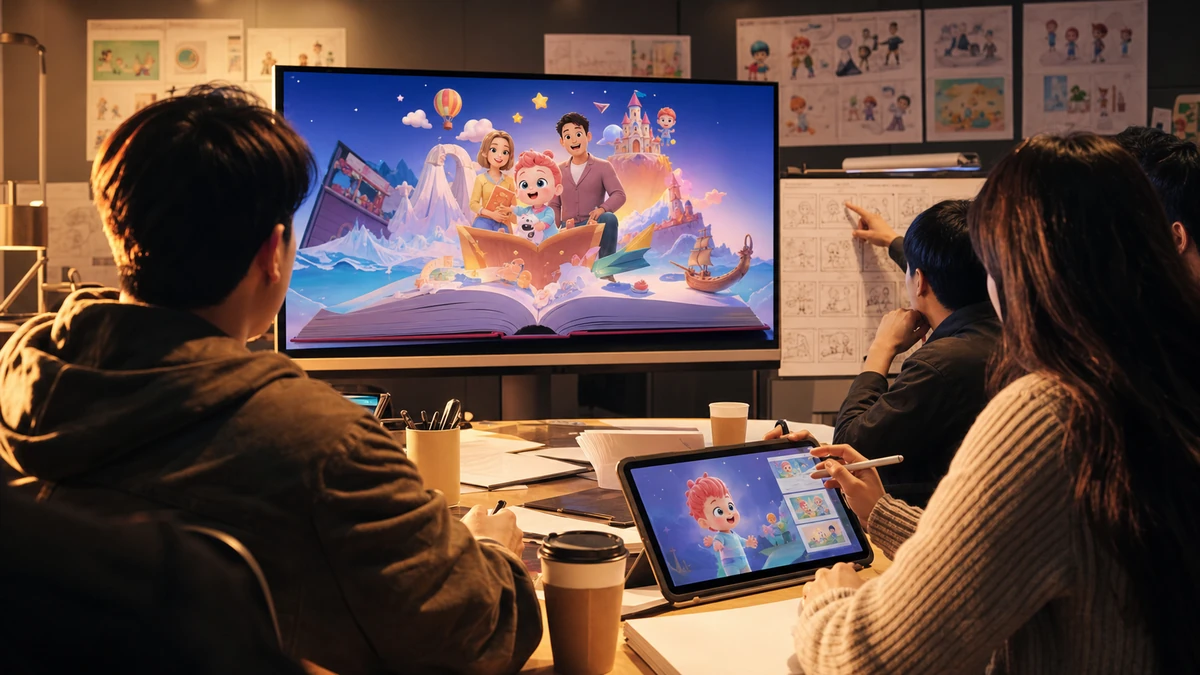
The Pinkfong Company, the South Korean entertainment firm best known globally for “Baby Shark,” said it is partnering with Amazon Kids+ to produce an original animated series built around its rising preschool property, Bebefinn. The new show, titled “The Big Book of Bebefinn,” is planned as an 18-episode musical animation series, with each episode running about seven minutes.
That may sound modest in length by the standards of prime-time television, but in the world of preschool media, seven minutes is a deliberate choice. It is long enough to tell a complete story, short enough for young attention spans, and ideal for repeat viewing — a key metric in children’s entertainment, where familiar songs, repeated routines and comforting characters often matter more than plot twists.
According to the company, the series will follow Finn, a curious young child, through ordinary childhood milestones: learning to ride a bicycle, going to the doctor, trying new foods and navigating the everyday experiences that loom large in a small child’s world. The show is designed as a musical, combining existing Bebefinn songs with newly created original tracks.
On one level, the announcement is straightforward: a popular children’s IP is getting a new show through a major global platform. But on another level, it marks something larger in the global children’s media business. It shows how a Korean-born digital property is trying to evolve from short-form, algorithm-driven popularity on YouTube into a more structured, story-based series inside a subscription platform. In media terms, that is the difference between having a hit song and building a lasting franchise.
For American parents who know Pinkfong mainly as the company behind the song that lived inescapably in living rooms, minivans and daycare classrooms, Bebefinn may be the clearest sign yet of what comes after “Baby Shark.”
Why this matters in the post-“Baby Shark” era
In the United States, “Baby Shark” is often remembered as a cultural flashpoint — one of those children’s songs that jumped from nursery staple to pop-culture punchline. It was streamed endlessly, parodied by late-night hosts, played at sports arenas and, for many parents, became shorthand for the hypnotic repetition of modern toddler entertainment.
But from the perspective of South Korea’s content industry, “Baby Shark” was something else: proof that a Korean media company could create a children’s property with truly global reach. Pinkfong was not simply exporting a song. It was exporting a system — catchy music, bright animation, character branding and platform-native distribution built for YouTube, mobile devices and international audiences.
Bebefinn appears to be the company’s next major attempt to turn that system into a broader family entertainment engine.
The Pinkfong Company says Bebefinn, first introduced in 2022, has already amassed 58 billion cumulative views on YouTube and 80 million subscribers. Those are eye-popping figures, even in a digital ecosystem where children’s content regularly generates huge volume because of autoplay, repetition and multilingual distribution. More important than the numbers themselves is what they suggest: Bebefinn is not being launched as an untested newcomer. It is entering this next stage with a large base of global familiarity.
That distinction matters. In Hollywood, studios often use box office performance, toy sales or Nielsen ratings to decide which children’s characters deserve a sequel, a spin-off or a bigger investment. In today’s global kids media market, YouTube can serve a similar function. It is less a side platform than a giant real-time audition stage. If a character can attract repeat viewers there, companies see an opportunity to stretch that popularity into subscription services, merchandise, live events and longer narrative programming.
That is effectively what is happening here. Pinkfong is taking a character ecosystem that succeeded in the fast, snackable world of digital video and asking whether it can hold attention in a more curated environment, where stories, emotional continuity and parental trust matter even more.
What Bebefinn is — and why it travels well across cultures
For readers unfamiliar with Korean children’s media, Bebefinn sits in a tradition that is both highly local and highly exportable. South Korea has become a major force in global entertainment through K-pop, television dramas and films, but children’s content is another important — if sometimes overlooked — part of the Korean Wave, or Hallyu. The term refers to the international spread of Korean culture, but it is not limited to glossy dramas or stadium-filling pop groups. It also includes animation, educational songs, toys and family entertainment designed to move easily across language barriers.
Bebefinn’s appeal rests on exactly that portability. The character became popular through songs and short episodes centered on early childhood routines, family interactions and first-time experiences. Those themes do not require much cultural translation. A toddler nervous about a doctor’s visit in Seoul is not so different from one in Seattle or suburban Atlanta. A child trying an unfamiliar food, wobbling on a bike or learning a simple lesson about behavior can be understood almost anywhere.
That universality is one reason children’s music and animation travel more easily than many live-action dramas. Dialogue matters less; rhythm, repetition and emotional cues matter more. Parents may not know Korean, but they understand structure, tone and educational intent. Kids, meanwhile, often respond before any adult has a chance to weigh in: they like the melody, the color palette, the voice, the pace.
In that sense, Bebefinn belongs to a global class of preschool properties that includes brands American audiences already know: “CoComelon,” “Bluey,” “Daniel Tiger’s Neighborhood” and “Peppa Pig,” each with its own cultural style and educational philosophy. What sets Korean content companies like Pinkfong apart is how fluently they have built for digital-first consumption. Rather than treating YouTube as a promotional outlet for television, they often build the brand there first and then expand outward.
That approach reflects both market strategy and media habit. South Korea is one of the world’s most digitally connected societies, and its entertainment companies have long been aggressive about multiplatform distribution. In kids media, that means songs engineered for replay, characters designed for immediate recognition and episodes that can function in fragments before being assembled into broader narrative worlds.
The Bebefinn-Amazon deal suggests that this approach is maturing. Instead of living mainly as clips, songs and short episodes on a free platform, Bebefinn is being developed into a more formalized series for a subscription audience.
From short-form clicks to long-form storytelling
The central business story here is not just that Amazon Kids+ is getting a new show. It is that a Korean kids brand is making what media executives would call a format expansion.
Short-form and mid-form video are excellent tools for building awareness. A catchy song can rack up hundreds of millions of views in markets where viewers have no prior connection to the characters. Short episodes also make localization easier: they can be dubbed, subtitled, clipped and redistributed across many markets with relatively low friction.
But there are limits to what short-form content can do. It can create familiarity, but it does not always build emotional depth. It can teach a simple lesson, but it may not establish character arcs. It can generate astonishing view counts, but those numbers do not automatically translate into the kind of narrative loyalty that helps a franchise endure over years.
That is why “The Big Book of Bebefinn” matters. Even at seven minutes per episode, the series format allows for a different kind of viewer relationship. A recurring structure, a library of episodes and a thematic frame — in this case, a “memory album” concept focused on moments of growth — can give parents and children a sense that they are not just watching isolated videos but participating in a broader world.
In practical terms, this is how a media property grows up. It starts by proving that children will click on it. Then it has to prove that families will return to it, trust it and perhaps build routines around it. Subscription platforms care deeply about that distinction. Viral reach may bring attention, but habitual viewing is what supports retention.
For an American audience, the closest comparison may be the path by which children’s brands move from YouTube ubiquity to streamer legitimacy. A character that begins as background entertainment on a tablet becomes, if all goes well, something parents intentionally select on the living room TV. That shift may sound subtle, but in the economics of children’s media, it is significant. Intentional viewing often brings higher platform value, greater licensing potential and a stronger case for expanding into books, toys, live shows and educational products.
Pinkfong appears to understand that. The company described the new project not simply as additional content but as a transition from YouTube-centered short- and mid-form videos to a more polished long-form narrative series. Even if each episode remains brief, the strategy is clear: move from clip-based popularity to story-based franchise building.
Why Amazon Kids+ is a meaningful partner
The involvement of Amazon Kids+ adds another layer to the story. For families in the United States, Amazon Kids+ is a subscription service that bundles books, videos, games and other children’s content into a parent-facing ecosystem. It may not dominate headlines the way Netflix or Disney+ does, but it occupies an important niche in the battle for family screen time, especially among households already using Amazon devices and services.
That makes the partnership notable for several reasons. First, it places Bebefinn inside a more curated environment aimed specifically at children and caregivers. On YouTube, discovery is wide-open and sometimes chaotic; on a subscription kids platform, the brand sits in a catalog that signals a certain level of editorial selection and platform endorsement.
Second, the deal underscores how global streaming and subscription companies are increasingly sourcing children’s content internationally. American audiences are now accustomed to seeing Korean dramas on Netflix or Japanese anime on multiple services, but preschool animation is also becoming more global. The category rewards simple emotional storytelling and musical repetition, which often travel well. For platforms, that can make imported or co-produced children’s programming a relatively efficient way to strengthen a catalog.
Third, the agreement suggests confidence in Bebefinn’s commercial viability beyond free video. Children’s brands often make the leap from ad-supported platforms to subscriptions only when executives believe the audience is sticky enough to justify investment. In other words, this is not merely a licensing afterthought. It is a vote that Bebefinn can function as a premium offering within a paid service.
At the same time, there are limits to what has been disclosed. The company announcement focused on the partnership, the production plan and the creative format. It did not provide detailed rollout information, including release timing or market-by-market availability. So while the deal is meaningful, it is still early, and many practical questions about distribution remain unanswered.
Even so, the broader takeaway is clear. For Korean media companies, success is no longer measured only by whether content crosses borders. It is measured by what kind of slot it earns once it gets there — a viral clip on an open platform, or a branded original series in a subscription ecosystem.
The storytelling strategy: everyday life, memory and music
If the business logic behind the series is easy to see, the creative logic is just as revealing. “The Big Book of Bebefinn” will center on daily experiences rather than fantasy quests or high-concept adventures. That is not a limitation. In preschool storytelling, ordinary life is often the point.
Learning to ride a bike, visiting a doctor or tasting a new food may seem small to adults, but they can feel enormous to young children. Shows built around those milestones can offer reassurance, language modeling and emotional regulation. Parents often gravitate to such programming because it gives children scripts for handling unfamiliar situations.
The “memory album” motif described by the company fits squarely within that framework. For American readers, it may help to think of it as something akin to a baby book, scrapbook or family photo album — a narrative device that turns scattered experiences into meaningful milestones. It suggests warmth, nostalgia and developmental progress, themes that play well with parents who want content that feels not only entertaining but gentle and emotionally constructive.
Music is likely to do much of the heavy lifting. In children’s media, songs are not decorative extras. They are often the engine of attention, recall and emotional connection. A strong song can transcend language, help children anticipate routines and turn an episode into something they actively request again and again.
That is one reason Pinkfong’s track record matters. The company’s expertise is not just in animation, but in combining music with character branding in ways that are unusually scalable across platforms. By mixing familiar Bebefinn songs with new original soundtracks, the series can appeal both to existing fans and to first-time viewers who encounter the brand through Amazon rather than YouTube.
It is also a smart way to bridge fandom generations within a single household. Parents who may not know every character name often still recognize a tune, and kids who respond first to songs can gradually grow attached to the narrative framework around them. In a crowded preschool market, that synergy can be powerful.
What this says about the next phase of the Korean Wave
For years, much American coverage of South Korea’s cultural influence has focused on K-pop superstars, Oscar-winning films and prestige streaming dramas. That attention is understandable, but it can obscure a broader reality: South Korean companies have become increasingly sophisticated at creating global intellectual property across age groups, genres and platforms.
Children’s media is a telling example because it reveals a different side of cultural export. Unlike adult dramas, preschool properties do not rely heavily on national specificity or subtitles to travel. Their success depends on something more fundamental: whether creators can package rhythm, repetition, emotional clarity and visual identity in ways that cross borders almost automatically.
Pinkfong has been one of the clearest success stories in that space, and Bebefinn may be its next major test case. If “Baby Shark” was the proof of concept that Korean kids content could break through worldwide, Bebefinn may be the proof that a second-generation property can be built into a fuller entertainment ecosystem rather than a single breakout sensation.
That matters not just for one company, but for the broader Korean content industry. In the language of media business, the goal is not simply awareness but premium IP — intellectual property that can sustain stories, songs, spin-offs, merchandise and long-term licensing value. The Pinkfong Company has explicitly framed Bebefinn in those terms, as a next-generation global property with room to grow.
From an American vantage point, this is also a reminder that the future of children’s entertainment is likely to be more international than many parents realize. A preschool hit no longer has to originate from Hollywood, PBS or a British animation studio to become part of a U.S. family’s daily routine. It can begin in Seoul, explode on YouTube, move into a subscription platform and eventually arrive in American homes with the same familiarity as any domestic brand.
That does not mean every viral children’s character becomes a lasting franchise. Many do not. But the Bebefinn announcement shows the playbook: build digital reach first, establish musical recognition, create trust with families, then expand into longer-form storytelling through a major platform partner.
Whether “The Big Book of Bebefinn” becomes the next staple of preschool viewing remains to be seen. But the strategic significance is already visible. A Korean children’s brand that mastered the language of the internet is now trying to master the language of franchise storytelling. In the increasingly borderless business of family entertainment, that may be exactly what comes after viral fame.
Comments
Post a Comment