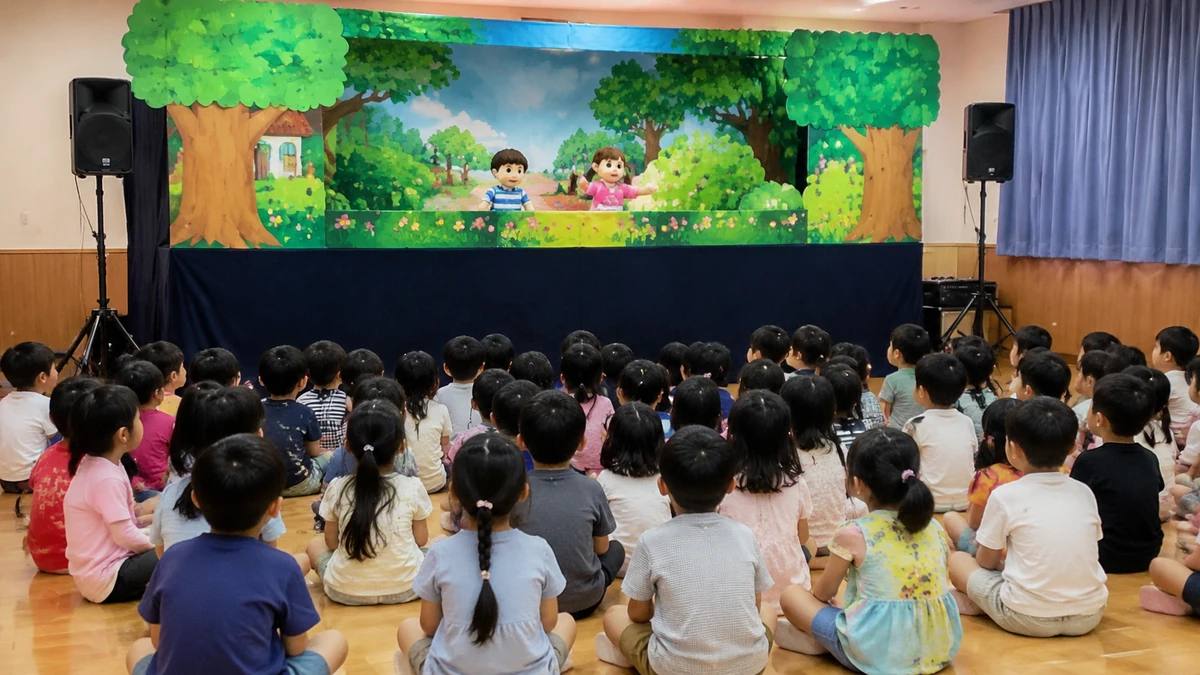
A neighborhood health lesson with a serious purpose
In one corner of Seoul, public health officials are taking on an old and still dangerous disease with a tool more commonly associated with story hour than epidemiology: a puppet show.
The Yeongdeungpo district government in South Korea’s capital said it is launching a traveling tuberculosis prevention program for about 110 children at six kindergartens, using professional puppeteers to teach preschoolers how to cover coughs, wash their hands properly and practice basic health habits in shared spaces. The performances are designed for very young children, who are unlikely to understand a lecture on infectious disease but can follow a story, copy a character’s actions and remember a repeated routine.
For American readers, the idea may sound a little unusual at first — local government using a children’s theater troupe to explain disease prevention. But it reflects a broader approach common in South Korea, where district-level governments often play a hands-on role in everyday public health, from vaccination outreach to health screenings to neighborhood education campaigns. In this case, the message is simple: the earliest lessons children learn about daily habits can shape how well they protect themselves and others later on.
That message may resonate well beyond Seoul. Tuberculosis, often abbreviated as TB, can sound to many Americans like a disease from another era, more likely to appear in black-and-white history books than in current school health materials. Yet TB remains a global public health challenge, and health officials around the world continue to stress the importance of early awareness, especially in environments where children spend long hours together indoors.
What Yeongdeungpo is attempting is not a high-budget medical intervention or a sweeping national campaign. It is something smaller and more local: taking a difficult concept — airborne disease prevention — and translating it into behaviors a 4- or 5-year-old can actually practice.
Why teach tuberculosis prevention to preschoolers?
South Korean officials say the answer starts with vulnerability. Infants and young children have developing immune systems, making them more susceptible to infections and, in some cases, more at risk of severe illness if they do become infected. That does not mean every child faces a crisis, or that officials are trying to alarm families. It means that health educators see early childhood as a critical time to build habits before illness ever enters the picture.
Public health experts have long known that teaching children about disease prevention is a balancing act. Move too far in one direction, and the message becomes frightening, abstract or developmentally inappropriate. Move too far in the other, and the guidance becomes so vague that it never turns into action. Preschool-age children usually do not respond to statistics, and they are not likely to retain detailed explanations about how bacteria travel through the air. They do respond to routines, repetition, visual cues and stories.
That is what makes the Yeongdeungpo program notable. Instead of asking children to absorb medical facts, it asks them to practice concrete behaviors: what to do when coughing, when to wash hands, how to behave in a classroom where everyone shares air, toys and space. In other words, the district is trying to make prevention visible and repeatable.
In the United States, similar logic often shows up in school-based lessons about covering sneezes, using tissues, staying home when sick and washing hands before meals. American parents are especially familiar with those messages after the COVID-19 pandemic, when phrases like “respiratory etiquette” and “shared indoor spaces” entered everyday conversation. South Korea’s kindergarten puppet initiative draws from the same underlying principle: public health works best when it becomes a habit rather than a warning.
The focus on TB adds another layer. Tuberculosis is spread through the air, typically when a person with active TB disease in the lungs or throat coughs, speaks or otherwise releases bacteria into the air. That makes cough etiquette and attention to respiratory behavior especially important in educational messaging, even when the audience is too young to understand the disease itself in adult terms. Officials are not expecting preschoolers to master microbiology. They are trying to help them learn, in age-appropriate ways, that how they breathe, cough and interact with others matters.
A local Korean approach to public health
To understand why this story matters in South Korea, it helps to understand how local government works there. Seoul is divided into districts, known as “gu,” that function somewhat like boroughs or local municipalities. Yeongdeungpo, in southwest Seoul, is one of those districts. It is a dense, urban area where district offices do far more than zoning or sanitation. They often serve as direct points of contact for public health services, community programming and family support.
That local administrative culture helps explain the “traveling” nature of this program. Rather than asking children to come to a clinic or public health office, the district is sending a professional puppet troupe directly into kindergartens. The strategy is practical. It lowers barriers to participation, reaches children in a familiar environment and allows teachers to reinforce the lesson afterward in daily routines. It also recognizes something educators everywhere know: children learn differently in the spaces where they already feel safe.
For Americans, a useful comparison might be a county health department partnering with preschool teachers and children’s performers to put on a mobile flu-prevention or hygiene program inside classrooms. The core idea is not especially foreign. The format is just more explicitly theatrical.
That theatrical element also speaks to a broader cultural tendency in East Asian education and public campaigns to blend instruction with performance, especially for younger children. Puppetry, songs and character-driven skits can lower the emotional temperature around difficult topics. Instead of presenting disease as a terrifying invisible threat, a puppet show can frame prevention as a series of smart, friendly actions children can take together. That matters when the goal is not just to inform, but to avoid shame or fear while still encouraging behavior change.
According to the district, the kindergarten sessions will focus on basic tuberculosis prevention guidance, including proper cough manners and handwashing. While handwashing alone is not the defining prevention measure for an airborne disease like TB, hygiene routines still play an important role in broader infection control and in the everyday health education that children can realistically practice. In a classroom, the lesson is often less about one single disease pathway than about forming a foundation of health-conscious behavior.
Why a puppet show may work better than a lecture
There is a reason children’s programming on public television, from “Sesame Street” to “Daniel Tiger’s Neighborhood,” has long relied on songs, repetition and recognizable characters to teach everything from sharing to brushing teeth. Young children learn best when information is attached to action, rhythm and story. A puppet who remembers to cover a cough is more likely to shape behavior than a poster full of adult language.
That is particularly true for a subject like tuberculosis, which carries the risk of sounding either too technical or too scary. The challenge for health educators is to explain the importance of prevention without overwhelming children with the idea of severe illness. A performance-based format offers a middle ground. It can model behavior without dramatizing danger. It can teach without turning a classroom into a clinic.
It also allows for what educators call social learning. Because the children watch together, often alongside teachers, the health message becomes communal rather than individual. A child who sees classmates laughing, copying gestures and repeating lines is more likely to join in and remember the routine later. In that sense, the puppet show is not just information delivery. It is habit rehearsal.
That distinction matters. Health communication often fails not because the facts are wrong, but because the intended audience cannot easily act on them. Adults may hear that a disease spreads through the air and understand the scientific point. A 5-year-old needs a narrower translation: cover your mouth and nose when you cough, listen to your teacher, keep clean hands and be thoughtful around other children. Those are behaviors a child can repeat the same day.
There is another practical advantage. Because the performance takes place inside the kindergarten classroom, teachers can connect the show to ordinary moments afterward: before snack time, after outdoor play, during cleanup or when reminding a child how to cough properly. The lesson does not disappear when the curtain falls. It becomes part of the daily script of school life.
That is why even a relatively small program — six kindergartens, about 110 children — can have meaning beyond its size. In preventive health, scale is not always the most important measure. A modest intervention can still matter if it is memorable, repeatable and easy for adults around the child to reinforce at home and in school.
Tuberculosis still matters, even if it feels distant
For many readers in the United States, tuberculosis occupies an unusual place in the public imagination. It is both familiar and remote — familiar because of its place in history, literature and older family stories, but remote because it is not discussed as often as influenza, COVID-19 or RSV in everyday life. In the 19th and early 20th centuries, TB was one of the world’s most feared diseases, commonly known as “consumption.” It shaped sanatorium culture, public health law and urban reform in the United States and Europe.
Today, TB is no longer the constant presence it once was in American life, but it has not disappeared. Globally, it remains a major infectious disease. That reality helps explain why health authorities in countries including South Korea continue to invest in prevention education, surveillance and early awareness. When officials in Seoul choose to teach children basic anti-TB habits, they are responding not to nostalgia for old public health campaigns but to a disease that still requires attention.
The Yeongdeungpo program also underscores a broader lesson sharpened by the pandemic years: the most important health messages are not always the most technologically sophisticated ones. In an era dominated by biotech breakthroughs, wearable health devices and algorithm-driven wellness advice, officials are returning to something more basic — the shared social behaviors that shape transmission risk in classrooms, buses, homes and workplaces.
That idea is broadly understandable in the American context. U.S. schools and pediatricians routinely emphasize practices that sound simple but carry real public health value: hand hygiene, covering coughs, recognizing symptoms and creating routines that families can repeat. South Korea’s district-level puppet program belongs to that same family of prevention thinking. Its language may be local, but its logic is global.
Importantly, the district’s announcement does not suggest a dramatic new outbreak or a sweeping expansion plan. The story here is narrower and, in some ways, more telling than a crisis headline. It is about the ordinary, unglamorous work of public health — the kind that tries to prevent problems before they become emergencies. In journalism, those stories can be easy to overlook because they lack the spectacle of a hospital surge or political showdown. But in many communities, that quiet preventive work is where health systems either build resilience or fail to do so.
What this says about post-pandemic health education
If there is a broader takeaway from this small Seoul program, it is that public health education is increasingly moving away from one-way instruction and toward embedded, everyday learning. Rather than waiting until illness appears, officials are trying to make prevention part of the environments where children already live and learn.
That shift feels especially relevant after COVID-19, when families around the world were reminded that disease prevention often depends on ordinary acts that can seem almost too small to mention — staying aware of symptoms, respecting shared air, practicing good hygiene and normalizing protective behavior without turning it into panic. The Yeongdeungpo initiative reflects that sensibility. It does not treat health education as a special event detached from daily life. It brings the lesson directly into the classroom and presents it in a form children can absorb.
For South Korea, that approach also fits a wider pattern in civic administration. Local governments there frequently deliver highly targeted, practical programs aimed at specific age groups or neighborhoods. The idea is less about mass persuasion than about tailored contact. In this case, the audience is preschoolers, the setting is their kindergarten and the messenger is not a doctor in a white coat but a puppet character who can make a room full of children pay attention.
There is also a subtle but important democratic aspect to that kind of outreach. By bringing public health into a normal educational setting, officials signal that prevention is not only the job of hospitals or specialists. It belongs to the whole community — teachers, parents, local administrators and children themselves, each at an age-appropriate level. That message may be especially powerful in early childhood, when ideas about care, responsibility and group behavior are still forming.
Yeongdeungpo District Mayor Choi Ho-kwon said it is important for children to learn proper daily habits and infectious disease prevention rules from an early age, expressing hope that the puppet-show lessons will help support lifelong health. That may sound aspirational, but it also gets at a core public health truth: habits learned early often outlast the campaign that introduced them.
A small classroom, a universal lesson
At one level, this is a very local Korean story: a district office in Seoul, six kindergartens, about 110 children and a traveling puppet troupe. But it points to something much bigger and more universal. Communities everywhere face the same basic question when it comes to children and public health: how do you teach prevention in a way that is accurate, calm and actually usable?
Yeongdeungpo’s answer is to start small and speak a child’s language. Do not begin with frightening medical terminology. Begin with behavior. Begin with a story. Begin with a classroom where a child can watch a character model what to do, laugh, imitate the action and then repeat it later with a teacher, a parent or a sibling.
That may be the most enduring part of the story. The global conversation about health often gravitates toward breakthroughs, crises and policy fights. Yet many of the most consequential public health gains come from quieter moments — a vaccination explained clearly, a teacher reinforcing a routine, a parent repeating a lesson at home, a child learning that caring for others can start with how they cough or when they wash their hands.
In that sense, the puppet show in Seoul is doing more than teaching tuberculosis prevention. It is illustrating a principle that would make sense in any American preschool, pediatric clinic or school district: health information matters most when people can act on it. For young children, action begins not with abstraction, but with habits simple enough to practice and stories vivid enough to remember.
That is the public health lesson coming out of Yeongdeungpo this week. Not every meaningful health intervention arrives with new medicine or dramatic numbers. Sometimes it arrives in a kindergarten classroom, carried by a puppet, asking children to learn the smallest acts of care before they are old enough to understand just how important those acts can be.
Comments
Post a Comment