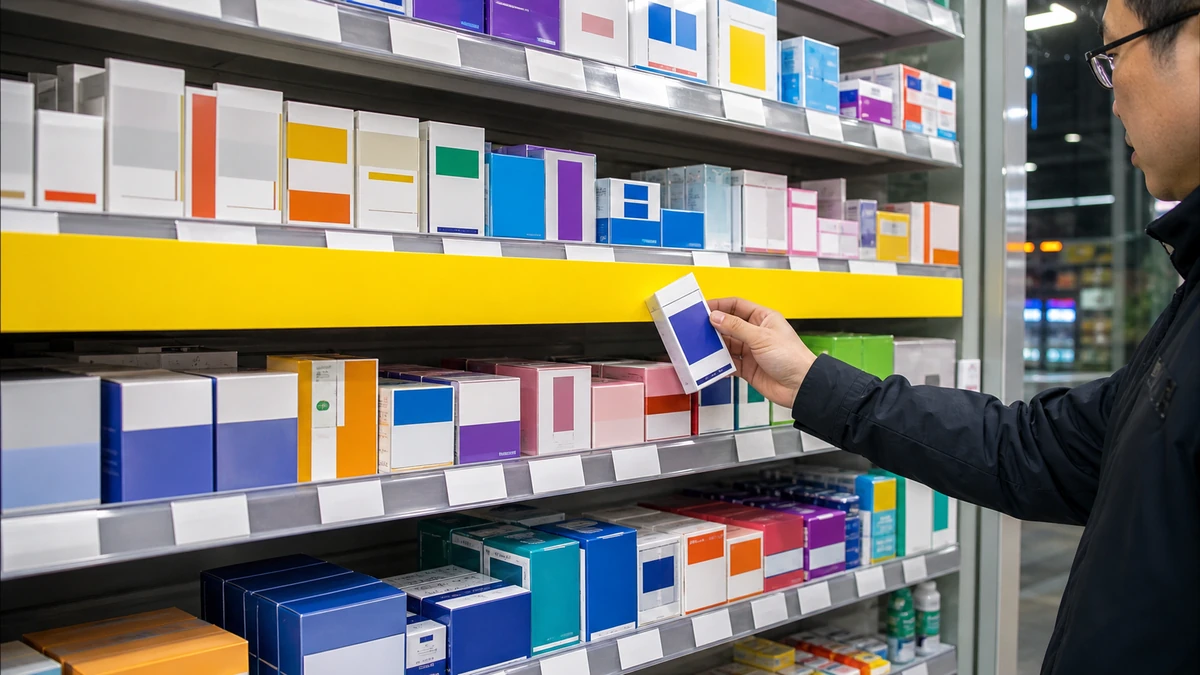
Aisles of snacks — and a stopgap for headaches
In the United States, many people have had some version of the same late-night problem: a splitting headache after the pharmacy has closed, a child with a fever at 2 a.m., or sudden indigestion when the nearest 24-hour drugstore is miles away. In South Korea, a growing share of those moments are being handled not at a hospital or a pharmacy, but at the neighborhood convenience store.
New sales figures from CU, one of South Korea’s largest convenience store chains, offer a revealing window into how that system works. According to industry data cited by Yonhap News, 50.5% of CU’s sales of so-called “safe over-the-counter emergency medicines” from January through May took place between 9 p.m. and 5 a.m. In other words, more than half of these basic medicine purchases happened after most pharmacies were closed and while much of the formal health care system was effectively off the clock.
That number helps explain something essential about daily life in South Korea: the convenience store is not just a place to grab instant noodles, bottled coffee or a subway transit card top-up. It is part of the country’s everyday urban infrastructure — as familiar and ubiquitous in Korean neighborhoods as a gas station mini-mart might be in many parts of America, but often much denser, more walkable and more deeply embedded in residential life. Increasingly, it is also filling a narrow but important gap in health access.
The medicines in question are limited. They are not prescription drugs, and they do not replace doctors, clinics or pharmacies. In Korea, the category refers to a restricted set of basic emergency-use medications that can legally be sold in convenience stores. Think pain relievers, digestive aids and other common remedies for mild symptoms that need quick attention but not necessarily a trip to the emergency room. For American readers, the rough analogy is not a full pharmacy counter at CVS or Walgreens, but a more tightly controlled retail backup system designed for those in-between hours when people still get sick even if the medical system is closed.
The significance of the CU numbers is not that Koreans suddenly discovered convenience stores. It is that the sales pattern shows how strongly consumers rely on them at night and on weekends — the exact times when access to pharmacies becomes harder. That, in turn, is fueling a broader conversation in South Korea about health access, consumer safety and whether convenience-store medicine should be viewed not just as retail, but as a small piece of the social safety net.
What the numbers say about life after pharmacy hours
The CU breakdown is striking. Of all convenience-store medicine sales tracked in the first five months of the year, 33.3% happened between 9 p.m. and 1 a.m., while 17.2% took place between 1 a.m. and 5 a.m. Those are not fringe hours. They represent the period when many people are getting home from work, winding down after dinner, caring for children, studying late, or working overnight shifts.
Seen another way, the data shows that the core demand for these items is not during the normal daytime shopping window. It is concentrated precisely when formal access points are reduced. That matters because it challenges the idea that these products are simply impulse purchases tossed into a basket with drinks and snacks. Instead, the timing suggests a more purposeful use: people are turning to convenience stores when they have an immediate, low-level health problem and few alternatives nearby.
The pattern is not limited to one chain. GS25, another major South Korean convenience-store brand, reported a similar trend in previous data, with 45.3% of its sales of emergency-use medicines occurring between 6 p.m. and midnight last year. Put the two chains together and a broader picture emerges. This is not just a quirk of one retailer or one neighborhood. It appears to reflect a structural feature of the Korean convenience-store medicine market.
For Americans, it may be helpful to compare this to the way urgent care centers, 24-hour pharmacies and grocery-store medicine aisles work as backup systems in the U.S. But South Korea’s version is distinct. The country’s convenience stores are often clustered near apartment complexes, office districts, train stations and side streets, making them more accessible on foot than many suburban American retail models. The result is a type of late-night support network that is commercial, highly localized and deeply responsive to daily routines.
None of this means that convenience stores are replacing pharmacies. Rather, they are stepping into a time gap. The sales figures make visible a simple reality that health policymakers everywhere sometimes overlook: mild medical needs do not obey business hours. Headaches, upset stomachs and fevers show up late at night, on Sundays and during holiday weekends. The question is whether a society offers a safe, practical response short of the emergency room.
Weekend demand exposes a familiar health care gap
If the late-night numbers tell one story, the weekend figures tell another. According to the data cited in the Korean report, Sunday accounted for 23.2% of CU’s convenience-store emergency medicine sales, while Saturday made up 21.3%. That means nearly half of these purchases were concentrated over the weekend, when many pharmacies are closed or operate on shorter hours.
This part of the story will sound familiar to many Americans. In the U.S., access to basic care often becomes harder outside the standard workweek, especially in smaller towns or neighborhoods without 24-hour pharmacy options. South Korea’s medical system is very different from America’s in many ways, including insurance coverage and urban density, but the underlying problem is recognizable: people still need basic relief when the normal system is less available.
The weekend pattern also reflects the rhythms of modern Korean life. South Korea has one of the world’s most urbanized populations, and many households are juggling long work hours, long commutes, shift work and dual-income schedules. Single-person households have grown steadily, a demographic change that often means more people managing minor illnesses alone, without a partner or family member available to run errands or offer help. If a person realizes at 10 p.m. on a Sunday that they need something for a headache or digestive trouble, the nearest convenience store may be the only realistic option.
That helps explain why the discussion in South Korea has moved beyond pure sales data. Supporters of broader convenience-store access to emergency medicines argue that the issue is partly about welfare in the broad sense — not government payments, but the public’s ability to meet basic daily needs safely and affordably. The argument is that when pharmacies are closed, some baseline level of medicine access should still exist.
At the same time, critics and health experts are careful to draw limits. Convenience stores are not staffed like pharmacies. There is no pharmacist on hand to explain drug interactions, check symptoms or advise consumers with chronic conditions. So while higher weekend demand underscores the access gap, it also sharpens the need for caution. The more these stores serve as backup health providers, the more important clear labeling, dosage instructions and public education become.
That tension — access versus oversight — is not unique to Korea. It echoes a familiar American debate over what should be available outside traditional medical settings and how much responsibility should fall on consumers to use those products correctly. Korea’s convenience-store medicine system offers one answer, but also raises some of the same questions the U.S. continues to grapple with.
Why convenience stores matter so much in South Korea
To understand why these sales numbers matter, it helps to understand the role convenience stores play in South Korea. In the U.S., convenience stores are often associated with highways, gas stations and quick stops by car. In South Korea, especially in big cities such as Seoul, Incheon and Busan, convenience stores are more integrated into the daily fabric of neighborhood life. They are everywhere: tucked under apartment towers, beside office buildings, near subway exits and on dense commercial streets.
They also do far more than sell snacks. Depending on the location, a Korean convenience store can function as a place to pick up packages, print documents, pay bills, withdraw cash, buy a quick meal, recharge transit cards or sit down for a late-night cup of instant ramen. For students, night-shift workers and people living alone, they are often an extension of home life. That makes them an intuitive place to turn when a minor health problem pops up after hours.
In that sense, the medicine data reflects something broader than consumer demand. It reflects the way South Korea has built dense, hyper-accessible commercial infrastructure that can be repurposed to support everyday needs. Americans may think of public infrastructure as roads, bridges and hospitals. In Korea, part of the lived infrastructure of urban life also includes private retail networks that are so widespread and predictable that they serve near-public functions.
This is one reason the Korean discussion has taken on a policy dimension. When a convenience-store chain’s medicine sales are heavily concentrated overnight and on weekends, it suggests those stores are doing something more socially significant than moving inventory. They are filling a health-access gap created by real work schedules, pharmacy hours and living arrangements. The policy question then becomes whether that role should be expanded, more carefully regulated, or both.
For foreign readers, particularly Americans, it is important not to overstate the concept. Korea is not turning convenience clerks into pharmacists. The medicines sold in stores remain limited, and serious symptoms still require professional medical care. But the Korean model is noteworthy because it treats basic medicine access as something that can be distributed through an already existing neighborhood network. In a country where convenience stores are abundant and often open around the clock, that network is difficult to ignore.
It also speaks to a larger feature of Korean society that outsiders often notice first in sectors like food delivery and transit: speed and proximity matter. South Korean consumers are accustomed to solving practical problems quickly and close to home. Convenience-store medicine fits neatly into that broader ecosystem of immediate access.
Access is only half the story. Safety is the other half.
The strongest argument in favor of convenience-store medicine is straightforward: it gives people a practical option when pharmacies are closed. But the strongest caution is just as clear: medicine is not the same as instant noodles or batteries, and easier access can come with real risks if people misunderstand what they are taking.
That is why the Korean debate has increasingly focused not just on whether more products should be sold, but on how to ensure they are used safely. In a pharmacy, consumers can ask questions. They can mention an allergy, a pregnancy, a child’s age or another medication they are already taking. In a convenience store, that layer of professional screening is largely absent. The burden shifts to packaging, instructions and the customer’s own judgment.
That matters particularly at night, when people may be tired, stressed or buying medicine for someone else. A parent dealing with a feverish child at midnight or a shift worker grabbing a digestive remedy after a long day may not be in the best position to parse fine print. The more central convenience stores become to off-hours health access, the more pressure there is to make labels easy to read and warnings impossible to miss.
For American readers, this concern mirrors long-running public health conversations at home. Over-the-counter drugs are widely available in the U.S., but misuse still happens. Consumers may double-dose similar ingredients, ignore age restrictions or fail to recognize when a symptom needs a doctor, not a drugstore shelf. Korea’s convenience-store model solves one problem — access — while leaving intact the universal challenge of consumer education.
There is also a broader ethical question behind the discussion. When people buy medicine at convenience stores late at night, is that a sign of empowerment or a sign that the formal health system is not available enough? The answer may be both. A convenience store can offer quick relief, but it can also highlight the limits of after-hours care in ordinary life. Policymakers have to decide whether retail accessibility should be viewed as a supplement to the health system or a pressure valve compensating for its blind spots.
The data from CU and GS25 does not settle that debate. What it does provide is hard evidence that these purchases are not random. They follow a pattern shaped by time, work, household structure and the operating hours of other institutions. That makes the safety question more urgent, not less. If this is now part of how people manage minor illness, then the system around it has to be designed with that reality in mind.
A Korean model with lessons beyond Korea
The story here is bigger than one country’s convenience-store industry. It points to a question that many developed societies are wrestling with: how do you make basic health care tools available at the exact moments people need them most, especially outside traditional office hours?
South Korea’s answer is shaped by its own geography and culture. Dense cities, walkable neighborhoods, strong convenience-store networks and long, often demanding work schedules have produced a retail environment that can absorb some low-level health needs after dark. For older adults, people living alone, overnight workers and those whose schedules do not line up neatly with pharmacy hours, that can make a meaningful difference.
There are obvious limits. A convenience-store pain reliever is not a substitute for a diagnosis. A digestive aid cannot replace a doctor’s visit if symptoms persist. And a broad retail network does not erase inequalities in health care access or solve the deeper problem of why off-hours care is hard to reach in the first place. But for mild, immediate needs, the Korean system appears to offer something valuable: a nearby, familiar, low-friction point of access.
That may be why the story resonates beyond Korea. In the U.S., where pharmacy deserts have become a growing concern and 24-hour retail options have shrunk in some communities, the Korean experience may prompt a practical question. If modern life keeps pushing more people into nontraditional schedules, should basic medicine access be redesigned around those schedules too?
Korea’s model is not plug-and-play for America. The two countries differ in regulation, urban design, health care structure and consumer habits. Still, the underlying insight travels well. Health access is not just about insurance cards, hospitals and prescription coverage. It is also about whether someone can get a safe, basic remedy at 11 p.m. on a Sunday without extraordinary effort.
The CU figures make that reality visible in a way policy papers often do not. More than half of its convenience-store medicine sales are happening between 9 p.m. and 5 a.m. That is not merely a retail trend. It is a map of when people feel the health system recede — and where they turn when it does.
For South Korea, the convenience store has become part of the answer. Not the whole answer, and not a flawless one, but a distinctly Korean response to a universal problem: illness does not keep office hours. The challenge now is making sure the ease of access that helps consumers in the middle of the night is matched by enough safeguards to keep that help truly safe.
Comments
Post a Comment