Jeju City Expands a Forest Park Around a Waterfall, Turning Climate Policy Into a Place People Can Actually Use
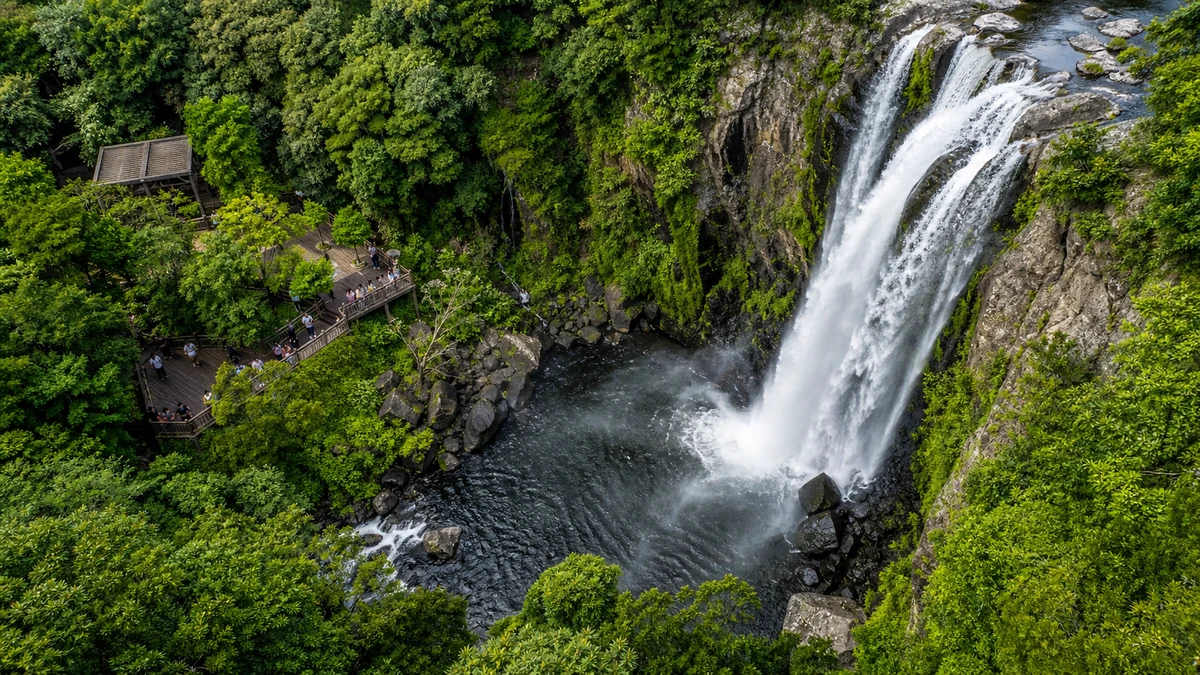
A South Korean island city is betting on trees, shade and walking paths
On South Korea’s Jeju Island, a city best known to many foreign visitors for volcanic landscapes, seaside cliffs and package tours, local officials are moving ahead with a public-works project that is at once practical, symbolic and increasingly global in its logic. Seogwipo, the island’s southern city, said it is launching the second phase of a climate-responsive urban forest project tied to Eongtto Falls, a waterfall and scenic area that already draws attention for its natural beauty.
The plan, announced by the city, is more than a beautification effort. Officials say the project is meant to expand carbon-absorbing green space while also giving residents and visitors a more usable place to walk, rest and spend time outdoors. In a period when cities from Los Angeles to Atlanta to Seoul are talking more urgently about extreme heat, livability and resilience, Seogwipo’s proposal reflects a broader shift in how local governments think about parks and public landscapes. Trees are not just trees anymore. They are shade infrastructure, tourism infrastructure, health infrastructure and climate infrastructure all at once.
Under the second phase, the city plans to invest about 2 billion won, or roughly the equivalent of $1.4 million, in a 2-hectare site, about 5 acres. Half of that funding comes from South Korea’s national government through a Forestry Service subsidy program. The city says it will plant some 180,000 carbon-storing trees, build a waterfall observatory, add a pergola and create about 1.5 kilometers, or just under a mile, of walking trails.
On paper, those details may sound like the kind of local planning memo that rarely travels far beyond city hall. But the project is notable because it captures a larger trend in South Korea: climate adaptation and quality-of-life improvements are increasingly being fused into the same civic agenda. It also offers a window into how Jeju, one of the country’s most recognizable travel destinations, is trying to evolve beyond postcard scenery into a place where nature is woven more deliberately into daily urban life.
For American readers, one way to think about it is as a hybrid of a city park upgrade, a climate resilience project and a tourism redesign. Imagine a local government taking a well-known natural landmark, then building out the surrounding landscape so it functions less like a quick photo stop and more like a destination where people linger — a little like turning the area around a scenic overlook into something closer to an urban greenway, botanical park and public commons rolled into one.
What “climate-responsive urban forest” means in the Korean context
The phrase South Korean officials use for this type of project — “climate-responsive urban forest” — can sound bureaucratic in English. But the idea behind it is fairly straightforward. Local governments create or expand tree-filled public spaces that can help absorb carbon, moderate heat, improve air quality and offer accessible outdoor recreation in places where people actually live, work or travel.
In the United States, city tree-planting campaigns are often discussed in terms of canopy coverage, stormwater management or environmental justice. In South Korea, the concept has a slightly different rhythm because of how densely developed many cities are and how intensively public land is planned. Urban forests are often designed not as remote woodlands but as carefully structured spaces where walking, resting and sightseeing are integral to the environmental mission.
That helps explain why Seogwipo’s announcement puts equal emphasis on tree planting and visitor amenities. The city is not simply trying to increase green acreage on a map. It is trying to create a place where people will return regularly. That matters because a park that is technically “green” but functionally empty does less for civic life than one that becomes part of a neighborhood’s routine.
In this case, the “climate-responsive” label and the “urban forest” label are inseparable. Officials want a site that can do environmental work in the background while also serving as a visible, tangible public amenity. In other words, the project is designed to make climate policy feel less abstract. Instead of asking residents to imagine carbon reduction in the form of regulations or long-range national targets, it offers something immediate: cooler shade, a better path, a view of the falls, a place to stop and breathe.
That blending of purposes is increasingly common in South Korea, where public officials often frame green projects in terms of both sustainability and everyday convenience. It reflects a policy culture that tends to favor visible implementation — not just goals, but built spaces people can point to, use and evaluate in their day-to-day lives.
Jeju is famous for scenery. This project asks what that scenery is for.
To understand why this project matters, it helps to understand Jeju’s place in South Korea. Jeju Island is often compared, loosely and imperfectly, to Hawaii in the American imagination: a place associated with honeymoons, dramatic natural landscapes, tourism and an identity somewhat distinct from the mainland. The comparison has limits — Jeju has its own language traditions, history and political context — but it offers a useful starting point for readers unfamiliar with Korea.
Seogwipo, on the island’s southern side, is one of Jeju’s main cities and is closely associated with some of the island’s best-known natural attractions. Eongtto Falls is part of that image. Like many scenic sites in Korea, it carries value not only as an environmental asset but also as a place layered with local identity, tourism appeal and everyday civic meaning. A waterfall is not just a waterfall; it is part of how a city imagines itself and presents itself to outsiders.
What is changing in Seogwipo’s approach is the idea that a scenic landmark should not function only as something visitors briefly “see.” The city wants to transform the area into a place people “stay.” That distinction is important. Tourism planners around the world increasingly talk about “dwell time,” meaning how long visitors remain in an area, how fully they experience it and how likely they are to spend money, return or form a lasting impression. Seogwipo’s project speaks directly to that logic.
Instead of treating Eongtto Falls as a single-view attraction — arrive, take a picture, leave — the city is building the connective tissue around it. Trails create movement. A pergola creates a stopping point. A viewing platform organizes perspective. The trees themselves create a changing seasonal atmosphere that can make the site feel different in spring, summer and fall. In effect, the forest becomes part of the attraction, not just the backdrop to it.
For a place like Jeju, where natural beauty has long been central to the economy, this is a subtle but meaningful shift. The question is no longer only how to market scenery, but how to structure an experience around it. That may sound like tourism strategy, but it is also urban planning. When done well, the same improvements that make a place more appealing to travelers can also make it more useful to residents who simply want somewhere pleasant to walk on a weekday evening.
From phase one to phase two, a local green project gets bigger and more intentional
The second phase does not begin from scratch. According to the city, the first phase was completed last year at a cost of 2.5 billion won, with the national government again covering half. During that earlier stage, Seogwipo planted more than 16,000 trees and added facilities including walking paths, a lawn plaza and a pavilion.
That first stage appears to have established the basic framework of the park: green coverage, circulation routes and a set of public-use features that made the area more than undeveloped land. The second phase is more directly tied to Eongtto Falls itself and is intended to strengthen the connection between the existing urban forest and the waterfall landscape.
Seen together, the two phases represent the kind of incremental public investment that often shapes city life more effectively than one-off megaprojects. There is no signature tower here, no convention center, no giant entertainment complex. Instead, the city is layering improvements over time, building out a piece of green infrastructure that is meant to become more coherent and more inviting as each phase is completed.
That matters because accessibility and usability often determine whether public nature spaces succeed. A wooded area can look impressive from an aerial photo and still fail people on the ground if it is difficult to reach, lacks shade where it is needed, offers no comfortable pause points or does not connect naturally to surrounding routes. The city’s phased approach suggests an understanding that the value of a forest in an urban or semi-urban setting is not measured by acreage alone. It is measured by how people move through it and whether they feel encouraged to return.
There is also a broader political point here. In many countries, climate spending can become contentious when residents do not see how it affects their lives. A project like this is easier to defend publicly because the benefits are legible. Even if the carbon-storage gains are long term and difficult for an ordinary resident to quantify, the path, the shade and the waterfall view are not. They are visible immediately.
The numbers tell one story. The design philosophy tells another.
The most eye-catching figure in Seogwipo’s announcement is the plan to plant roughly 180,000 carbon-storing trees. That kind of number is meant to signal seriousness about climate response, and in South Korea’s policy language, tree planting retains a strong association with ecological repair and national greening. But the raw total only tells part of the story.
The more interesting question may be how the forest is being framed. Officials are not describing a passive green buffer. They are describing a place designed around experience: walking, looking, resting and lingering. In planning terms, that is a different ambition. It assumes that environmental infrastructure works best when it is also social infrastructure.
That idea has gained traction globally as cities confront the intertwined effects of warming temperatures, public health concerns and uneven access to quality open space. A park can help with all of those things if it is built thoughtfully. Trees cool nearby areas. Paths encourage low-impact exercise. Rest structures help older visitors and families with children. Scenic views improve the emotional appeal of spending time outdoors. None of that is incidental. It is the mechanism by which a climate project becomes part of ordinary life.
In the Korean context, this approach also reflects how public landscapes are often curated with close attention to movement and atmosphere. Korean parks and walking routes frequently emphasize not just destination but sequence — what visitors see as they approach, where they pause, how the terrain opens up, what seasonal plantings create visual interest. Seogwipo’s mention of a themed forest using different trees and flowers suggests a similar sensibility. The goal is not just to preserve nature at a distance, but to orchestrate access to it.
That balancing act is not always simple. Public access can put pressure on natural sites if it is poorly managed. Building around a scenic area always raises questions about overdevelopment, maintenance and whether visitor infrastructure enhances or dilutes the landscape it is meant to celebrate. Seogwipo’s challenge will be to make the site easier to use without making it feel overly programmed or detached from the very nature that draws people there in the first place.
Why small-scale projects like this matter in the climate era
It is easy, especially from afar, to overlook a local forest project as modest compared with the scale of the climate crisis. But that would miss an important point. Much of climate adaptation ultimately happens not through dramatic global gestures but through place-specific decisions about land use, shade, water, transportation and public access.
In that sense, Seogwipo’s plan belongs to a category of climate action that is increasingly relevant worldwide: local interventions that improve environmental performance while also making daily life more tolerable and, ideally, more pleasant. Americans have seen versions of this in riverfront restorations, rail-to-trail projects, urban tree equity campaigns and cooling-corridor initiatives. The details differ, but the underlying principle is the same. If climate policy is going to endure politically, it often needs to produce spaces people can directly value.
There is also a tourism dimension that should not be underestimated. Destinations everywhere are under pressure to offer more than iconic scenery. Visitors increasingly judge places by comfort, walkability, atmosphere and the quality of public space. A beautiful site without a clear path, shade or places to pause can quickly become a frustrating one. By contrast, even relatively simple additions — a well-placed overlook, a shaded route, coherent landscaping — can dramatically improve how a place is experienced.
For Jeju, that matters because the island’s appeal has long rested on the tension between popularity and preservation. As visitor numbers grow and expectations evolve, local governments must constantly negotiate how to make natural areas accessible without flattening them into generic tourist products. Seogwipo’s urban forest project suggests one answer: build lighter, greener and more gradually, using the language of public rest and ecological function rather than spectacle.
That may prove to be one of the more durable development models for a place like Jeju. Instead of competing through larger and louder construction, it can deepen what already makes the island distinctive: landscape, pace and the feeling of stepping into a different rhythm from the mainland city.
For residents, the payoff may be as important as the tourism pitch
Though Seogwipo officials clearly see the site as part of the city’s tourism and recreation profile, the project’s local significance may be even greater. One recurring challenge in high-profile tourist destinations is that public investment can be skewed toward visitors at the expense of residents. The urban forest framing is one way of pushing back against that imbalance. By situating the project as everyday green infrastructure, the city is implicitly arguing that scenic landscapes should also function as living civic assets.
That is especially important in a city like Seogwipo, where nature is not peripheral to urban identity but central to it. The quality of walking routes, the amount of shade and the ease of reaching attractive outdoor spaces all shape how residents experience their own city. In that sense, a forest path near a waterfall is not a luxury item. It is part of the social fabric.
South Korea’s local governments have become increasingly attentive to this kind of quality-of-life planning, especially as the population ages and public demand grows for healthier, more walkable environments. A pergola or pavilion may seem minor in budget terms, but for older adults, caregivers, children and anyone spending time outdoors during warmer months, those elements affect whether a space feels welcoming or exhausting. The same is true of trail design. A path is not merely a route; it is an invitation.
If the project succeeds, its long-term value may lie in repetition. The real test of an urban forest is not whether it photographs well on opening day but whether people fold it into routine: a morning walk, a weekend family outing, a stop after work, a place to bring visiting relatives. When that happens, climate infrastructure stops being a technical term and starts becoming part of the local commons.
Seogwipo says that once the second phase is complete, the total project cost will reach 4.5 billion won, combining the 2.5 billion won from phase one and the 2 billion won now being invested. For a city-scale project, that is a meaningful commitment but not an extravagant one. Which may be precisely the point. This is not a moonshot. It is a measured attempt to show how environmental policy, civic design and tourism planning can reinforce one another in a place already rich in natural capital.
A local Korean project with a global lesson
For readers outside South Korea, the Eongtto Falls project may seem highly specific — a waterfall, a park, a city on an island many have heard of but not visited. Yet its underlying lesson is broadly recognizable. Cities and regions facing climate pressure are searching for ways to make resilience visible, useful and politically durable. One answer is to build spaces that people do not experience as sacrifice, but as improvement.
Seogwipo is effectively translating a large, abstract problem into a walkable landscape. Plant more trees. Create more shade. Extend the path. Frame the view. Make the place somewhere people want to stay. That does not solve climate change. But it does change how a community lives with nature, and possibly how it values the choices needed to protect it.
In an era when governments often talk about climate in the language of targets and timelines, there is something strikingly concrete about this approach. It starts with a specific place. It responds to local geography. It treats beauty not as a frivolous extra, but as a legitimate part of public policy. And it assumes that one of the best ways to get people to care about ecological futures is to give them landscapes that feel worth caring for now.
That may be why this relatively modest project on Jeju Island deserves attention beyond South Korea. It shows how environmental action can become legible at human scale — not only in emissions reports or scientific models, but in the experience of standing under trees, slowing down on a shaded path and looking out at a waterfall from a place designed to let you stay a little longer.
Comments
Post a Comment