Lee Su-jung Steps Behind the Camera as Korean Mystery Film ‘Shadow Child’ Explores Grief, Family and the Fear of a Familiar Face
A Korean star known for emotional precision takes on a new role
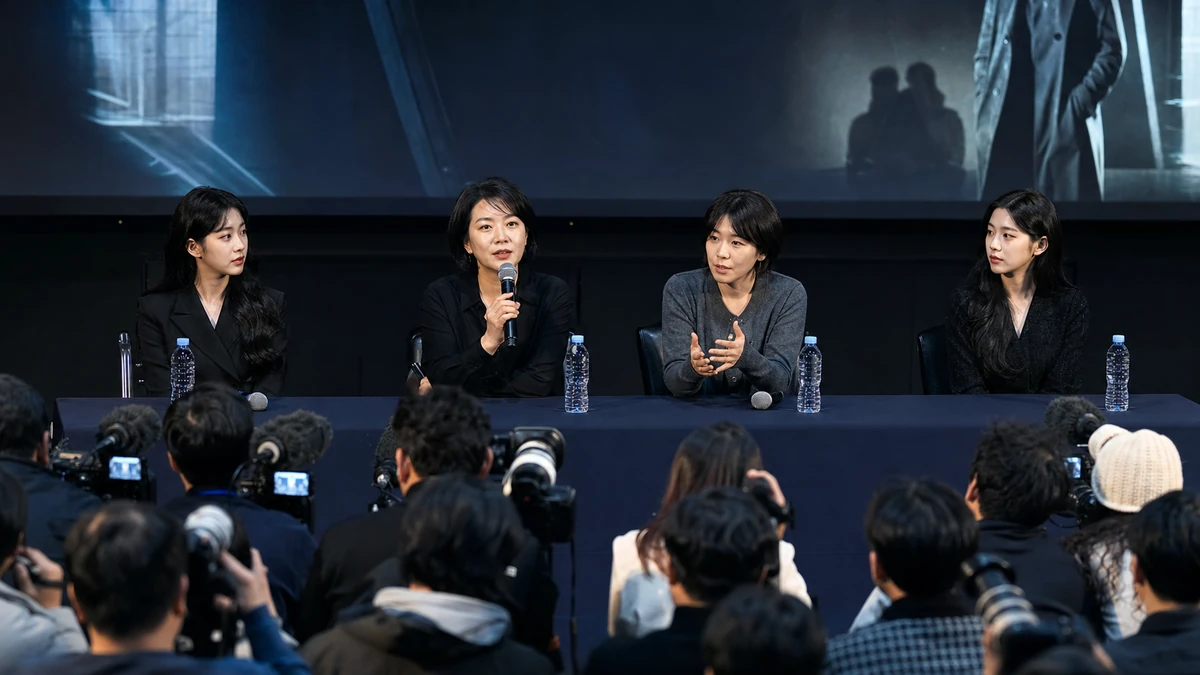
SEOUL — In South Korea’s film industry, actors with long, respected careers occasionally expand into directing or producing, but those moves still draw attention when the performer in question has become closely associated with a particular emotional register on screen. That is part of what made Tuesday’s press event for the mystery film Shadow Child notable in Seoul: Actor Lee Su-jung, long admired by Korean audiences for restrained, psychologically nuanced performances, is participating as a producer for the first time.
The announcement came at a press conference held at CGV Yongsan I’Park Mall, one of Seoul’s best-known multiplex and event venues, where director Yoo Eun-jung and cast members introduced a film built around an unsettling but instantly legible premise. Shadow Child tells the story of a girl with the exact same face as a deceased family member who suddenly appears before a mother and daughter. In a single image, the film brings together several of the themes that have made Korean genre cinema so resonant at home and abroad: grief, family, memory, uncanny resemblance and the idea that intimacy can be as terrifying as any outside threat.
Lee is not simply lending her star power to the project. She is also playing Geum-ok, a mother confronted by what has been described as the doppelganger of her dead daughter. In American terms, this is the kind of premise that might invite comparisons to prestige psychological horror more than jump-scare entertainment — less a roller-coaster haunted house than a story about what happens when mourning refuses to stay in the past.
For U.S. audiences who may know Korean film mainly through global touchstones like Parasite, Train to Busan or the streaming-era boom in Korean dramas and thrillers, Shadow Child appears to sit in another important tradition: the emotionally dense family mystery. It is a lane Korean filmmakers have worked in for decades, one where supernatural or near-supernatural premises are often used not just to frighten viewers, but to expose guilt, longing and fractures inside the home.
That Lee’s first producing credit is attached to such a story matters. In the Korean entertainment industry, where an actor’s screen persona can carry enormous weight, the decision to move into producing is often read as more than a business credit. It suggests a deeper investment in tone, theme and the overall direction of a project. Public details about Lee’s specific producing duties have not been disclosed, but her name on the production side alone signals that this is a work she wanted to help shape, not merely perform in.
Why the film’s premise travels across cultures
The core setup of Shadow Child hardly needs a cultural glossary to land. A family loses someone. Then a child appears bearing the exact same face. Is that child a miracle, a delusion, a threat or some impossible mix of all three? The emotional hook is nearly universal, which helps explain why Korean mystery and horror titles frequently travel well internationally even when the social details are distinctly local.
Still, some Korean cultural context helps explain why a film like this can feel especially charged. In Korean storytelling — as in many societies shaped by strong family expectations and intergenerational duty — family is not merely a private emotional unit. It is a structure of obligation, memory and identity. Loss inside that unit can carry a crushing weight, not only because someone beloved is gone, but because the roles and rituals that organize daily life are ruptured with them.
That is one reason Korean genre films often return to the household as a site of dread. In American horror, the menace may come from a cursed object, a serial killer or a haunted location. In Korean mystery and horror, the family itself often becomes the chamber where unresolved feelings reverberate. The terror comes not only from what enters the home, but from what the home has been unable to absorb or bury.
The “same face” device in Shadow Child works on several levels at once. It is a visual shock, obviously, but also a psychological provocation. For the grieving, resemblance can be both consolation and violation. To see the face of a lost loved one again is to feel desire and alarm at the same time. That paradox appears to be central to the film. The question is not just whether the mysterious girl is dangerous. It is whether the very hope of getting someone back can become its own kind of danger.
That tension should be familiar to American viewers who have embraced stories like The Others, Hereditary or prestige television dramas in which trauma manifests as mystery. But Korean filmmakers often push those emotional contradictions in a slightly different direction, allowing melodrama, maternal grief and genre suspense to occupy the same space without apology. What might look overly heightened in a strictly realist framework becomes compelling when approached as a movie about emotional states too overwhelming for ordinary language.
The ‘A Tale of Two Sisters’ connection is more than nostalgia
At the press conference, director Yoo said she thought of Lee’s earlier horror film A Tale of Two Sisters while developing Shadow Child. For English-speaking audiences, that title deserves some explanation. Released in 2003, A Tale of Two Sisters is widely regarded as one of the landmark Korean horror films of the 21st century. Directed by Kim Jee-woon, it combined the architecture of a ghost story with deeper currents involving sisterhood, trauma and fractured perception. In the United States, it became one of the Korean horror titles that helped introduce Western viewers to the moodier, more emotionally layered style of East Asian genre filmmaking during the 2000s.
Yoo said A Tale of Two Sisters served as a reference point because it was a film that portrayed the emotions and love between sisters through genre. That framing is significant. She was not invoking the earlier film simply because it was scary or because Lee had appeared in it. She was pointing to a model for how intimate relationships can be translated into suspense, how affection and dread can coexist in the same cinematic language.
For Americans who remember the era when Japanese and Korean horror films were being remade in Hollywood, the reference may initially sound like a call-back to a recognizable brand of Asian psychological horror. But Shadow Child appears to be aiming at something more specific than genre homage. It is less about recycling old scares and more about revisiting a creative lineage in which family bonds are the source material for mystery itself.
The revival of interest in that tradition also says something about Korean cinema’s current moment. South Korean film and television have become global brands in part because they are highly adaptable: one year the international breakout is a class allegory, another year it is a survival thriller, a revenge drama or a romantic series with fantasy elements. Yet one of the most durable strengths of the industry remains its ability to take emotions many viewers would consider private or even sentimental and translate them into rigorous genre storytelling.
In that sense, referencing A Tale of Two Sisters is not about trying to repeat a classic. It is about identifying a grammar. The earlier film showed how the domestic sphere could be transformed into a chamber of emotional distortion and revelation. Shadow Child appears poised to apply a similar principle to a different relationship: not sisters this time, but a mother, a daughter and the impossible return of a face that should no longer exist.
Lee Su-jung’s producing debut carries weight in Korea’s film world
In Hollywood, audiences are accustomed to actors picking up producer credits, sometimes as part of packaging deals and sometimes as a sign of genuine creative control. In South Korea, the meaning can be somewhat different depending on the performer and project. The industry is smaller, the public tracks stars closely, and a performer’s choice of material often becomes part of broader conversations about artistic seriousness and career evolution.
That is why Lee’s move matters beyond résumé-building. She has long been associated with a screen presence that is inward, attentive and emotionally fine-grained. Korean viewers remember her not simply as a celebrity, but as an actor whose performances often hinge on delicate shifts of feeling rather than obvious display. Her decision to expand into producing with a mystery centered on bereavement and a destabilizing family encounter suggests continuity rather than reinvention. She is not stepping into an unrelated commercial lane. She is deepening her involvement in the kinds of emotional textures that helped define her career.
From the information released so far, it is not clear which aspects of production Lee directly handled, and it would be premature to overstate her behind-the-scenes authority. But in film culture, symbols matter. A first producing credit tells colleagues and audiences alike that an actor is beginning to claim a different kind of authorship. It can also signal confidence in a director and script that might not otherwise receive the same spotlight.
That spotlight is especially meaningful in a market where mid-budget adult dramas and genre hybrids often face commercial pressure. South Korea has a robust film culture, but it is also a difficult theatrical environment, with local and imported blockbusters competing for screens and attention. A name like Lee’s can help a film cut through that noise, particularly if it is offering a more emotionally complex experience than standard commercial horror.
It also reflects a broader trend within Korean entertainment, where established actors are increasingly seeking ways to shape projects more directly. For international fans, that may sound familiar; it parallels how stars in the United States have used producing to champion personal material, from Reese Witherspoon backing female-led stories to actors using their clout to steer adaptations and genre pieces. The difference is that in Korea, where public narratives around craft and reputation are especially pronounced, such moves can feel like a statement about artistic identity as much as business ambition.
A mother, a daughter and the terror of recognition
The casting introduced at the Seoul event points to a story anchored in performance as much as concept. Alongside Lee, the film stars Park So-yi and Yuna. The reported focus on a girl who appears before a mother and daughter with the same face as a deceased family member creates the kind of premise that depends heavily on emotional calibration. If it leans too far into the supernatural, the story risks losing its human center. If it leans too far into grief drama, the mystery may lose force. The challenge is to let the two modes intensify one another.
The central question raised by the setup is simple and unnerving: When a familiar face returns under impossible circumstances, is it a comfort or a violation? For a mother who has lost a child, the answer would almost certainly be both. The face is recognizable, but the person is not. The longing is real, but so is the instinct to recoil. That contradiction gives the film a strong psychological engine before any plot twists are revealed.
In Korean cinema, maternal figures have often carried enormous dramatic weight, whether in social dramas, thrillers or family films. The mother is frequently not a background stabilizer but a vessel for sacrifice, repression, duty and, at times, explosive desperation. Casting Lee as Geum-ok places a performer known for controlled interiority into a role that appears designed around emotional overload. Watching how she manages recognition, denial, attachment and suspicion may become one of the film’s major draws.
There is also a reason the “double” or “doppelganger” motif remains so durable across cultures. It externalizes the mind’s refusal to accept finality. In folklore, religion, literature and modern horror alike, the return of the double asks whether identity can be trusted and whether grief can distort reality. Shadow Child seems to deploy that motif not as an abstract philosophical puzzle, but as something painfully domestic. The impossible arrives at the family’s doorstep wearing a beloved face.
That domestic scale may be precisely what gives the story power. Big mythology is not always necessary when the emotional stakes are this raw. If the film succeeds, viewers may find themselves less concerned with solving a supernatural puzzle than with confronting a more human question: What would it do to a family to be offered what looks like a second chance, only to realize that the terms of that return are unknowable?
How Korean genre films use family as emotional machinery
One of the reasons Korean genre films continue to resonate internationally is that they often treat plot not as an end in itself, but as a machine for generating emotional pressure. A murder mystery becomes a story about shame and hierarchy. A zombie outbreak becomes a test of parental failure and class selfishness. A haunting becomes an archive of unresolved family pain. Shadow Child, based on the details disclosed so far, appears to fit squarely within that tradition.
American viewers sometimes approach foreign thrillers looking first for novelty — the twisty plot, the cultural difference, the new visual texture. But what often gives Korean films their staying power is something more classical: the conviction that suspense is strongest when it emerges from relationships. That is where the family theme becomes so potent. Families know one another too well, and often not well enough. They are built from love, but also obligation, resentment, sacrifice and silence. Genre storytelling can pry those layers apart.
In the case of Shadow Child, the announced premise suggests that the source of tension will not merely be whether the girl is an intruder. It may also be how surviving family members project onto her their memories, guilt and emotional need. A dead loved one’s face could reopen wounds that had never closed. It could revive affection while also collapsing the order that grief, however painfully, had begun to establish.
This is a pattern American audiences may recognize if they think beyond horror to dramas and thrillers where the mystery cannot be disentangled from emotion. Yet Korean cinema often permits a level of tonal intensity that Hollywood sometimes shies away from. Scenes can be both mournful and suspenseful, sentimental and unnerving. Rather than neatly separating grief from genre, Korean filmmakers often let those modes contaminate each other. That contamination can create a distinctive emotional aftertaste — less about the clean release of fear than the lingering discomfort of feeling too much at once.
It also helps explain why a film like Shadow Child could appeal to global audiences even without large-scale spectacle. The premise is high-concept, but the likely payoff is intimate. Viewers do not need detailed knowledge of South Korean customs to understand a mother’s grief or a family’s destabilization. What they may discover, however, is how Korean filmmakers stage those emotions differently: with a willingness to make the home itself a haunted emotional system.
What the press conference revealed — and what it left open
As with many early promotional events, Tuesday’s press conference clarified the project’s emotional and artistic direction more than its detailed plot. Yoo outlined the film’s development background and her interest in translating relationship-driven emotion into genre form. Lee’s dual role as actor and producer emerged as a central point of attention. The cast was presented, and the premise was framed in a way that emphasizes loss, recognition and mystery over conventional horror mechanics.
What remains unknown is just as telling. There is still no full public picture of how the film resolves its mystery, how literal or metaphorical its premise becomes, or exactly how much of the story leans into supernatural explanation versus psychological ambiguity. That uncertainty may be strategic. Films built around doubles, dead family members and unstable perception tend to benefit from secrecy, especially when their emotional force depends on the audience entering the story with a measure of unease rather than a road map.
Still, the event left behind one larger question that goes beyond plot: How will Shadow Child update an older Korean genre tradition for the present moment? The invocation of A Tale of Two Sisters places the film in conversation with an earlier era of Korean horror defined by elegant visual control and emotional severity. But contemporary audiences — in Korea and abroad — now approach these stories in a media landscape shaped by streaming platforms, fandom culture and much broader awareness of Korean entertainment.
That creates both opportunity and pressure. On one hand, a mystery centered on family trauma and an uncanny child can now reach viewers far beyond South Korea with relative ease. On the other, the film will likely be judged not only as a domestic release but as part of a globally visible Korean wave, or Hallyu, the term used to describe the international spread of Korean pop culture. In practical terms for American audiences, that means the movie arrives in a world where Korean content is no longer niche, but part of mainstream viewing habits.
If Shadow Child fulfills what its premise and creative team suggest, it may attract exactly the kind of audience that has helped Korean storytelling flourish abroad: viewers who want genre entertainment with emotional weight, and who are willing to follow a film into the uncomfortable territory where grief, desire and fear are impossible to separate. For Lee, the project also marks a professional threshold. For Korean cinema, it is another reminder that some of its most unsettling mysteries begin not with monsters, but with the people we loved most — and the faces we thought we had lost forever.
Comments
Post a Comment