A different kind of nightlife on Jeju
Jeju Island is usually marketed to the world with images of black volcanic rock, beachside resorts and honeymoon getaways. But a quieter story is unfolding there after dark — one that says as much about South Korea’s future as any tourism campaign ever could.
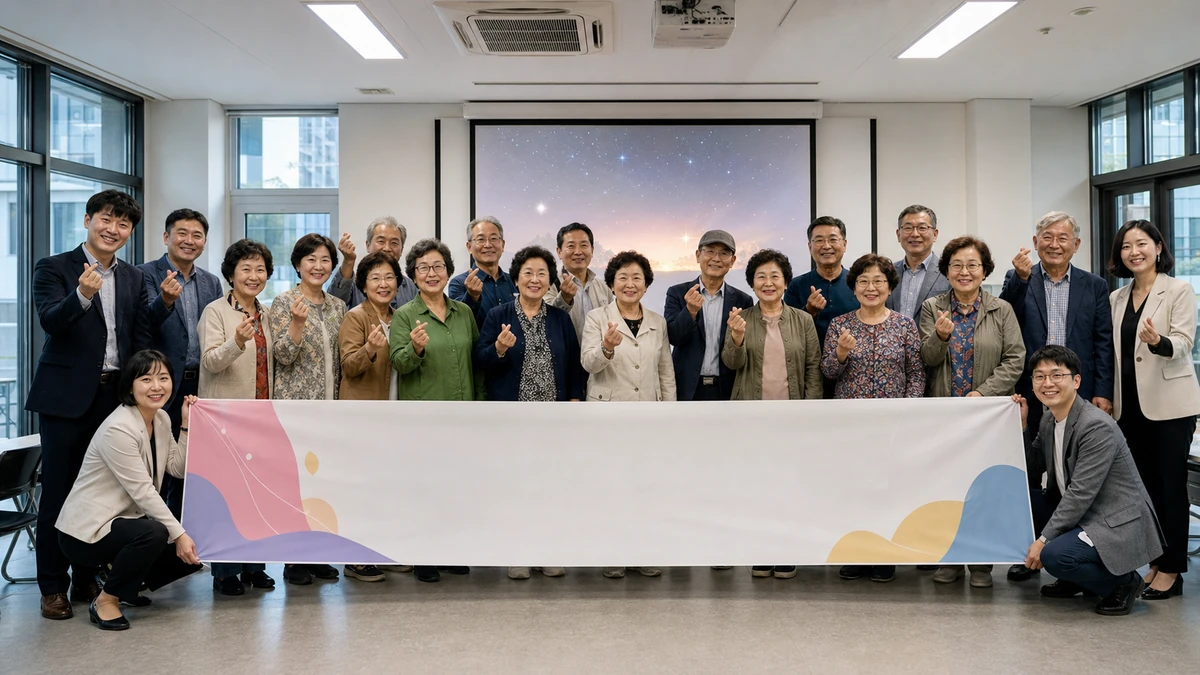
A public corporation on Jeju, the Jeju Special Self-Governing Province Development Corp., said it will operate a nighttime literacy education program for older adults inside unused space at a public rental housing complex in Jeju City. The program, called “Uri Olle Byeolbit Tteurak,” is aimed at elderly residents who have difficulty reading and writing and who may not be able to attend classes during the day because of work, caregiving responsibilities or other personal circumstances.
That may sound like a small local initiative. In fact, it touches on several major themes reshaping South Korea: a rapidly aging population, growing concern over social isolation among seniors, the challenge of making public services fit real people’s schedules, and a broader push to treat housing not simply as shelter but as a hub for community support.
For American readers, the closest comparison might be a public housing authority or city agency turning an underused common room into a neighborhood-based adult education center, then scheduling classes at night specifically for older residents who are otherwise left out of traditional programming. It is a practical fix, but also a revealing one. It asks a basic question many governments struggle with: If a service exists but people cannot realistically use it, how useful is it really?
On Jeju, officials are trying to answer that question with a classroom light switched on after sunset.
What the program does — and who it is for
According to the corporation, the program will be run in idle or unused space inside “Maeume On Samdo 1-cha,” a public rental housing complex in the Samdo 1-dong neighborhood of Jeju City. The target population is older adults, especially those who have had limited access to basic literacy education.
In South Korea, “literacy education” in this context does not mean enrichment classes for hobby learners or book clubs for retirees. It refers to foundational instruction for people who may have missed out on formal schooling earlier in life or who continue to struggle with reading and writing in daily life. For some elderly Koreans, especially women and people who grew up during or just after the Korean War, interrupted education was not unusual. Poverty, displacement, family obligations and the pressure to work young all shaped who got to stay in school and who did not.
That historical background matters. South Korea today is globally known for its high-performing students, intense college admissions culture and near-universal literacy. But the country’s older generations did not all benefit equally from the education boom that helped transform South Korea from a war-ravaged nation into one of the world’s leading economies. Beneath the country’s modern image is a quieter reality: Some seniors still struggle with the basic reading and writing skills needed to navigate daily life.
The Jeju program is meant to address those everyday barriers. Literacy affects far more than whether someone can read a novel or write a letter. It shapes whether a person can make sense of a hospital notice, read a bus schedule, understand a government form, follow apartment management announcements or fill out routine paperwork without having to rely on a relative or neighbor.
That dependence can narrow a person’s sense of autonomy. It can also discourage fuller participation in community life. In that sense, the program is not just about letters and words. It is about access, confidence and dignity.
Why nighttime classes matter
The most striking feature of the Jeju initiative may be the hour on the clock.
Public welfare and education programs often assume that older adults are most available during the day. That assumption can be misleading anywhere, including in South Korea. Older people are not one uniform group with open schedules. Some still work, especially in lower-income households. Some care for grandchildren while parents are on the job. Others manage medical appointments, household responsibilities or simply have personal routines that make daytime participation difficult.
By offering classes at night, the Jeju corporation is acknowledging a reality that service providers often overlook: Time can be as much a barrier as money, transportation or eligibility rules. In policy language, this is a question of access. In everyday language, it is about meeting people where they actually are.
That makes this initiative notable beyond its size. It reflects a shift away from the traditional model in which residents are expected to fit themselves around a fixed public-service schedule. Instead, the service is being adjusted to residents’ lives. For older adults who may have wanted to learn but could not attend daytime programs, that change could make the difference between exclusion and participation.
Americans will recognize the logic. Libraries, community colleges and adult education centers in the United States have long wrestled with the same issue. Night classes became a staple partly because working adults needed an option outside the standard 9-to-5 framework. What Jeju is doing applies that same principle to older learners — and to public housing itself.
It also carries symbolic weight. A housing complex at night is usually understood as a place of return, rest and private life. Here, it is also becoming a place of study. The image is quietly powerful: seniors walking not to a distant institution, but to a nearby room in their own residential community, turning nighttime from a dead zone in public programming into a window for learning.
Turning public housing into social infrastructure
The Jeju project also reflects an evolving idea about what public housing should be.
In many countries, public rental housing is primarily discussed in terms of affordability and supply: how many units exist, who qualifies, what rents cost and how quickly homes can be delivered. Those issues matter in South Korea as much as they do in the United States. But the Jeju initiative suggests a broader understanding. A housing complex is not just a collection of apartments. It can function as a piece of neighborhood infrastructure — a place where services are delivered, relationships are formed and daily problems are addressed close to home.
That is especially meaningful for older residents. Proximity matters. Even when programs technically exist elsewhere, getting to them can be tiring, intimidating or inconvenient. A nearby classroom reduces the burden of travel and lowers the psychological threshold that sometimes keeps people from joining a program in an unfamiliar institutional setting.
There is also a practical lesson in the use of “idle space,” or unused room inside the complex. Rather than waiting for a new facility to be built, officials are repurposing an existing asset. That approach may sound modest, but it offers a potentially scalable model for places that have limited budgets and underused community space. It is a reminder that social policy is not always about constructing something entirely new; sometimes it is about seeing dormant space differently.
For U.S. readers, the concept may call to mind efforts to use school gyms after hours, vacant storefronts for public health outreach, or common rooms in affordable housing developments for senior services and digital literacy programs. The underlying idea is similar: Publicly managed space can do more than serve its original narrow purpose.
In Jeju’s case, the corporation described the effort as a new “housing social service” project. That phrase may sound bureaucratic, but it signals something important. Housing policy and social welfare policy are often treated as separate silos. This project blurs that line. It starts from the premise that where people live is one of the most effective places to offer support that improves daily life.
The meaning behind the name
The program’s title, “Uri Olle Byeolbit Tteurak,” is deeply rooted in Jeju’s local culture, and understanding it helps explain the spirit of the project.
“Uri” means “our,” a common Korean word that often emphasizes collective identity more than the English equivalent does. Koreans routinely say “our house,” “our mother” or “our school” in places where Americans would instinctively use “my.” The word carries a sense of shared belonging.
“Olle” is one of the best-known Jeju words. It refers to a narrow pathway or alley connecting a street to a home or village space, and it gained international recognition through the Jeju Olle Trail system, a network of walking routes that helped rebrand the island as a destination for slow travel and nature tourism. To Jeju residents, though, “olle” also evokes local ways of living and moving through community space.
“Byeolbit” means starlight, and “tteurak” means a yard or courtyard — the kind of intimate open space associated with a home, neighbors and everyday gathering. Put together, the program name suggests something like “Our Olle Starlight Courtyard.” It is not a literal description so much as an emotional one: a shared, familiar, neighborhood-like place for learning at night.
That may sound poetic by the standards of a government initiative, but in Korea, public programs often use names intended to signal warmth, community and accessibility rather than administrative formality. The branding here matters because literacy education can carry stigma. A softer, locally resonant name may help make the program feel inviting rather than remedial.
For international audiences, the title also underscores that this is not just a generic education project dropped onto Jeju from above. It is framed in the language of the island’s own culture. That local identity is part of the story. Jeju is often flattened into postcard imagery for outsiders, but this program reveals the island as a lived-in community with its own vocabulary, rhythms and social needs.
Aging, isolation and the everyday stakes of literacy
South Korea is one of the world’s fastest-aging societies, and that demographic transformation is forcing local governments and public institutions to rethink what support for older adults looks like. In broad terms, the challenge will sound familiar to Americans. Longer life expectancy does not automatically bring a stronger safety net, less loneliness or better access to services. In fact, aging can expose weak points in all of those systems.
Literacy is one of those weak points because it often hides in plain sight. People who struggle with reading and writing frequently develop coping strategies that mask the problem. They may memorize routes, ask others for help, avoid paperwork when possible or decline opportunities that might expose their difficulty. Over time, that can contribute to withdrawal from public life.
For seniors, the consequences can be especially acute. Modern life depends on text more than ever, even before adding smartphones and digital forms into the mix. Apartment notices, clinic instructions, transit information, utility bills and government announcements all require some level of reading confidence. When that confidence is missing, independence becomes harder to maintain.
The Jeju corporation said the purpose of the classes is not simply academic instruction but support for daily adaptation and social participation. That distinction is important. Success here is not primarily measured by test scores or certificates. It may be measured by whether a participant feels more comfortable reading a notice, signing a form, identifying the right bus or engaging more actively with neighbors and local institutions.
There is also a matter of self-respect. In both Korea and the United States, literacy challenges among older adults can be deeply tied to shame. A program delivered close to home, in a familiar environment and at a time people can realistically attend, may help reduce that barrier. It says, in effect, that needing this support is not a private failing but a community concern worth addressing publicly and thoughtfully.
What this says about South Korea’s local welfare model
It would be easy to dismiss this as a feel-good local story, but that would miss the larger significance. Small-scale programs often reveal the direction in which a society is moving long before national policy slogans do.
In this case, the Jeju initiative points toward a more neighborhood-centered model of public service in South Korea, one that is less about simply announcing programs and more about tailoring them to the actual conditions of residents’ lives. The adjustments are concrete: the program is nearby, it uses existing space, it targets a specific unmet need and it addresses a scheduling problem that had kept some people out.
Just as important is what the announcement does not claim. The available information does not specify how many participants will enroll, how often classes will meet or whether the model will expand to other housing complexes. That restraint matters. It keeps the story grounded in verified facts rather than inflated rhetoric. What is confirmed is straightforward: A public housing provider on Jeju is opening unused residential space for nighttime literacy education for older adults.
Still, even on those limited facts, the program offers a useful lens on Korean local governance. Across South Korea, public institutions are under pressure to respond to aging, uneven access to services and the need for more personalized welfare delivery. Programs like this suggest that the response is not always large-scale construction or entirely new bureaucracies. Sometimes it is a more careful reading of existing communities — their empty rooms, their overlooked hours, their residents whose needs do not fit neatly into daytime office logic.
That approach may resonate far beyond Jeju. Around the world, governments face the same question of how to make public services more humane and more usable. The answer is often not glamorous. It is practical, local and specific.
Beyond the tourist image of Jeju
For overseas audiences, Jeju is often reduced to its travel-brand identity: South Korea’s island escape, a place of scenic drives, seafood, waterfalls and lava tubes. Stories like this complicate that picture in the best way. They remind readers that Jeju is not just a destination but a home to residents navigating the same pressures seen in aging communities elsewhere.
There is something especially striking about that contrast. The island known to tourists for leisure is, for some local seniors, also a place where learning has to be scheduled around work, family demands and the realities of later life. The beauty of the setting does not erase the practical challenges of access, education and aging. If anything, the distance and geography of island life can make local access to services even more important.
That is why the story matters. It presents Jeju not as fantasy but as community — a place where public officials are looking at an unused room and seeing an opportunity for connection, not just vacancy. It shows a form of policy that is intimate rather than dramatic, rooted in the lived experience of residents rather than the expectations of visitors.
And it offers a broader lesson for American readers. The most meaningful public interventions are not always the biggest or the loudest. Sometimes they begin with a small redesign of space and schedule, one that recognizes a truth communities everywhere eventually confront: People do not stop wanting to learn because they grow older, and they should not be shut out of learning because institutions never bothered to meet them at the right place and time.
On Jeju, that meeting point now has a name, a room and a nighttime hour. For the seniors who walk through its doors, it may also offer something less tangible but no less important — a renewed sense that public life still has space for them.
Comments
Post a Comment