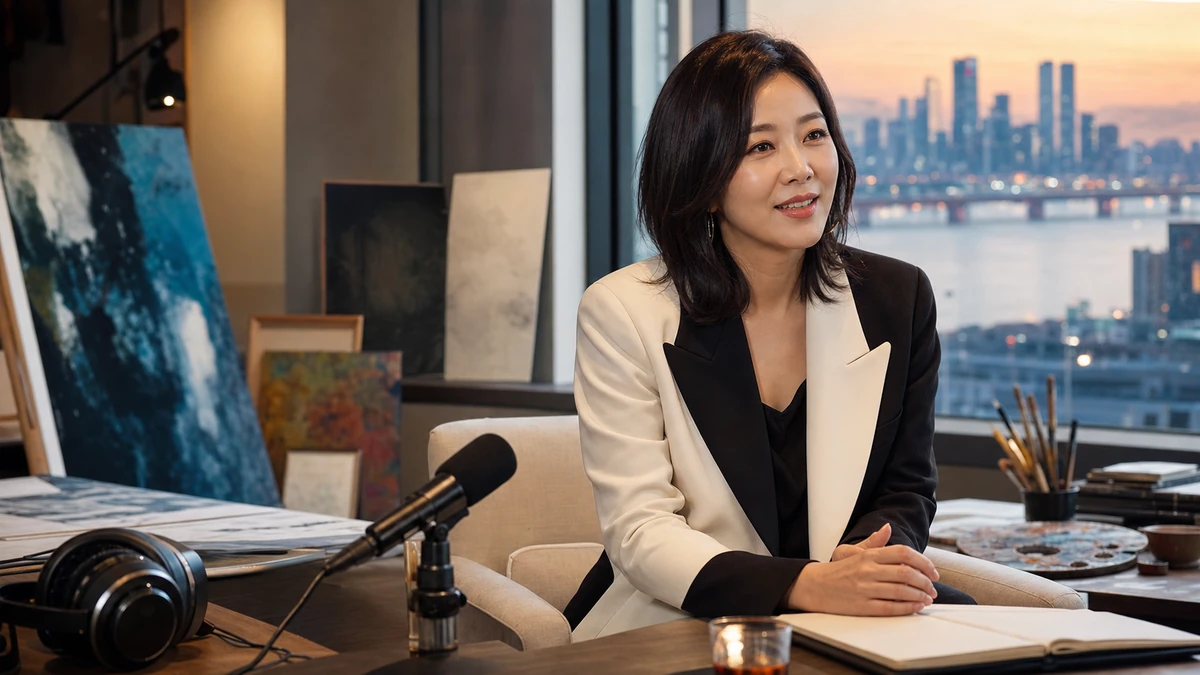
A 20-year career that does not fit neatly in one box
In the United States, entertainers who successfully reinvent themselves across several creative fields are often treated as rare exceptions — the musician who becomes a respected actor, the actor who turns to directing, the pop star who builds a fashion label that lasts longer than a trend cycle. In South Korea, where celebrity culture is both intensely competitive and unusually fluid, those transitions can happen faster and more often. Even so, the career of Solbi stands out.
Solbi, whose given name is Kwon Ji-an, is marking the 20th anniversary of her debut in 2026 with the kind of resume that resists a simple label. She first became known as a singer in the mid-2000s, then as a familiar television personality, and later as a painter, essayist and scriptwriter. In an interview in Seoul marking the milestone, she reflected on the path that took her from K-pop-adjacent stardom to a broader life in the arts, saying she hopes to "dream good dreams" for the next decade as well.
That line may sound soft or sentimental in English, but it carries a particular weight in the context of Korean celebrity culture, where careers are often measured in hard metrics: chart positions, ratings, endorsements, online buzz and fan loyalty. Solbi’s framing suggested something different. She was not simply taking stock of commercial wins or losses. She was describing an artistic life as an evolving process — one in which trying, changing and enduring mattered at least as much as arriving.
For American readers who may know South Korea mostly through global K-pop juggernauts like BTS or Blackpink, or through Oscar-winning films and Netflix hits such as "Parasite" and "Squid Game," Solbi’s story offers a different but revealing angle on the Korean Wave. Not every Korean celebrity follows the polished export model built around highly choreographed international fandom. Some careers unfold more messily, more experimentally, and perhaps more humanly. Solbi’s is one of them.
Her anniversary is not just a commemoration of longevity. It is also a case study in how South Korean popular culture has matured over the past two decades, creating room — though not always easy room — for artists to cross from mainstream entertainment into more personal forms of creative work.
From Typhoon to solo artist in the boom years of Korean pop
Solbi debuted in 2006 as a member of the coed group Typhoon, entering the music industry during a pivotal stretch for modern Korean pop. This was a period before K-pop became a default part of global youth culture, but after South Korea had already built the industrial foundations of its star-making system. Acts were trained, packaged and promoted with increasing sophistication. Music television mattered. Fan communities were intensely organized. Variety shows could be nearly as important as singles in shaping public recognition.
For readers less familiar with the Korean entertainment system, coed groups have historically been less common and less durable than all-male or all-female idol groups. Typhoon occupied a distinctive place in that landscape, gaining attention with emotional dance tracks that helped define a certain strand of mid-2000s Korean pop: melodic, dramatic and highly suited to television performance. Songs associated with the group, including "So..." and other sentimental club-oriented tracks, made them recognizable to Korean audiences of that era.
But music was only part of the story. Solbi also became widely known through television variety programs, a uniquely important institution in South Korean entertainment. To an American audience, variety shows can be difficult to explain because there is no perfect equivalent. Imagine a mix of reality television, late-night banter, sketch comedy, game show improvisation and celebrity personality branding, all compressed into a format that rewards spontaneity and relatability. In South Korea, appearing on those programs can build a public image far beyond what a singer does on stage.
That mattered for Solbi. She developed a recognizable screen persona that made her accessible to a broad audience, not just music fans. In a media ecosystem where likability, quick wit and emotional openness can be as important as technical skill, those appearances helped turn her into a household name. For many viewers, she was not just a singer from a group. She was a celebrity presence with a distinct voice and character.
In 2007, she debuted as a solo singer, a move that can mean many things in Korea: independence, rebranding, vulnerability or a bid to establish a clearer personal identity. Solbi has said her life rarely followed a predictable path, and that observation seems especially apt here. The transition from group member to solo artist was not merely a career adjustment. It was part of a larger pattern in which she kept resisting the idea that one stage of fame should define the rest of her life.
The turn to art, and why it mattered
If Solbi’s musical debut introduced her to the public, her move into visual art appears to be the turn she herself regards as most transformative. In reflecting on her past 20 years, she said the best thing she did was start making art. That is a striking statement from someone whose public identity was built first through music and television. It suggests that painting was not a side hobby or a celebrity vanity project, but a deeper act of self-reconstruction.
That distinction matters. In South Korea, as in the United States, celebrities often branch into other fields. Sometimes the move is genuine; sometimes it is treated skeptically as branding. When a well-known entertainer enters the art world, the suspicion can be especially sharp. Is the work being taken seriously on its own terms, or merely because of name recognition? Is the exhibition a real artistic statement or an extension of fame?
Solbi began holding solo exhibitions in 2012 and has continued to work as a painter over time, which is part of what makes this chapter notable. Longevity does not automatically settle debates about artistic merit, but it does show commitment. Sustained practice is different from a one-off gallery appearance designed to generate headlines. Her endurance in that space suggests she was willing to absorb scrutiny and keep going.
For American readers, there is a useful parallel in the way some pop culture figures have sought credibility in adjacent artistic worlds that initially viewed them with suspicion. Think of musicians who move into film directing or actors who seek recognition in fine art circles and are met with a mixture of curiosity and eye-rolling. The challenge is not just producing work. It is persuading the public — and often oneself — that the new work is not a costume.
Solbi’s own language points to why art became so central. She said she feels good knowing she has proven herself to be someone who can make dreams real, whether as a singer or painter. That is not simply a statement about achievement. It is a statement about agency. In an industry where celebrities can be produced, managed and consumed at high speed, painting offers a different kind of authorship. It is slower, more solitary and less dependent on immediate public reaction.
That may help explain why the move resonated so deeply for her. Korean entertainment rewards visibility; art can reward interiority. For someone who spent years being seen, the act of making something outside the usual machinery of celebrity may have offered not just a new discipline, but a new language for self-definition.
Why variety-show fame can be both a gift and a trap
One of the more interesting themes in Solbi’s anniversary reflections is the idea that she did not want to remain frozen in the image people first attached to her. That is a familiar struggle for celebrities everywhere, but it carries special force in South Korea, where the entertainment industry can be both remarkably inventive and rigidly image-conscious.
Variety shows, which helped make Solbi popular, can also become a kind of trap. Because they magnify personality, they can lock celebrities into memorable but narrow identities: the funny one, the awkward one, the blunt one, the sweet one, the lovable troublemaker. Those personas can be commercially useful, but they can also outlast the person’s own interest in them. Once the public decides who you are, changing the script is difficult.
Solbi’s comments suggest she has spent much of her career pushing against that kind of containment. She said she wanted to be someone with a twist, someone unpredictable. In Korean, that idea can carry a playful but meaningful undertone — the desire to have a surprising side, to reveal a reversal that people did not see coming. In her case, that "twist" was not scandal or shock value. It was artistic expansion.
This is one reason her story may resonate beyond fans of Korean entertainment. In the American celebrity system, reinvention is almost a national myth. We admire comeback stories, image overhauls and second acts. But we also punish public figures who change too much, too abruptly or in ways we do not understand. South Korea’s system operates differently, yet the underlying tension is similar. Audiences often say they want authenticity, but they also grow attached to stable, recognizable versions of people.
Solbi’s path shows what it looks like when an entertainer tries to outgrow a familiar frame rather than optimize it. The process is not always clean. It does not always produce instant consensus. But after two decades, the cumulative effect is hard to miss. She is no longer just the TV personality some viewers first met in the 2000s. She has turned the act of not staying put into the defining trait of her career.
There is also something quietly telling in her decision to speak about this milestone in terms of self-recognition. She said she wants to praise herself for challenging and fulfilling dreams as a singer, painter and writer. In a profession built on external judgment, that kind of language can be radical in its modesty. It is less about self-congratulation than about reclaiming the right to interpret one’s own life.
Writing, scriptwork and the expanding idea of what a Korean star can be
Solbi’s career has extended beyond music and painting into writing as well. She published an essay collection in 2014 and more recently wrote the script for a short-form drama project whose title translates roughly to "My Ex-Boyfriend Is a Top Star." That range matters not because multitasking is inherently impressive, but because it illustrates a broader shift in Korean entertainment: stars are increasingly expected, or at least encouraged, to become creators of worlds, not just performers within them.
That shift has accelerated as the Korean Wave has globalized. International audiences often first encounter Korean content through highly polished end products — a charting single, a tightly edited series, a festival-ready film. What can be harder to see from abroad is the layered ecosystem behind those exports. Increasingly, Korean entertainers move across music, television, digital video, publishing, visual art and live performance. The boundaries are more porous than outsiders sometimes assume.
In that sense, Solbi’s career looks less like an anomaly and more like an especially vivid example of a broader crossover culture. Still, her case is distinctive because the movement seems rooted in long-term curiosity rather than simple market logic. She has described enjoying the process of making things through challenge, even though her work takes place in fields where output is constantly judged. That emphasis on process stands out in an age of algorithmic attention, in which artists are under pressure to stay visible and instantly legible.
For American readers, there may be echoes here of creators who resist being forced into a single lane — artists who release music, publish essays, direct films or mount gallery shows while critics debate whether they are spreading themselves too thin or finding a more complete form of expression. The Korean context, however, adds its own texture. Because the entertainment system there can be highly managed, any move toward self-authored creative work can carry extra symbolic weight.
Writing, especially, represents a different mode of control. A singer interprets a song; a scriptwriter shapes the scene itself. An essayist is not merely delivering performance but articulating thought. Together with painting, those forms suggest a gradual move from being the object of public attention to becoming the architect of one’s own narrative.
That may be one reason Solbi’s anniversary comments feel larger than a standard celebrity retrospective. They offer a small map of how Korean fame can evolve — from manufactured visibility to a more layered authorship, from entertainment persona to creative identity.
A dream called the “Solbi Museum”
Among the lighter but more revealing details from Solbi’s interview was her comment that she dreams of one day, as an older woman, hosting both art exhibitions and concerts at a place she imagines as the "Solbi Museum." She laughed when she said it, and it was not presented as a formal project or business plan. But as a symbolic idea, it says a great deal.
A museum is a place of preservation, interpretation and legacy. A concert is a space of immediacy, feeling and public connection. Put them together and you get a concise metaphor for what Solbi has been building across 20 years: a career that refuses to separate music from visual expression, performance from reflection, popular appeal from more personal forms of art.
For U.S. audiences, the image may call to mind celebrity estates, artist foundations or immersive retrospectives that blend archive and spectacle. But in Solbi’s version, the dream feels less corporate than intimate. It is a vision of a future where the different selves she has inhabited — singer, painter, writer — can coexist in one place without apology.
That idea also speaks to changing fan culture. In both South Korea and the United States, fans no longer consume only songs, episodes or red-carpet images. They want a larger sense of the person: what they think, what they make, what obsessions shape them, what kind of world they are trying to build. The fandom economy is often criticized, sometimes rightly, for turning people into brands. But it can also create space for audiences to follow a long creative journey rather than a single hit-driven moment.
Solbi’s imagined museum reflects that broader shift. It assumes that an artist’s life can be an interconnected body of work, not a collection of disconnected gigs. It imagines legacy as something assembled over time through experimentation, not merely secured by early popularity.
Whether such a museum ever exists is almost beside the point. What matters is the confidence embedded in the fantasy: the belief that a life in the arts can be cumulative, expansive and worth curating on its own terms.
What Solbi’s story says about the Korean Wave now
As of 2026, the Korean Wave is no longer a niche topic in English-language media. Korean music tops charts, Korean dramas dominate streaming recommendations, Korean beauty products fill American retail shelves, and Korean directors and actors are no longer treated as exotic newcomers in global entertainment. Yet broad international familiarity can flatten nuance. When people outside Korea think of Hallyu — the Korean term commonly used for the global spread of Korean culture — they often think of scale, polish and export power.
Solbi’s 20th anniversary offers a useful corrective. Her story is not primarily about global domination or industry triumphalism. It is about artistic persistence inside a system known for speed and pressure. It is about what happens after a celebrity becomes recognizable and then has to decide whether recognition is enough. It is about challenging the script that fame hands you.
There is also something telling in the timeline itself. A singer who debuted in 2006, started solo exhibitions in 2012, published essays in 2014 and continued into scriptwriting by the mid-2020s reflects the widening of South Korea’s creative ecosystem. Entertainment is no longer just about songs, dramas or variety ratings. It is increasingly an interlocking network in which image, authorship and multidisciplinary work feed one another.
For American readers, that may be the most interesting takeaway. The Korean Wave is often discussed as a machine that manufactures stars. Solbi’s career reminds us that it also produces — and sometimes demands — reinvention. Behind the viral songs and impeccably managed acts, there are artists trying to build lives that are less tidy than the brand narratives attached to them.
In her interview, Solbi emphasized not the result but the process. That may be the most durable line from the conversation. In a global media environment obsessed with rankings, milestones and instant judgment, there is something quietly defiant about an artist who treats the making itself as the point. Her 20th anniversary, then, is not just a look back at what she has done. It is a statement about how she intends to keep going.
And perhaps that is why her wish for the next 10 years lands as more than a feel-good quote. To keep dreaming, after two decades in public life, is not a small ambition. In Solbi’s case, it sounds less like nostalgia than a creative strategy — one that has already taken her far beyond the role in which many people first met her.
Comments
Post a Comment