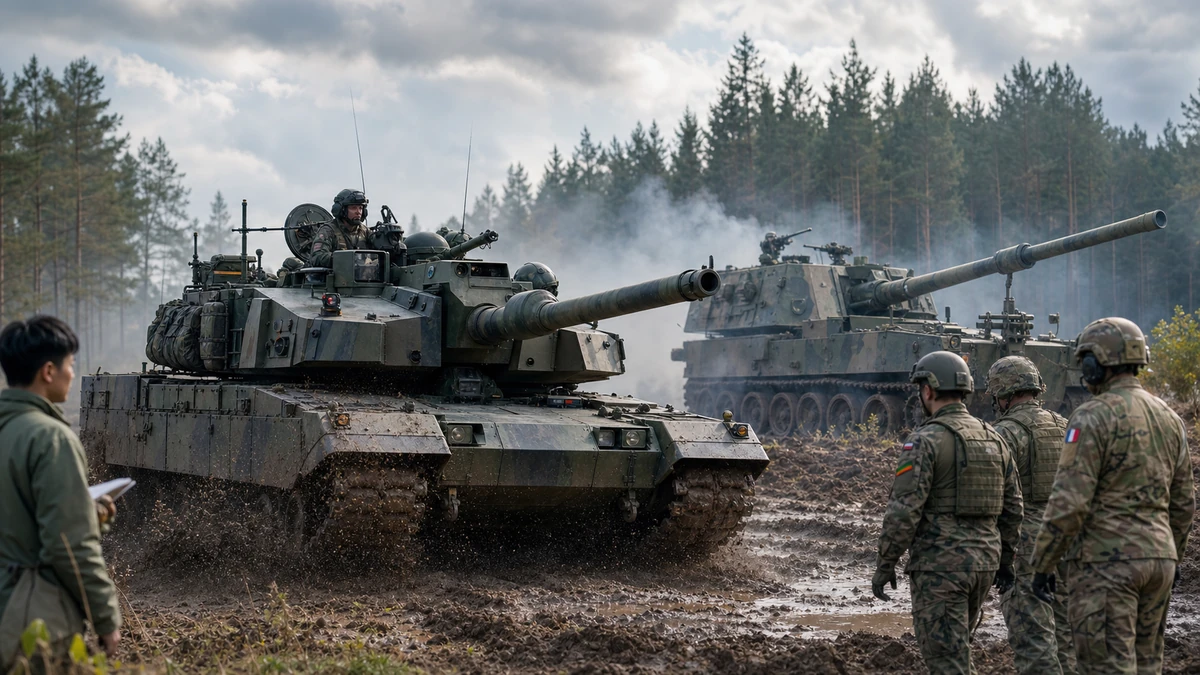
A South Korean weapons system shows up in an unexpected place
When Americans think about South Korea’s global footprint, they are more likely to picture K-pop, Oscar-winning films, Samsung phones or Hyundai cars than tanks and artillery. But on a training ground in northeastern Poland this month, another side of South Korea’s rise came into view: heavy battlefield equipment built in Korea and now operating as part of a large multinational military exercise on NATO’s eastern flank.
According to local Polish reporting cited by South Korea’s Yonhap News Agency, South Korean-made K2 main battle tanks and K9 self-propelled howitzers were deployed as key assets in a major joint drill underway near Orzysz, a town in northeastern Poland not far from some of Europe’s most sensitive security geography. The exercise, known as Zielony Dzik-26, or “Brave Wild Boar 26,” runs from June 16 to June 26 and includes Polish forces, along with troops from Lithuania and France.
The scale matters. The exercise involves about 10,000 troops and roughly 600 pieces of military equipment, including tanks, self-propelled artillery, infantry fighting vehicles, aircraft and drones. In that setting, the Korean-made systems were not simply parked for display as export hardware at a trade show. They were reported to be participating in the actual movement-and-fire sequence of a live multinational field exercise.
That distinction is what makes the story notable beyond the defense industry. For years, South Korea has steadily expanded its role as a major arms exporter, especially in conventional ground systems. But there is a difference between signing contracts, appearing at international expos and becoming embedded in the routine operating picture of a NATO member’s frontline military formations. What appears to be happening in Poland is the latter: Korean-designed equipment being folded into the working force structure of a European army in a region where deterrence, readiness and alliance coordination are under constant scrutiny.
This is not, based on the facts available, a story about a new purchase announcement, a new intergovernmental agreement or a fresh policy shift. It is something more practical and, in some ways, more revealing. It is a story about operational use: about what it means when Korean-made armored systems are no longer discussed mainly as export successes, but are seen maneuvering with NATO militaries in one of the alliance’s most strategically watched zones.
Why Poland matters so much in Europe’s security map
To understand why this deployment is drawing attention, it helps to understand Poland’s position in today’s European security order. Since Russia’s full-scale invasion of Ukraine in 2022, Poland has become one of NATO’s most important frontline states. It sits on the alliance’s eastern edge, borders Ukraine and Belarus, and lies near Russia’s heavily militarized exclave of Kaliningrad. In practical terms, that makes Poland both a logistical hub and a strategic buffer.
For American readers, a rough comparison might be this: If Germany has long been one of the traditional anchors of NATO in Europe, Poland has increasingly become one of the alliance’s most urgent forward operating spaces. It is where questions about deterrence stop being abstract. Troop readiness, mobility, artillery coordination, armored maneuver and cross-border interoperability all matter there in immediate ways.
The area around Orzysz has become especially symbolic in this new security environment. Northeastern Poland sits near what defense planners often describe as a particularly vulnerable part of the NATO map, where military reinforcement, coordination and speed would be critical in a crisis. That is one reason large exercises held there attract more than routine military attention. They are also read as signals: to allies, to adversaries and to defense markets.
In that context, the appearance of K2 tanks and K9 howitzers carries weight beyond simple hardware identification. These are not consumer products traveling well overseas. They are high-end land warfare systems operating in a place where military credibility is measured by whether equipment can function smoothly in combined operations with allied forces under realistic conditions.
That is also why the story resonates outside Korea and Poland. NATO’s eastern flank has become one of the most closely watched security theaters in the world, not because open war is unfolding there among alliance members, but because readiness there is meant to prevent war in the first place. When equipment from outside the traditional U.S.-Western European defense manufacturing orbit becomes central to that readiness picture, it says something about how the alliance’s supply chains and force structures are evolving.
What the K2 and K9 are, and why they stand out
The names K2 and K9 may mean little to general readers in the United States, so some translation of military culture, rather than language, is useful here. The K2 is South Korea’s modern main battle tank, broadly comparable in role to the American M1 Abrams or the German Leopard 2. It is designed for frontline armored warfare, combining mobility, armor protection and firepower. The K9 is a self-propelled howitzer, a mobile artillery platform that allows forces to fire powerful rounds and then relocate quickly, a capability that has become especially important in an age of drones, counterbattery fire and surveillance-heavy battlefields.
In simple terms, the K2 is the kind of platform that leads armored movement on the ground, while the K9 delivers sustained artillery support from mobile positions. If the tank is about shock, maneuver and direct engagement, the howitzer is about shaping the battlefield from farther away. Modern armies need both, and they need them to work within a larger network that includes infantry fighting vehicles, reconnaissance assets, drones and air support.
That broader combined-arms setting appears to be exactly the environment in which these Korean systems were used during the Polish drill. Local reports described the K2 and K9 as delivering significant firepower and participating not as symbolic additions, but as integrated components of the exercise. That matters because military equipment is rarely judged only by its technical brochure. The real question is whether it fits into doctrine, communications, logistics, training cycles and command structures.
South Korea has long built weapons with its own tense security environment in mind. The Korean Peninsula remains one of the most heavily militarized regions in the world, and South Korea’s defense industry developed under conditions that demanded speed, reliability and high readiness. In that sense, Korean systems are products of a country that has spent decades preparing for the possibility of large-scale conventional conflict. That does not automatically guarantee export success, but it does help explain why foreign militaries have taken interest.
For Americans accustomed to seeing U.S., German or British equipment dominate discussions of NATO land power, the rise of South Korean systems can seem sudden. In reality, it has been building for years. Korea’s defense companies have been moving from regional relevance to global visibility, aided by competitive pricing, relatively rapid production timelines and a growing reputation for equipment that can be delivered and fielded quickly. Poland has emerged as one of the clearest examples of that shift.
From export story to frontline integration
The most important point in this episode is not that Korean-made weapons appeared overseas. That, by itself, is no longer unusual. The more meaningful development is that the systems appear to be operating as part of Poland’s main armored force structure during a multinational exercise involving NATO members.
That is a different category of evidence. A defense exhibition can demonstrate appearance and advertised capability. A bilateral contract can demonstrate intent. But a live field exercise involving 10,000 troops and about 600 military assets demonstrates something closer to practical adoption. It suggests the systems are being used within real operational routines, alongside other national forces and amid the complexity that comes with drones, aircraft, armored vehicles and multinational coordination.
Military organizations care deeply about integration because warfighting is never just about one platform. A tank that performs well in isolation still has to communicate with command networks, move with infantry, receive maintenance support, fit within ammunition supply chains and function under the pace and friction of large formations. Artillery systems face similar demands: they must fire accurately, relocate rapidly and mesh with reconnaissance and targeting procedures.
That is why the symbolism of the Polish exercise is so strong for South Korea’s defense industry. It offers a visible, real-world scene in which Korean systems are not presented as hypothetical options, but as active tools in a European security environment. For an industry seeking not just sales but long-term credibility, those images can be more powerful than marketing language.
There is also a broader economic and strategic subtext. South Korea is increasingly part of a global conversation about resilient defense supply chains. Since the war in Ukraine exposed stockpile shortages and production bottlenecks across Europe and North America, countries have looked for faster ways to replace and expand conventional military inventories. South Korea’s manufacturers have benefited from that demand, especially in areas like artillery and armored vehicles where production speed and proven systems matter. Poland, in turn, has moved aggressively to modernize and expand its military, making it one of the most important testing grounds for how quickly nontraditional suppliers can become central players in European defense.
What this says about South Korea’s changing global identity
There is a cultural angle here, too, even if the story is about tanks rather than television dramas. South Korea’s international brand has often been framed through what is known as the Korean Wave, or Hallyu, the global spread of Korean popular culture. That wave has been enormously successful in the United States, where Korean music, film, beauty products and food have all gone mainstream. Americans who once needed K-pop explained to them now likely know BTS, “Parasite,” kimchi and Korean barbecue without introduction.
But South Korea’s global presence was never only cultural. It has also been technological, industrial and strategic. Americans already encounter this every day through semiconductors, electric vehicle batteries, shipbuilding and consumer electronics. The defense sector is part of that same larger story: a country that rose from war and poverty in the mid-20th century into one of the world’s most advanced manufacturing powers, and that now exports not just lifestyle brands but complex national-security systems.
In that sense, the image of Korean tanks and artillery in Poland captures an underappreciated dimension of South Korea’s place in the world. If Hallyu showed that Korean culture could travel globally, defense exports suggest Korean industrial power can do the same in far more hard-edged arenas. One reaches foreign audiences through streaming platforms and stadium tours; the other enters alliance structures, procurement plans and military exercises.
For American readers, this may challenge an outdated mental map. South Korea is still often discussed in U.S. news mainly in relation to North Korea, U.S. troop deployments or summit diplomacy. Those are important frames, but they can flatten the country into a security problem set. Stories like this one broaden the picture. They show South Korea not only as an ally under threat, but as a producer of security capabilities that other allies increasingly rely on.
That does not mean South Korea is replacing the United States or Europe as a defense anchor in NATO. It does mean, however, that Korean firms and Korean-designed systems are becoming harder to ignore in the practical business of deterrence. And in an era when alliances are judged in part by how quickly they can equip and reinforce their forces, that has geopolitical significance.
What the exercise does, and does not, prove
It is worth drawing a careful line around what can be said based on the reported facts. The exercise demonstrates visibility, participation and a degree of operational integration. It does not, on its own, prove that the systems are superior to every alternative, that new export deals are imminent or that the alliance has made any broader policy shift because of this drill.
Journalistically, that distinction matters. Defense stories are especially vulnerable to hype because military imagery is powerful and procurement politics are often opaque. A tank firing on a training ground can quickly become shorthand for a sweeping narrative about strategic transformation. Sometimes that narrative turns out to be true; sometimes the image outruns the facts.
What appears solid here is more modest, but still important. Korean-made K2 tanks and K9 self-propelled howitzers were used in a major multinational exercise in Poland. The drill included Polish, Lithuanian and French forces, along with a broad mix of military equipment. Local reports described the Korean systems as important combat assets in the exercise. And they were operating in one of the most security-sensitive regions in NATO.
That is enough to support a meaningful conclusion: Korean land systems are no longer merely export catalog entries in Europe. They are becoming part of the lived operational environment of a frontline NATO member. For defense planners and industry analysts, that is a significant data point.
It is also fair to say that such exercises can shape future perception. In the global arms market, credibility is cumulative. Militaries look not only at specifications, but at whether equipment is fielded by serious operators, under demanding conditions and in partnership with other forces. Every time a system shows it can fit into that environment, it gains political and institutional legitimacy.
That may be the biggest takeaway from this moment in Poland. The K2 and K9 are being seen not just as Korean products, but as working components in a broader allied military ecosystem. That is the kind of visibility money alone cannot buy.
Why American readers should pay attention
For U.S. audiences, this story matters for at least three reasons. First, it highlights how the defense landscape inside the U.S. alliance network is changing. Americans often assume security flows outward from Washington, with allies mostly receiving protection and equipment. In reality, the alliance system is becoming more multidirectional. Allies such as South Korea are not just consumers of U.S. security; they are increasingly producers of defense capacity that matters to other partners.
Second, it underscores the growing strategic links between Europe and Asia. Washington has spent years talking about the Indo-Pacific and Europe as connected theaters, especially in the context of supply chains, military technology and alliance cooperation. This is what that connection looks like on the ground: hardware developed for one region’s security environment turning up in another region’s frontline military posture.
Third, it says something about the future of deterrence in a world where industrial base strength is once again a central security issue. The war in Ukraine has reminded governments that military power is not just about elite technology or defense budgets on paper. It is also about whether a country and its partners can produce enough ammunition, armor and artillery, and deliver them fast enough to matter. South Korea’s emergence as a reliable defense manufacturer has put it in that conversation in ways that would have surprised many Americans a decade ago.
There is also a media lesson here. Coverage of Korea in the English-speaking world often swings between two extremes: soft power fascination and peninsula crisis alerts. This story sits outside both categories. It is not about celebrity culture, and it is not about missile tests. It is about industrial strategy, alliance politics and the on-the-ground mechanics of military integration. In other words, it is about South Korea acting not as a niche story, but as a consequential middle power shaping events beyond its own neighborhood.
As the exercise in Poland continues through June 26, the immediate facts may remain limited. But even those limited facts are telling. In a field crowded with tanks, howitzers, drones and allied troops, South Korean-made systems are no longer outsiders drawing curiosity. They are part of the operational picture. And on NATO’s eastern edge, where symbolism and readiness often overlap, that is a development the United States and the rest of the alliance are likely to watch closely.
Comments
Post a Comment