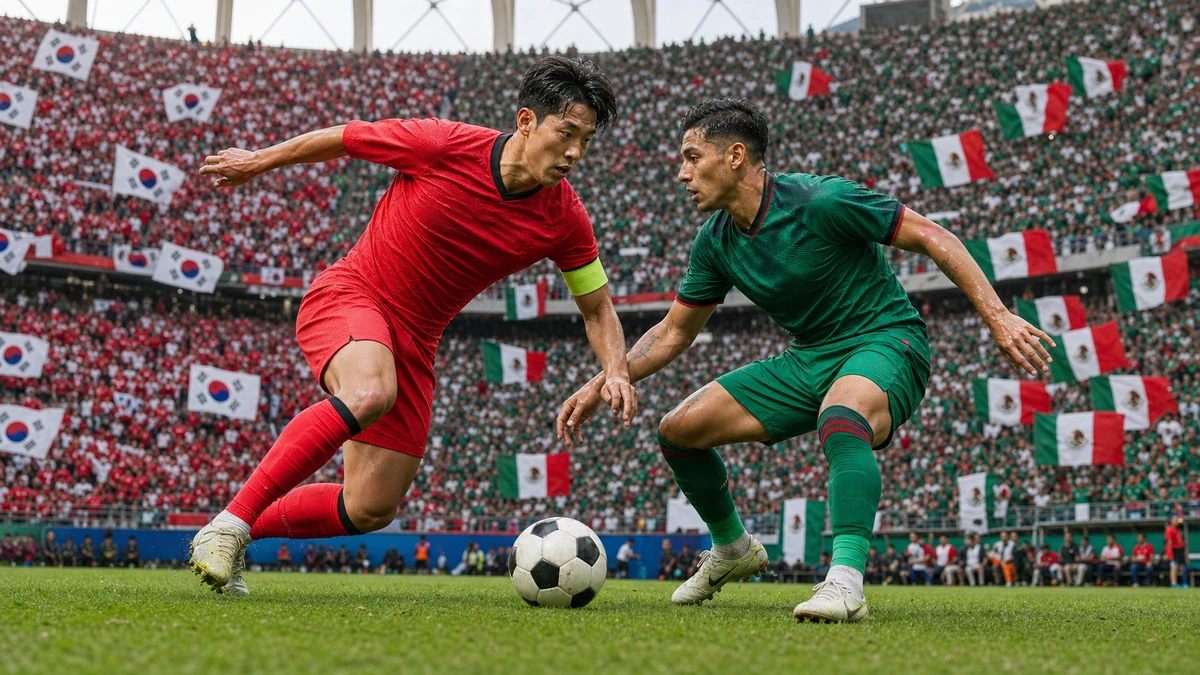
South Korea’s Son Heung-min and Mexico’s Raul Jimenez set up a World Cup showdown with first place at stake
A group-stage game that feels bigger than June
For American sports fans, the early rounds of a major tournament can sometimes blend together: one more group-stage match, one more set of standings, one more game that seems meaningful mostly to people already deeply invested. This World Cup meeting between South Korea and Mexico does not fit that description. When the teams meet June 19 in Guadalajara in their second Group A match of the 2026 FIFA World Cup, the stakes go well beyond three points in the standings. At issue is control of the group, momentum heading into the knockout phase, and a marquee duel between two veteran stars who have come to define modern soccer in their countries: South Korea captain Son Heung-min and Mexico striker Raul Jimenez.
The matchup, scheduled for 10 a.m. Korea time at Guadalajara Stadium in Zapopan, arrives with both teams carrying real expectations. South Korea opened the tournament with a 2-1 comeback win over the Czech Republic, a result that did more than pad the table. It gave manager Hong Myung-bo’s side proof that it could handle pressure, adapt in real time and finish a match on the sport’s biggest stage. Mexico, one of the three co-hosts of the 2026 tournament, enters with the emotional weight and public attention that come with playing a World Cup close to home. For both teams, this is the kind of second group match that can shape the rest of the tournament.
There is also a reason the game is drawing attention beyond Seoul and Mexico City. Son and Jimenez are not simply accomplished forwards. They are national symbols, senior figures from a generation that helped globalize Asian and North American soccer for audiences who still tend to see the sport through a European or South American lens. In U.S. terms, this is not just a game between talented scorers. It is closer to a matchup between franchise-defining veterans whose careers have become woven into their countries’ sports identities.
That framing matters because World Cup narratives often flatten teams into stereotypes: technical, physical, underdog, host, dark horse. South Korea and Mexico are more complicated than that. South Korea is no longer simply a hard-running, disciplined Asian side hoping for an upset. Mexico is no longer just a passionate regional power expected to survive the first round. Both nations arrive with experienced squads, tactical flexibility and star players whose résumés demand attention from global audiences.
Why Son Heung-min remains the face of Korean soccer
For readers in the United States who may know Son primarily from his years in the English Premier League, his place in South Korean soccer extends far beyond club fame. He is the captain of the national team, the player around whom public expectation and national pride are most visibly organized, and arguably the most internationally recognizable Korean athlete in team sports. South Korea has produced elite players before, most notably Cha Bum-kun, the trailblazing forward whose career in Germany made him a standard-bearer for generations. But Son’s stature in the social media era, and in the era of the Premier League’s global reach, is different.
According to the Korean report, Son has already become South Korea’s all-time leader in men’s national-team appearances, with 145 caps. He also sits second on the country’s all-time scoring list with 56 international goals, just two behind Cha’s record of 58. To American readers less familiar with soccer statistics, a cap is simply an appearance for the national team, and building a total that large means more than longevity. It signals trust across different coaching regimes, tournament cycles and tactical systems. It means a player has spent years not only making the roster but serving as the center of gravity for it.
That is what gives this Mexico match a potentially historic dimension for South Korea. If Son scores, he would move even closer to, or possibly level, one of the most revered records in Korean men’s soccer. In a World Cup, that kind of milestone carries a different emotional charge. Records in qualifiers or friendlies matter; records under World Cup pressure become part of a country’s sporting memory. For South Korean fans, this is not merely about whether Son is still dangerous in the final third. It is about whether one of the defining players in the nation’s soccer history can keep pushing the story forward on the grandest stage available.
There is also the question of leadership. In South Korea, the team captain is often described not just as an on-field organizer but as the emotional standard-bearer for the squad. Son’s role reflects that expectation. He is the most gifted attacker, but he is also expected to absorb pressure, answer for setbacks and provide calm in moments when a younger roster might tighten up. That dynamic can be hard for American audiences to grasp unless they think of the social burden carried by a national team quarterback, captain or Olympic flag bearer. Son is not just the best-known player. He is the public face of the effort.
Jimenez carries Mexico’s hopes on home soil
If Son represents one kind of national soccer icon, Jimenez represents another. He has long been one of Mexico’s most recognizable attacking players, a veteran striker whose career has included high-level experience in England and whose international scoring record places him among the most productive forwards his country has produced. Like Son, he has surpassed 100 appearances for the national team. Like Son, he ranks second all-time in goals for his country and stands as the leading active scorer in the pool.
That parallel gives this game its dramatic symmetry. Both teams will look to a veteran forward in his 30s, a player shaped by years in Europe, to provide the decisive moment. The comparison is not exact. Son’s game has often been defined by his speed, his ability to attack open space and his work from wide or hybrid positions. Jimenez’s reputation has leaned more toward center-forward craft: hold-up play, timing in the box, aerial presence and finishing under traffic. But in tournament soccer, styles matter less than moments, and both players have made careers out of supplying them.
For Mexico, the emotional context is impossible to ignore. This World Cup is being co-hosted by the United States, Mexico and Canada, and that means Mexico enters every home-area match under intense national scrutiny. American audiences understand what that can look like. Imagine a U.S. national team star playing a World Cup game in Los Angeles, Dallas or Miami, knowing millions expect not just a result but a statement. That is the atmosphere surrounding Mexico. A strong performance from Jimenez would not simply boost the team’s chances of topping the group. It would help set the tone for the host nation’s tournament identity.
Mexico’s soccer culture is among the most passionate in the world, and its expectations can be unforgiving. A co-hosting role raises those stakes even higher. Every tactical decision gets debated; every missed chance becomes a national conversation. That is why Jimenez’s presence matters so much. Veterans are valued not only for their production but for their ability to steady a team when tournament emotion threatens to outrun discipline. If Mexico is to manage the pressure that comes with being a co-host, it will need not just energy from the crowd but authority from its leaders.
South Korea’s preparation suggests this is no ordinary group match
The Korean team’s training schedule offers a clue to how seriously it is treating this game. According to the report, Hong’s squad held a fully closed training session for about 90 minutes at a training center near Guadalajara two days before the match. The team had allowed media access to part of the prior day’s practice, then shut things down entirely for what amounted to its final full tactical rehearsal before facing Mexico.
That kind of closed-door session is common in international soccer, but it is still revealing. Coaches generally do not hide basic fitness work or light regeneration drills. They close training when they want to protect details: starting-lineup decisions, shape changes, pressing triggers, set-piece routines or contingency plans. In this case, it suggests South Korea sees Mexico not just as its next opponent, but as the opponent most likely to determine whether the team finishes first in Group A.
In American sports language, this has the feel of a team treating a regular-season matchup like a playoff preview. The official stakes say group stage. The behavior says more than that. South Korea knows Mexico will be motivated, emotionally charged and tactically prepared. It also knows that winning the first match created opportunity but not comfort. A comeback victory over the Czech Republic was encouraging, but it does not guarantee stability. Second games at the World Cup are often where confidence is tested: was the opener a foundation, or just a moment?
Hong himself adds historical weight to the occasion. He is one of the most recognizable figures in Korean soccer history, remembered internationally for captaining South Korea during its remarkable 2002 World Cup run to the semifinals on home soil. For Korean fans, his presence on the sideline evokes a period when the national team redefined what Asian soccer could look like to the rest of the world. That does not automatically translate into results, of course, but it does shape how his decisions are read. A closed session before Mexico signals seriousness, calculation and respect for the magnitude of the opportunity.
The possible Son-Oh Hyeon-gyu partnership could change Korea’s attack
One of the more intriguing tactical storylines in the Korean report is the possibility that South Korea could start Son alongside Oh Hyeon-gyu. To casual American readers, that may sound like a routine lineup note. In practice, it could be one of the game’s defining strategic choices. Pairing Son with a more central attacking option could alter how South Korea occupies Mexico’s back line, how quickly it transitions after regaining possession and how much freedom Son has to drift into spaces where he can do the most damage.
Oh, identified in the report as playing for Besiktas, would offer a different profile than Son. Son does not need heavy explanation for global audiences: he can stretch defenses, finish from range and punish hesitation. A second forward can create the kind of platform that lets a player like Son become even more dangerous. If defenders collapse on the central striker, Son can arrive facing goal. If they track Son aggressively, the striker may find pockets inside the box. Tournament games at this level are often decided by tiny distortions of shape, not long stretches of dominance.
South Korea is reportedly expected to keep much of the same core that started against the Czech Republic. That would make sense. Teams that win their opener usually prefer continuity, especially when the schedule allows enough time to recover physically and refine details rather than overhaul the plan. This tournament’s expanded 48-team format has increased the amount of preparation time between matches, and that can favor coaches who want to sharpen combinations rather than improvise. South Korea has had time to recover, analyze Mexico and test attacking patterns in training.
For American audiences, the best comparison may be an NFL team preserving its successful base offense from Week 1 while installing a few opponent-specific packages for Week 2. The personnel looks familiar, but the usage changes. Son plus Oh could be exactly that kind of adjustment: not a reinvention, but a recalibration aimed at a different defensive challenge.
What South Korea’s comeback against the Czech Republic really means
Opening wins matter in every World Cup. But not all opening wins carry the same message. South Korea’s 2-1 comeback over the Czech Republic mattered because of the way it happened. A team that falls behind in its first tournament game can panic, especially if the burden of national expectations is heavy. Instead, South Korea reversed the result. That is significant psychologically, tactically and politically inside the team.
Psychologically, a comeback gives players evidence that they can solve problems without unraveling. Tactically, it suggests the coaching staff made workable in-game adjustments. Politically, it stabilizes the internal environment. There are fewer lineup controversies, less media pressure and more room for a coach to ask players to buy into a long-term plan. In a tournament as compressed and emotionally volatile as the World Cup, that kind of early equilibrium is valuable.
At the same time, the Mexico match presents a different kind of test. The Czech Republic may have asked one set of questions. Mexico, with a star forward, host-adjacent support and its own ambition to win the group, will ask another. South Korea is unlikely to enjoy extended comfort. The first 20 minutes could be especially important. Games like this often turn on whether one side can withstand the crowd’s early energy and avoid the sort of concession that changes the emotional tenor of the afternoon.
That is why finishing first in the group matters even this early. In the expanded World Cup, progression scenarios can become complicated, but the basic principle remains simple: teams want the cleanest possible path forward. Winning the group offers both practical and symbolic benefits. It may shape the knockout draw, and it signals that a team did more than merely survive. It imposed itself.
A meeting of soccer cultures, not just strikers
There is an easy way to sell this match: Son versus Jimenez, two veteran goal scorers, one game, first place on the line. That story is real, but it is not the whole story. What makes this contest especially compelling for an English-speaking audience is that it also reflects two soccer cultures trying to assert themselves on a global stage that still tends to privilege Europe and South America.
South Korea’s soccer identity has evolved dramatically over the last quarter-century. The 2002 World Cup, co-hosted by South Korea and Japan, changed how many people in the West viewed Korean soccer. What had been dismissed by some as merely industrious or well-organized began to be understood as something more sophisticated and more dangerous. The generations that followed, including Son’s, built on that reputation by establishing themselves in major European leagues. Today, when South Korea arrives at a World Cup with a Premier League-proven star and realistic ambitions, it no longer feels novel. It feels earned.
Mexico’s path is different but equally layered. For decades, it has been the dominant soccer power in its region, with a huge domestic fan base, a strong league and constant pressure to convert all of that into deeper World Cup runs. To American readers, Mexico may be familiar as a rival of the U.S. men’s national team, but that rivalry can obscure how globally significant Mexican soccer culture really is. A World Cup match in greater Guadalajara is not merely a neutral event with supporters in the stands. It is a civic and national occasion.
That is part of why the Son-Jimenez frame works so well. Each player stands at the intersection of local expectation and global recognition. Each has spent years proving himself in Europe while carrying the hopes of a national team that sees him as indispensable. Each is old enough now that every World Cup appearance feels a little more consequential. There may be younger stars coming, but tournaments have a way of elevating the players whose careers already carry emotional history.
Why this match will resonate far beyond Group A
If South Korea beats Mexico, the result will be interpreted as more than a single upset or statement. It would reinforce the idea that Asian teams are not just dangerous on a good day but capable of controlling major group-stage matches against established opposition. If Mexico wins, it would strengthen the notion that co-host energy, veteran leadership and tournament experience can still tilt the field in crucial moments. Either way, the game promises a story line that reaches beyond the math of the standings.
For Son, the appeal is obvious: another chance to lead, another chance to score, another chance to move closer to a national record while carrying South Korea toward the knockout rounds. For Jimenez, the assignment is just as clear: deliver for Mexico in a tournament that carries the emotional intensity of a home event, and remind the world that the hosts are not just here to celebrate but to contend.
That is what should make this game resonate with American audiences as the 2026 World Cup unfolds across North America. This is the kind of match that reveals the tournament’s true scale. It is not only about the traditional giants or the games staged in the United States. It is about the way the World Cup gathers different football histories, different public pressures and different ideas of national pride into one afternoon.
By kickoff, the most obvious focus will be the two famous forwards. But the larger story is about what they represent. Son is chasing history while carrying the expectations of a country that sees him as a once-in-a-generation figure. Jimenez is leading a co-host nation that expects boldness, not caution. And somewhere between those individual burdens lies the result that could define Group A.
In a tournament full of familiar heavyweights, South Korea versus Mexico offers something more textured: a meeting of veteran stars, ambitious national programs and soccer cultures that know exactly what a World Cup can mean. For one of them, June 19 could become the day the path ahead suddenly looks much brighter.
Comments
Post a Comment