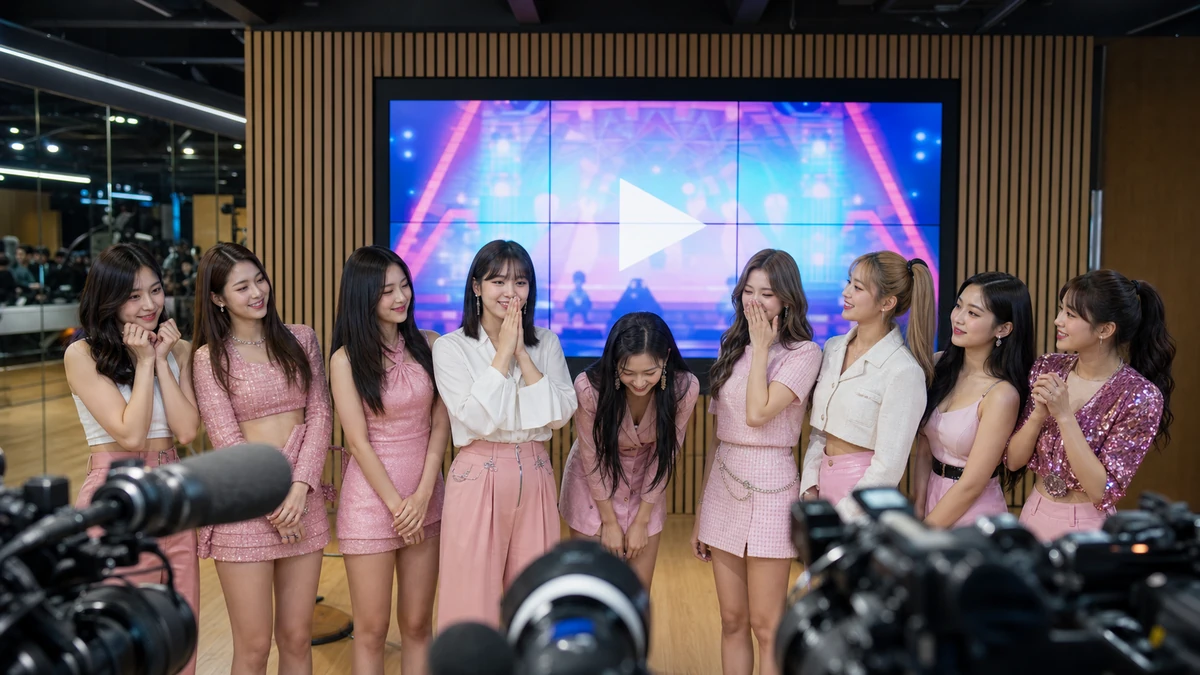
A 2016 K-pop hit finds new life nearly a decade later
TWICE, one of South Korea’s most durable and commercially successful girl groups, has crossed another major digital milestone: the music video for its 2016 smash “Cheer Up” has surpassed 600 million views on YouTube, according to the group’s agency, JYP Entertainment.
On paper, that may sound like one more large number in the streaming age, when pop stars routinely stack views, likes and followers into eye-watering totals. But in the context of K-pop — and especially for an act now deep into its career — the milestone says something more meaningful about staying power. “Cheer Up” is not a new single boosted by a short-lived burst of release-week excitement. It is a song that came out in April 2016, during a very different chapter of both YouTube and K-pop, and it is still drawing viewers in 2026.
That kind of longevity matters. In American pop terms, it is one thing to debut high on Billboard for a week or dominate TikTok for a month. It is another to remain culturally legible year after year, to keep being rediscovered by teenagers who were in elementary school — or not even born yet — when the song first came out. “Cheer Up” appears to have entered that rarer category of pop artifact: a song that is no longer just a hit from one era, but part of the permanent entry point into an artist’s catalog.
With this achievement, TWICE now has five music videos with at least 600 million YouTube views: “TT,” “What Is Love?,” “Likey,” “Fancy,” and now “Cheer Up.” That is a remarkable tally not simply because the numbers are high, but because they are spread across multiple signature songs rather than concentrated in a single blockbuster. It suggests a group whose audience has built habits around revisiting a body of work, not just replaying one viral moment.
For Americans who may know K-pop mostly through global headline-makers such as BTS or Blackpink, TWICE’s latest milestone is a reminder that the genre’s ecosystem is broader and often more sustained than casual observers assume. Success in K-pop is not only about the newest comeback, the latest chart record or a social media trend. It is also about catalog strength — about whether older songs continue living in playlists, reaction videos, dance covers and fan memory.
Why ‘Cheer Up’ still matters in the story of TWICE
“Cheer Up” occupies a special place in TWICE’s history. Released as the title track from the group’s second EP, it helped define the bright, high-energy image that became central to TWICE’s early identity. The song’s buoyant production, instantly recognizable hook and upbeat choreography made it an enduring favorite at a time when the group was still establishing itself in a crowded idol market.
To understand why that matters, it helps to know how K-pop groups are often built and branded. Unlike many American acts that evolve organically from a local scene, K-pop groups are typically assembled by entertainment companies, trained for years, and launched with a carefully calibrated concept. In that system, a breakout song can do more than top charts; it can set the emotional and aesthetic template for a group’s public identity. “Cheer Up” was one of the songs that did that for TWICE.
Its sound was “refreshing,” to use a term often heard in Korean pop coverage — bright, clean and spirited rather than dark or aggressively self-serious. The music video leaned into that same accessible energy. Even for viewers unfamiliar with Korean lyrics, the visual language was easy to grasp: playful expressions, bold styling, polished choreography and a mood that invited repeat viewing. That combination has long been part of K-pop’s strength on YouTube, where a song does not function only as audio but as a packaged visual performance.
That distinction is important for English-speaking audiences used to thinking of music videos as promotional companions to songs. In K-pop, the music video is often a primary text. It is where performance, fashion, group dynamics, fan service and branding all converge. A successful K-pop video does not just illustrate a song. It helps define how the song will be remembered, memed, taught in dance practice rooms and introduced to new fans years later.
Seen that way, the 600 million-view benchmark for “Cheer Up” is more than a nostalgia victory. It is evidence that TWICE’s early-era identity remains legible and attractive on a global platform years after trends have shifted. In an industry sometimes caricatured as relentlessly disposable, that is a notable accomplishment.
The meaning behind 600 million views
Large YouTube totals can be easy to dismiss, especially in fandom-driven genres where organized streaming is common. But the significance of “Cheer Up” crossing 600 million views lies precisely in the timeline. A new release can benefit from concentrated fan campaigns, countdown hype and algorithmic momentum. An older video reaching a number this high usually points to something broader: long-term circulation.
That circulation happens in several ways. Existing fans keep returning to the video out of affection or routine. New fans work backward through a group’s history after discovering more recent material. Casual listeners encounter a familiar title while browsing K-pop playlists. Dance fans revisit the choreography. Reaction channels and nostalgia compilations create another layer of visibility. Over time, the video stops being tied to one release cycle and becomes part of a larger archive.
That arc mirrors what American entertainment executives often call “library value” — the ongoing worth of older content after its initial commercial moment has passed. Disney relies on it. So do streaming services that bank on deep catalogs. K-pop, increasingly, relies on it too. Hits are no longer consumed only during a promotional window. They remain accessible, searchable and endlessly replayable on platforms that flatten time. A song from 2016 can sit one click away from a song released last month, competing for the same attention.
For TWICE, having five separate videos above 600 million views strengthens the argument that the group’s appeal is cumulative rather than episodic. Fans are not just rallying around one canonical smash. They are sustaining a network of songs that together map the group’s evolution. That matters for how K-pop acts build legacy. Unlike Western artists who may rely more heavily on album cycles or radio ubiquity, many Korean acts build identity through a sequence of title tracks, each with its own visual concept and choreography. When several of those songs remain active online years later, the group’s history becomes easier for new audiences to enter and understand.
The number also illustrates a broader truth about K-pop’s international reach: the genre’s success cannot be measured only by U.S. chart peaks. For many acts, YouTube remains one of the most important global connectors, especially in markets where traditional music industry gatekeepers carry less influence. A video with hundreds of millions of views represents not just domestic popularity in South Korea, but transnational circulation across languages, regions and age groups.
From screens to stadiums: the online-offline feedback loop
TWICE’s digital achievement arrives alongside another marker of scale: the group recently completed its largest world tour to date, according to JYP Entertainment. The company said the tour began in Incheon, South Korea, in July of last year and ran for one year, covering 44 locations across the globe in 81 shows.
Those figures matter because they show how online visibility can translate into ticket-buying power. In the American music business, an artist’s ability to sell out arenas is often treated as the clearest proof of durable fandom. Streams may be passive; concert attendance is not. Fans have to spend real money, travel, coordinate schedules and show up. By that measure, TWICE appears to have moved well beyond internet popularity.
JYP says the group drew 550,000 attendees in North America alone, setting a new audience record for a K-pop girl group in that market. Even accounting for the way agencies frame their own achievements, the figure points to a significant fact: TWICE is not simply a Korean act with an international online following. It is a touring force capable of mobilizing fans in one of the world’s toughest live entertainment markets.
That is particularly notable in the United States and Canada, where K-pop has moved from niche convention culture to mainstream venue business over the past decade. There was a time when Korean acts performed mostly in theaters or festival-style showcases aimed at diaspora communities and dedicated early adopters. Today, top-tier groups can fill arenas and stadium-adjacent venues with audiences that include Asian American fans, second-generation immigrants, multilingual younger listeners and plenty of people with no personal tie to Korea at all.
TWICE has been one of the groups helping build that infrastructure. The group’s appeal in North America has often rested on a combination that translates well across borders: polished live performance, easy-to-love group chemistry, choruses built for communal singing, and a catalog broad enough to reward both casual fans and hardcore followers. A song like “Cheer Up,” then, is not isolated from the touring story. Its continued visibility online helps keep the group’s earlier era alive, while the live tour reinforces the emotional investment that sends people back to older videos.
That feedback loop — watch online, attend live, revisit the catalog, bring in new fans — has become central to modern K-pop economics. It is one reason view counts still matter, even in an era crowded with streaming metrics. They show how cultural memory gets maintained between album cycles and across generations of fans.
The symbolism of a sold-out Seoul finale
TWICE is scheduled to hold the finale concerts for its world tour next month at KSPO Dome in Seoul’s Olympic Park, with performances set for July 10 through July 12. The shows are sold out, according to the agency.
For international readers, a sold-out hometown finale may sound routine. In K-pop, however, it carries a layered kind of symbolism. Many major tours begin in South Korea, travel outward through Asia, North America, Europe and other markets, and then return home for a closing chapter. That structure tells a story. It frames global expansion not as a departure from the domestic base, but as a journey that ultimately reconnects with it.
In TWICE’s case, the symbolism is especially strong. The group launched the tour in Incheon and, after a year of performances around the world, will bring it to a close in Seoul. It is a narrative arc that both Korean agencies and fans value: the act proves itself internationally, then comes home to a local audience that remains central to its identity.
The venue itself matters too. KSPO Dome, formerly known to many fans as the Olympic Gymnastics Arena, is one of Seoul’s most important indoor concert halls. Selling it out is not just another booking statistic. It signals prestige, scale and concentrated domestic demand. In practical terms, it means TWICE still commands strong support in its home market even after years of expanding globally. In strategic terms, it shows the group has avoided a trap that sometimes shadows internationally successful acts: appearing stronger abroad than at home.
That dual strength — robust overseas touring and reliable domestic demand — helps explain why a milestone like 600 million views on “Cheer Up” resonates beyond fandom circles. It fits a broader pattern in which TWICE’s older hits, current activities and concert business all reinforce one another. The group is not surviving on nostalgia alone, nor is it relying solely on fresh material to stay relevant. Instead, its past and present appear to be working in tandem.
How K-pop teaches fans to keep old songs alive
One reason K-pop stories like this can be difficult for outsiders to interpret is that the genre has trained audiences to engage with songs differently than many Western pop industries do. In the U.S., fans may love an older hit, but the promotional system usually moves on quickly. Radio shifts focus. Labels chase the next single. Music videos become relics unless they are iconic enough to enter pop-culture shorthand.
K-pop encourages a more archival relationship. Comebacks — the industry term for a new release and promotional cycle, even when a group never actually disappeared — are intense, but they do not erase prior eras. Fans are taught to think in “eras” defined by title tracks, styling, color palettes and choreography. That makes older songs easier to revisit as complete worlds rather than just tracks in a discography.
TWICE benefits from that structure because its catalog is rich in clearly defined signature songs. “TT,” “Likey,” “What Is Love?” “Fancy” and now “Cheer Up” each carry distinct visual and musical memories for fans. They are not interchangeable. They mark phases in the group’s development while remaining accessible enough for newcomers to enjoy without deep background knowledge.
There is also a communal element. K-pop fandom often functions as a culture of recommendation and education. Veteran fans guide newer fans through the essential music videos, variety clips, dance practices and performances that explain why a group matters. That informal canon-building helps older content keep moving. “Cheer Up” remains a likely recommendation because it captures so much of what made TWICE’s rise compelling in the first place.
For English-speaking readers, a useful comparison might be the way certain TV episodes or movie scenes become mandatory viewing for new fans joining a long-running franchise. The value is not just in the original moment of release, but in the work the content continues to do for community identity. “Cheer Up” appears to function that way within TWICE fandom and, more broadly, within K-pop’s digital memory.
A milestone that says as much about fans as the group
Ultimately, this kind of record is not made by a company announcement alone. It is built by years of repetition — by fans who keep clicking, sharing, introducing, replaying and remembering. That may sound obvious, but it is worth stating because it gets at the real reason old songs still become news in K-pop. These milestones are measurements of attention across time.
In that sense, “Cheer Up” passing 600 million views tells two stories at once. One is about TWICE, a group that has now built a portfolio of enduring hits rather than a career dependent on one or two cultural spikes. The other is about the global K-pop audience, which has become sophisticated at preserving and reactivating the past. Fans do not treat the music video as disposable marketing. They treat it as a living archive.
That dynamic is part of what makes K-pop such a compelling beat for international journalism. A single view-count headline can open onto bigger questions about global fandom, digital memory, platform economics and the changing geography of pop stardom. A Korean girl group can release a bright, breezy dance track in 2016, continue touring North America at record-setting scale a decade later, and still generate fresh headlines because that old song remains in motion online. That is not a minor footnote. It is a map of how pop culture now travels.
For TWICE, the “Cheer Up” milestone reinforces a reputation the group has spent years building: consistent, multigenerational and globally resonant. For K-pop, it offers another case study in how the genre’s biggest hits do not simply flare and vanish. They accumulate value over time, gathering new listeners long after the original promotion ends.
And for American readers still trying to understand why K-pop commands such intense loyalty around the world, the answer may be sitting right there in the number: 600 million views on a nearly 10-year-old video. In a media environment obsessed with what is new, “Cheer Up” is proof that in K-pop, longevity can be just as powerful as novelty.
Comments
Post a Comment