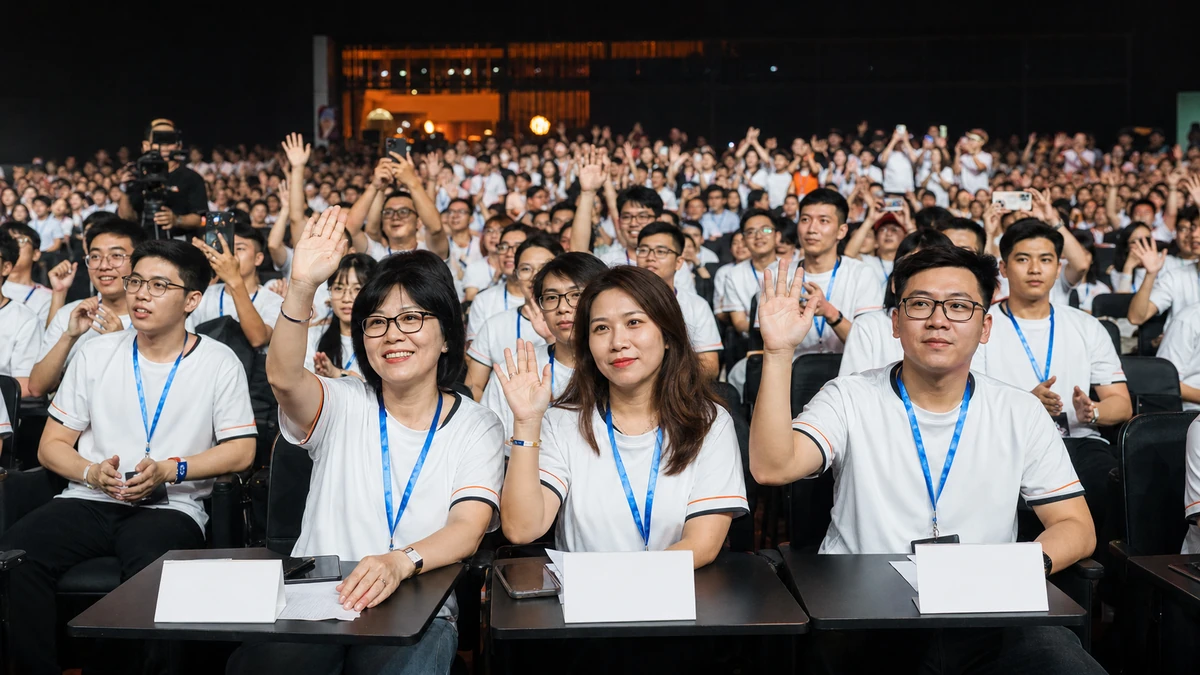
A Korean esports team draws a stadium-scale crowd in Vietnam
For many Americans, the idea of thousands of people packing a gymnasium to meet a professional video game team may still sound niche — more Comic-Con than major league sports. In much of Asia, though, that distinction has been fading for years. And in Hanoi this week, a vivid example of that shift came into focus when Hanwha Life Esports, a South Korean professional “League of Legends” team often known as HLE, drew about 5,000 local fans to a fan meeting at Quan Ngua Sports Palace.
The turnout, first reported by South Korea’s Yonhap News Agency, was not a championship match, not an international tournament and not a one-night-only spectacle built around a title victory. It was a fan event — players on stage, questions from the audience, direct interaction, brand-building and the kind of emotional connection that modern sports organizations increasingly treat as a core business asset. In other words, it was less like a game broadcast and more like a road show, the kind of in-person activation American audiences might recognize from NBA preseason global events, Formula One fan festivals or pop-star meet-and-greets.
That matters because it says something larger about the global reach of Korean esports. What used to be seen outside Asia as a specialized internet subculture is now functioning more like a mature entertainment export. South Korean teams are no longer simply producing matches for overseas fans to watch online. They are showing up in those fans’ cities, speaking to them directly and turning digital loyalty into real-world community.
In Hanoi, that strategy appears to have paid off. The sight of thousands of Vietnamese fans filling a sports venue for a Korean team’s fan meeting suggests that Korean esports has moved well beyond the boundaries of hard-core gamer fandom. It is increasingly woven into mainstream youth entertainment in major Southeast Asian cities, where gaming, streaming, social media and celebrity culture often overlap.
And for anyone tracking the broader Korean Wave — the global spread of South Korean culture through K-pop, TV dramas, film, beauty, food and fashion — this is another sign that esports belongs in that conversation. It may not travel in exactly the same way as a Netflix hit or a BTS single, but it is increasingly part of the same ecosystem: a Korean cultural product with a loyal overseas following, a sophisticated branding strategy and a business model built on fandom.
More than a one-off event
Part of what makes the Hanoi turnout notable is that this was not HLE’s first push into Vietnam. The team held its first Vietnam fan meeting in Ho Chi Minh City in 2024 and returned there again the following year. This year, it moved north to Hanoi for the first time, extending its reach from the country’s southern commercial hub into the capital region.
That geographic shift may sound like a logistical detail, but it points to something more important: this is beginning to look less like an experiment and more like a sustained market strategy. In sports and entertainment, there is a major difference between visiting a country once for publicity and returning year after year to cultivate a community. Repetition signals commitment. It tells fans they are not being treated as a temporary promotional stop, but as part of a long-term audience worth investing in.
American sports franchises have long understood the value of that kind of repeated contact. When the NFL schedules games in London year after year, or Major League Baseball stages recurring events in Mexico or Asia, the goal is not just to sell a single night of tickets. It is to deepen a habit of engagement and slowly turn interest into durable fandom. Korean esports teams appear to be following a similar playbook, adapted to a younger, more digitally native audience.
For HLE, the third straight year of fan events in Vietnam suggests the organization sees the country not simply as a place where its content happens to be watched, but as a strategic base of support. That distinction matters economically. Esports organizations do not sell only wins and losses. They sell personalities, team narratives, visual identity, emotional attachment and a sense of belonging. A packed fan meeting is evidence that those intangible assets are resonating beyond Korea’s borders.
At the same time, caution is warranted. The available reporting establishes the scale of the turnout and HLE’s recent history of fan events in Vietnam, but it does not provide hard figures on revenue, sponsorship gains or future business plans. So the safest conclusion is not that Korean esports has solved the commercial puzzle overseas, but that it has demonstrated meaningful, measurable fan heat on the ground.
Why Vietnam matters in the Korean esports map
HLE described Vietnam as a core market where fandom for the LCK — South Korea’s top-tier “League of Legends” league — is growing rapidly and passionately. For readers who do not follow competitive gaming, the LCK is one of the most prestigious leagues in the world, widely associated with elite play, disciplined team systems and some of the biggest stars in the game. If “League of Legends” esports has a spiritual home, South Korea is often seen as one of its central capitals.
That prestige helps explain why Korean teams command interest across Asia. But Vietnam’s importance is not just about admiration for Korean talent. It is also about demographics, media habits and the everyday place gaming occupies in the lives of younger consumers. Southeast Asia has a large population of digitally connected young people who move fluidly between livestreams, mobile games, social video, influencer culture and online communities. In that environment, esports is not a fringe hobby. It is part of a broader entertainment lifestyle.
Vietnam, in particular, has become one of the region’s most energetic gaming audiences. The country’s fan culture around esports has been visible for years, especially in online engagement and tournament viewership. Korean teams entering that space are not creating interest from scratch. They are stepping into an existing ecosystem where the language of fandom — cheering for players, discussing strategy, buying merchandise, attending events and following personality-driven content — is already well developed.
That is one reason a fan meeting can carry so much weight. It transforms passive overseas viewership into shared physical experience. People who may have watched matches alone on phones or laptops suddenly gather in a crowd, chant for players, react together and see their online loyalty validated in public. In practical terms, that helps strengthen community. In branding terms, it turns a distant team into a tangible presence.
For Korean companies, that kind of engagement also reflects a broader shift in how South Korea competes globally. For decades, American coverage of Korean business often focused on manufacturing, semiconductors, cars, shipbuilding and consumer electronics. Those remain foundational sectors. But South Korea’s international influence today is also powered by content industries — music, drama, film, gaming and all the fan economies built around them. HLE’s event in Hanoi is a small but revealing case study in that transformation.
Esports as culture, not just competition
One of the most revealing details from the Hanoi fan meeting had little to do with game strategy or tournament results. During a conversation with fans, a local attendee asked player Kim Geon-woo whether Vietnamese food suited his taste. He replied that he already enjoyed pho and cha gio — the fried spring rolls often known in English as Vietnamese egg rolls — back in Korea, but that trying them at a local restaurant in Vietnam confirmed that the food tastes even better there.
On paper, it is a small exchange. In practice, it shows why these events matter. Global fan culture is built not only on excellence, but on intimacy — or at least the feeling of intimacy. Fans are drawn to the idea that the stars they follow are responding to their city, their language, their food and their daily life. A player commenting warmly on local cuisine may sound minor compared with a tournament win, but it can do important cultural work. It narrows distance. It suggests respect. It tells fans they are being seen, not merely marketed to.
This is true well beyond esports. K-pop’s global success, for example, has depended not only on polished production and catchy music, but on a highly developed system of fan communication, from livestreams and social posts to in-person tours and merchandise events. In American sports, too, fan loyalty increasingly grows through behind-the-scenes access, personality-driven content and moments that feel authentic. Esports, perhaps more than any other entertainment sector, sits naturally at the intersection of all those trends.
That makes cultural fluency especially important. A Korean team hoping to deepen its following abroad cannot rely on gameplay alone. It also needs to show that it understands local fan culture and approaches it with curiosity rather than distance. The exchange over Vietnamese food in Hanoi may be remembered by attendees precisely because it was ordinary. It was not a scripted marketing slogan. It was a familiar, human-scale interaction — one of the easiest ways for international fandom to feel personal.
For American readers, a useful comparison may be how sports stars often build goodwill overseas by embracing local customs, trying regional dishes or learning a few words in the local language. These gestures can be symbolic, but symbols matter. They tell fans that the relationship is a two-way street. In the crowded global attention economy, those details help determine which brands are merely visible and which are genuinely beloved.
The business logic behind fan meetings
It is easy to view fan meetings as lightweight publicity, but in modern entertainment they are part of a much larger commercial structure. Esports is not just competition. It is also media content, live events, merchandise, sponsorship, storytelling and intellectual property. Teams are brands. Players are personalities. Matches are only one piece of the product.
That is why a fan meeting in Hanoi deserves attention beyond the novelty factor. By gathering 5,000 people in one venue, HLE demonstrated that its appeal can mobilize an audience in physical space, not just on streaming platforms. That is a meaningful distinction for sponsors, local partners and organizers, all of whom care about whether digital popularity converts into real-world attendance and visible enthusiasm.
In traditional sports, that conversion has long been essential. A team with television ratings but weak arena attendance faces one kind of business challenge; a team that can activate fans both online and in person is in a stronger position. Esports organizations face similar questions, even if their business models are still evolving. Can they sell merchandise? Can they create fan experiences people will travel for? Can they sustain loyalty when results fluctuate? Can they make their brand matter between competitions?
Offline events help answer those questions. They deepen emotional attachment, generate social media moments, create new content and give fans memories that are more durable than a stream watched at home. They can also help broaden a team’s identity from pure competitive performance into lifestyle affiliation — the difference between supporting a club because it wins and supporting it because it feels like part of your world.
None of that means every packed fan meeting guarantees major profits. The underlying financial picture in esports remains uneven in many markets, and a strong event turnout alone does not reveal the full economics. But it does show that the foundation of fandom exists, and that matters. In cultural industries, attention is often the scarce resource that comes before monetization. If thousands of people are willing to spend time and energy showing up in person, that is a signal no serious entertainment business ignores.
The Korean Wave keeps expanding its borders
For years, the term “Korean Wave,” or hallyu, has been associated in American conversation mostly with K-pop and television dramas. More recently, films such as “Parasite” and streaming sensations like “Squid Game” helped push Korean storytelling further into the U.S. mainstream. But hallyu has never been limited to music and TV. It is better understood as a broader ecosystem of cultural influence, where industries reinforce one another and fandom travels across formats.
Esports fits naturally into that pattern, even if it receives less attention in many American newsrooms than music or film. Like K-pop, esports depends on devoted fan communities, recognizable personalities, highly networked digital distribution and constant content circulation online. Like Korean dramas, it travels through emotional investment, serialized narratives and intense audience attachment. And like much of the Korean entertainment industry, it benefits from South Korea’s reputation for producing polished, globally competitive cultural products.
The scene in Hanoi suggests that for many young fans in Southeast Asia, Korean esports is not a separate universe from the rest of Korean pop culture. It is part of the same larger current: a way of engaging with Korea through stars, brands, language, online communities and consumer identity. In that sense, an esports team fan meeting can function much like an idol event or a fan convention. It offers proximity, recognition and the thrill of shared belonging.
This is especially important in a region where youth culture is shaped heavily by mobile connectivity and platform-driven media consumption. Fans may discover a Korean team through match clips, follow players through social media, engage with other supporters through online communities and then eventually show up at an in-person event. That journey from screen to venue is central to how modern fandom works.
From a U.S. perspective, there is also a broader lesson here about how global influence is measured. Soft power is not only about government diplomacy or blockbuster exports that dominate Western charts. Sometimes it is visible in the quieter but deeply significant spread of fan rituals, shared references and recurring live events. A Korean team filling a venue in Hanoi does not look like traditional geopolitics. But it tells us something real about which countries, brands and cultural systems are successfully building long-term affection abroad.
What Hanoi reveals about the next phase of global esports
The Hanoi event also hints at where esports may be headed as an international industry. For years, much of the conversation centered on online viewership, tournament prize pools and platform growth. Those metrics still matter, but the next stage may depend increasingly on how well organizations turn remote audiences into local communities. That means more city-based events, more direct fan engagement and more investment in cultural relevance outside the home market.
HLE’s decision to bring its Vietnam fan meeting to Hanoi after two previous editions in Ho Chi Minh City underscores that point. It was not just revisiting the same audience. It was testing and expanding the map. The large turnout suggests that enthusiasm for Korean esports in Vietnam is not confined to a single city or one isolated pocket of supporters. It appears broad enough to support live engagement in multiple urban centers.
That should get the attention of anyone studying media and youth culture in Asia. It suggests that Korean esports teams can function almost like touring entertainment brands, moving between cities and converting regional recognition into localized loyalty. The playbook is familiar from music and sports, but esports may be especially well suited to it because its audience already lives online and is accustomed to constant interaction.
There is also a larger regional implication. If Korean teams can successfully build repeated offline engagement in Vietnam, other Southeast Asian markets may become increasingly important in the same way. The region’s youthful demographics, heavy mobile usage and strong gaming culture make it fertile ground for organizations that know how to build relationships, not just stream content.
Still, the most responsible reading of the Hanoi event is a measured one. The available facts support a clear conclusion: Korean esports has demonstrated striking fan engagement in Vietnam, and HLE’s three-year pattern of events points to deliberate long-term outreach. What they do not support is any sweeping claim about guaranteed commercial dominance or precise financial outcomes. The significance here lies first in cultural traction, then in the business possibilities that traction may create.
For American and English-speaking readers, that is the reason this story matters. It offers a glimpse of how global entertainment is changing. The next influential export is not always a movie, an album or a consumer gadget. Sometimes it is a professional gaming team from Seoul drawing thousands of fans in Hanoi, proving that in the digital era, community can cross borders faster than almost any product — and that the industries best positioned to win are the ones that know how to meet those communities face to face.
Comments
Post a Comment