A new job in South Korean education points to a bigger question: Who records power in real time?
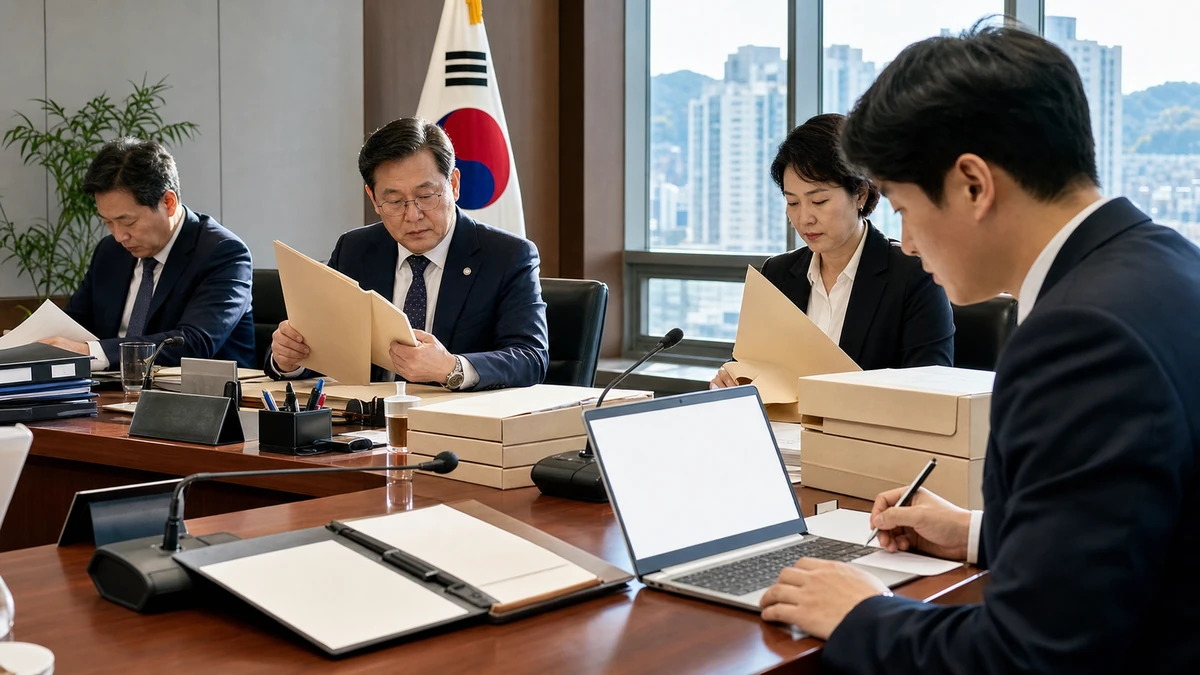
In South Korea’s most populous province, the incoming administration for the superintendent of education in Gyeonggi Province has announced plans to openly recruit a new kind of official: a “record secretary,” a role designed to systematically document the superintendent’s remarks, directives and decision-making process as it unfolds.
At first glance, the posting may sound narrow or bureaucratic, the sort of internal staffing notice that rarely travels beyond government offices. But in a country where education policy can shape the daily lives of millions of students and families, the move is drawing attention for what it suggests about public administration, accountability and the value of institutional memory.
According to the transition committee for the province’s newly elected superintendent, the position would be filled through an open recruitment process among fifth- and sixth-grade local civil servants working at the Gyeonggi Provincial Office of Education headquarters. The person selected would accompany the superintendent, record major statements and instructions in real time, and preserve and manage key political and administrative records.
For American readers, it may help to think of the role as part policy aide, part archival officer and part in-house chronicler of executive decision-making. The closest comparison is not a typical press secretary, who helps communicate decisions to the public, but a staff member charged with preserving the official trail behind those decisions while they are being made.
In an era when public trust often depends on whether government can show not just what it decided but how it got there, that distinction matters.
Why Gyeonggi Province matters
To understand why this job posting is noteworthy, it helps to understand what Gyeonggi Province represents in South Korea. The province surrounds Seoul, the capital, and includes a vast suburban belt that is home to a large share of the country’s population. Its education office is one of the largest local education administrations in South Korea, overseeing policy that affects a huge network of public schools, teachers, students and parents.
South Korea’s education system is highly structured, intensely competitive and politically consequential. Unlike in many parts of the United States, where school governance is often spread across local districts, county boards and state agencies, South Korea has elected provincial and metropolitan superintendents of education who can wield considerable influence over school policy in their jurisdictions. These officials are not merely symbolic figures. They help shape curriculum priorities, student welfare initiatives, teacher administration and the practical direction of public education at the regional level.
That means the superintendent’s public comments, field instructions and internal judgments can carry significant weight. A remark made during a school visit or a directive given during a meeting may later affect how a policy is implemented on the ground. In a system that serves large numbers of students and depends on coordination among administrators, principals, teachers and families, the record of what was said and why can be as important as the final policy document itself.
For Americans, a rough analogy might be a governor’s office or a major state education department creating a dedicated post to follow the chief official, capture verbal guidance in real time and maintain a structured archive of politically significant records. That would likely be seen not as clerical housekeeping but as an effort to formalize accountability.
That appears to be the broader significance of what is happening in Gyeonggi.
More than note-taking: the administrative meaning of “accompanying records”
The most striking detail in the announcement is that the record secretary would travel with or accompany the superintendent and document major remarks and instructions as they happen. In other words, the role is built around capturing the flow of decision-making before it hardens into official policy language.
That matters because government often runs on a mix of formal documents and informal direction. A decision may begin as a comment in a meeting, a question during a site visit or a quick instruction after a conversation with staff. If those moments are not recorded carefully, agencies can end up relying on memory, interpretation or fragmented notes. Over time, that can create confusion about what was intended, who was responsible and how a policy evolved.
The transition committee’s description suggests that the record secretary would help bridge that gap. Instead of leaving consequential remarks to be reconstructed later, the office wants a system that captures them in real time and turns them into managed records.
In South Korea, where administrative culture has long placed a high value on process, documentation and hierarchy, the idea carries particular weight. Public institutions are expected to maintain records, but this role appears to elevate the act of recording from a secondary task to a specialized one. It treats documentation not as an afterthought but as a core function of governance.
That can have practical benefits. Education policy touches a wide range of stakeholders: students, parents, teachers, school staff and local administrators. If a superintendent’s intent is poorly documented, confusion can ripple outward. Schools may interpret the same directive differently. Staff turnover can weaken continuity. Later reviews of a policy may focus only on its outcome, without a clear understanding of the conditions or reasoning that shaped it.
By preserving what might be called the “memory” of decision-making, a record secretary could help reduce that drift. The role would not decide policy. But it could help ensure that the path to policy is not lost.
What the hiring criteria say about the job
The transition committee said the personnel division of the provincial education office would oversee the selection process, and that officials with strong understanding of education policy, experience across multiple institutions and skill in drafting administrative documents would be preferred.
Those qualifications offer an important clue: this is not being framed as a shorthand or stenography job. It is a role for someone who understands policy language, organizational structure and how oral direction becomes administrative action.
That distinction is crucial. A superintendent’s remarks in the field can be compressed, political or situational. A capable record secretary would need to understand not only the literal words but also the institutional context in which they were delivered. Was a comment a formal instruction, a policy preference, a question for review or a rhetorical remark for an audience? In any bureaucracy, getting that wrong can create problems.
The emphasis on document-writing ability is also telling. In many governments, drafting is power. The way an instruction is written down affects how it is interpreted later. A person who can accurately translate spoken directives into precise administrative language performs a meaningful public function, especially in a large education system where written guidance can travel across layers of offices and schools.
The criterion of having worked in multiple institutions is equally revealing. Education governance does not happen only at headquarters. It involves coordination with schools, affiliated bodies and frontline administrators. Someone who has moved across institutions may be better equipped to understand how a comment from the superintendent will travel through the system and where ambiguity is likely to arise.
Seen together, the qualifications suggest the office is looking for someone who can do more than keep minutes. It wants a civil servant capable of interpreting administrative context and preserving it with precision.
Why an open recruitment process sends its own message
The transition committee’s decision to use an open recruitment process among eligible internal civil servants is another notable part of the story. In any government, appointments that sit close to top officials can raise questions about loyalty, favoritism or political convenience. Opening the process, at least within the pool of qualified staff at headquarters, signals that the administration wants to present the position as a professional function rather than a purely personal appointment.
That does not automatically make the process fully transparent or beyond criticism. An open application process can still leave unanswered questions about how candidates are evaluated, how much weight is given to each criterion and whether the final choice reflects the stated goals. Those details were not laid out in the summary of the announcement. But the decision to publicly recruit rather than directly designate a person still matters.
It tells employees inside the institution that record-keeping at the superintendent’s level is being treated as a distinct competency. It also tells outside observers that the administration sees value in articulating what the role is for and what kinds of skills it requires.
For American audiences, that may sound similar to debates around records management in city halls, governors’ offices and federal agencies. Questions over emails, meeting logs, visitor records and informal instructions have become central to public trust in the U.S. as well. Whether in Washington, a state capital or a school system, citizens increasingly expect that important decisions leave a recoverable trail.
Gyeonggi’s move does not solve every issue around transparency. But it acknowledges something that many institutions only learn after controversy: if the record is weak, accountability becomes weak too.
Education policy is personal in South Korea
This story may sound procedural, but in South Korea, education is deeply personal and politically sensitive. Families often invest enormous emotional and financial energy in schooling. The country is known internationally for high academic achievement, but also for the pressure that surrounds exams, admissions and educational opportunity. Decisions made by education authorities can quickly affect after-school routines, teacher workloads, school operations and household expectations.
That is one reason the mechanics of administration matter. To parents, a change in school policy is not abstract. It can shape transportation, tutoring, testing schedules, classroom support and the overall rhythm of family life. To teachers, policy changes can alter reporting requirements, classroom discretion or disciplinary procedures. To students, they can change the conditions under which everyday school life unfolds.
In that context, documenting the superintendent’s direction becomes more than an internal management issue. It becomes part of how the system explains itself to the public over time. If a policy later draws praise or criticism, a reliable record can help establish whether it emerged from a formal plan, a field observation, a crisis response or a series of incremental instructions.
That is especially important in education, where the effects of a decision may not become visible right away. A superintendent’s priorities can continue shaping schools long after a press conference ends or a campus visit is forgotten. A preserved record offers continuity in a system where personnel change, administrations turn over and memories fade.
In the U.S., Americans are familiar with archival disputes in presidential administrations, battles over text messages and controversies about whether key conversations were properly documented. The same principle applies here on a regional education level: public institutions work best when official memory does not depend on whoever happens to still be in the room.
What this does — and does not — tell us yet
For all the attention the announcement is receiving, it is important to be precise about what has actually been confirmed. The transition committee said it would openly recruit a record secretary, tentatively named, from among eligible fifth- and sixth-grade local civil servants at the Gyeonggi Provincial Office of Education headquarters. The job would involve recording the superintendent’s major remarks and instructions in real time and preserving and managing key records connected to the office’s political and administrative work.
What has not been confirmed, based on the available summary, is any broader reorganization of the education office, a larger record-management overhaul or a final implementation schedule beyond the recruitment itself. The announcement does not by itself mean a sweeping new policy architecture has been put in place. Nor does it guarantee how the role will function in practice once filled.
That caution matters in journalism, especially with administrative stories that can invite overinterpretation. The significance here lies less in claiming a revolution in governance and more in recognizing a meaningful signal: a major public education office is explicitly trying to institutionalize how an elected leader’s words and judgments are preserved.
That may sound modest. In practice, modest administrative changes often shape how responsibly a government functions. A new title can indicate a new norm. A formalized duty can reveal what an institution has decided to value. In this case, the value appears to be this: decisions should leave a documented path, not just a result.
The larger lesson: public trust depends on public memory
There is a reason this development resonates beyond South Korea. Democracies depend not only on elections, laws and leaders, but on records. Without records, continuity breaks down. Officials cannot reliably reconstruct why a choice was made. Citizens cannot easily judge whether promises matched actions. Successors inherit outcomes without inheriting context.
That is why the Gyeonggi announcement is more than a staffing note. It reflects a basic but often overlooked truth about modern government: memory is infrastructure. Just as schools need buses, budgets and buildings, public administration needs systems that preserve how decisions were made.
In many countries, record-keeping becomes visible only during scandal, when missing documents or undocumented instructions create suspicion. What makes this case interesting is that the issue is being addressed proactively, at least in form, through a dedicated role tied to the superintendent’s daily work. It is an attempt to make documentation part of governance at the point of action, not just after the fact.
For Americans watching developments in South Korea, the episode also offers a small but revealing window into how Korean public institutions are evolving. Much of international attention on South Korea tends to focus on K-pop, technology, North Korea or headline politics. But the texture of democratic life is often found in quieter places: in school systems, personnel procedures and the methods governments use to remember themselves.
If the new role works as intended, it could improve continuity, clarify policy origins and strengthen administrative discipline in one of the country’s most important education systems. If nothing else, it underscores a principle that crosses borders: when public officials speak, direct and decide, those moments are not disposable. In a functioning democracy, they become part of the public record.
And increasingly, that record is not just a pile of paperwork. It is the institutional memory that allows a government — and the public it serves — to understand what happened, why it happened and who should answer for it.
Comments
Post a Comment