BTS Jimin’s World Cup halftime outfit sells for $110,000, underscoring K-pop’s power far beyond music
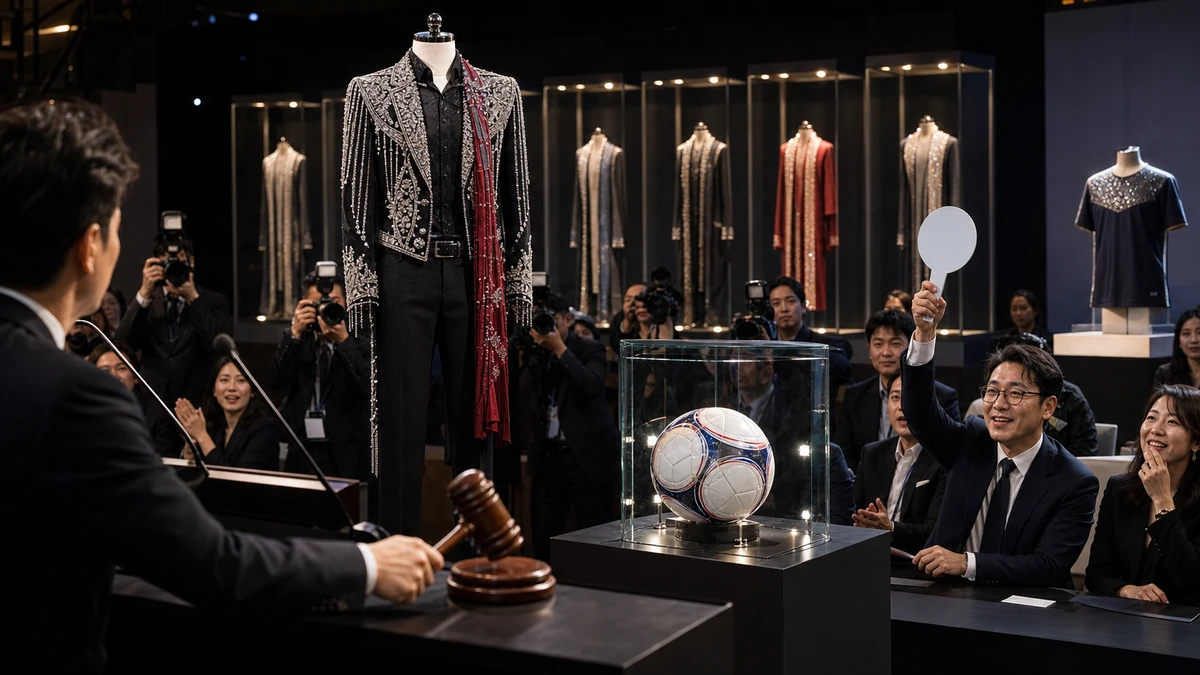
A K-pop costume stands alongside soccer’s biggest symbols
A stage outfit worn by BTS member Jimin during the 2026 FIFA World Cup final halftime show has sold at a charity auction for $110,000, a result that says as much about the changing map of global pop culture as it does about celebrity memorabilia. According to South Korean broadcaster MBC, the outfit matched the auction’s top price alongside the official World Cup match ball and sold for more than 20 times its appraised value.
That figure alone would have made headlines in South Korea, where BTS remains not just a chart-topping act but a national cultural force. But the sale drew even wider attention because Jimin’s outfit reportedly fetched more than a signed Lionel Messi jersey offered in the same auction. Messi, one of the most recognizable athletes on the planet and often referred to by fans as soccer’s greatest player, represents a level of sports iconography familiar to American audiences in the way Michael Jordan or Tom Brady memorabilia might. For a K-pop performance costume to outpace a Messi-signed item in a World Cup-related sale is the kind of comparison that instantly signals a larger shift.
The auction result is not a simple measure of who is “more famous.” Memorabilia markets are notoriously shaped by timing, rarity, emotional connection and the specific story attached to an object. Still, the headline number matters. It suggests that for a growing class of global collectors and fans, the cultural memory of a major sports event no longer belongs only to the game itself. It also belongs to the music, the fashion, the spectacle and the fandom that surround it.
In that sense, Jimin’s outfit was not just clothing. It was a souvenir of a highly choreographed global moment: one of the world’s biggest pop stars appearing on the sport’s biggest stage, in front of an audience measured in the hundreds of millions. The price paid for it reflects how valuable that moment has become.
Why this matters to American readers
For Americans, the easiest point of comparison may be the Super Bowl halftime show, where a performance can become almost as discussed as the game itself. Prince in the rain, Beyoncé’s politically charged choreography, Rihanna’s floating platforms during pregnancy, Kendrick Lamar’s recent high-profile turn — these are remembered not as side attractions but as defining pieces of the event. Costumes worn during those performances can take on a second life as artifacts of pop culture history.
The World Cup final halftime stage now appears to be operating in a similar space, and BTS is uniquely positioned to capitalize on that convergence. In the United States, K-pop has often been treated as a youth-driven or niche import, despite years of evidence to the contrary. BTS has sold out stadiums, topped the Billboard Hot 100, spoken at the United Nations and built one of the most organized fan bases in modern entertainment. Their impact has long surpassed music charts. What this auction suggests is that the group’s influence is also extending deeper into adjacent markets Americans understand well: sports entertainment, luxury collecting and high-profile philanthropy.
That is especially notable because memorabilia is often one of the last places where old cultural hierarchies remain visible. Sports relics, especially those connected to the World Cup, tend to occupy a near-sacred place for collectors. Match balls, game-worn jerseys and signed boots carry an aura rooted in competition, records and athletic mythmaking. A performance costume entering that realm at the very top of the price ladder signals a broader recalibration of what fans consider historically significant.
For years, American entertainment executives have watched K-pop’s growth through the lens of streaming numbers, concert grosses and social media engagement. Those metrics matter, but they can flatten what fandom actually feels like on the ground. Auction results like this one offer something more tangible. They show what people are willing to pay to own a physical piece of a shared emotional experience. That is a different kind of cultural proof.
The BTS effect was bigger than one outfit
The sale of Jimin’s costume was the headline-grabber, but it was hardly the whole story. MBC reported that seven BTS-related items tied to the group’s World Cup final halftime appearance — including scarves, jackets and gloves worn by all seven members — brought in a combined 440 million won, or roughly $320,000 at recent exchange rates. Taken together, those BTS items reportedly accounted for half of the auction’s total sales.
That detail may be even more revealing than the $110,000 figure attached to Jimin’s outfit. It suggests the market was not responding only to one especially popular member, but to the collective power of BTS as a complete group. In K-pop, that distinction matters. While individual members often develop distinct followings, BTS has long thrived on a dual identity: seven global celebrities, but also a single unit with a carefully built group narrative that fans, known collectively as ARMY, have invested in for years.
To people unfamiliar with Korean pop culture, that kind of attachment can look unusually intense. But it helps to understand fandom in K-pop not just as passive admiration, but as active participation. Fans do not simply consume albums and concert tickets. They track story lines, analyze visuals, celebrate anniversaries, support charitable campaigns, collect physical merchandise and treat key performances as milestone events. The emotional bond is reinforced through frequent direct communication, behind-the-scenes content and a level of narrative continuity that few Western acts attempt at the same scale.
That helps explain why items such as gloves or scarves can command serious money. Their value is not in the fabric itself. It lies in what collectors believe the object contains: a trace of a historic performance, a connection to a moment shared across continents, and a piece of a group identity that fans have spent years helping sustain. If that sounds abstract, it is also exactly how cultural artifacts acquire meaning. The most coveted memorabilia is almost never about material utility. It is about memory.
The fact that seven different BTS items collectively drove half the auction’s performance points to another reality: K-pop is increasingly producing collectible objects with staying power. Not disposable merch. Not novelty items. Cultural assets.
From Seoul to the world stage
South Korea has spent decades building what is now commonly called the Korean Wave, or hallyu, a term used to describe the global spread of Korean popular culture, including music, television, film, fashion and beauty products. In the United States, the effects are already visible. Korean dramas routinely trend on Netflix. Bong Joon Ho’s “Parasite” won the Oscar for best picture. Korean skincare has become a staple in American retail. And BTS helped push Korean-language pop music into spaces once thought nearly impossible to crack without full English assimilation.
But the symbolism of a World Cup final halftime performance is slightly different from topping a chart or winning an award. The World Cup is not only a sports event; it is one of the rare cultural gatherings where national identity, commercial spectacle and mass entertainment are compressed into a single stage. For a Korean act to be central to that moment matters because it reflects how South Korea’s cultural exports now circulate independently of the country’s geopolitical size.
That is worth pausing on. South Korea is a U.S. ally with enormous influence in technology, defense and manufacturing, but in purely demographic terms it is a mid-sized country. Its entertainment output has become globally influential not because of scale, but because of strategy, quality and timing. The rise of BTS is often framed as an improbable success story, but it is also part of a larger ecosystem in which Korean culture has become one of the world’s most effective soft-power tools.
The auction result functions as a kind of aftershock from that broader phenomenon. South Korea did not need to have its national soccer team in the final for Korean culture to be present at the event in a major way. BTS, by performing during the halftime show, gave the country a form of visibility disconnected from the scoreboard. Now, the charity sale suggests that visibility did not fade when the broadcast ended. It converted into collectible value.
For American audiences accustomed to thinking about global cultural power as flowing outward from Hollywood, New York, London or Los Angeles, that is an important development. The center of gravity is no longer fixed.
Why Jimin’s outfit beat a Messi jersey
Much of the buzz around the sale came from the comparison with Messi’s signed jersey, which MBC said sold for less than Jimin’s stage outfit. It is a striking contrast, but it deserves careful reading. Different types of memorabilia attract different types of bidders, and signed items do not always outperform game-worn or event-specific objects. A match ball, for example, can carry different symbolic weight from a jersey; a costume worn in a globally televised performance can appeal to both music and fashion collectors, not just sports fans.
Even so, the comparison resonates because Messi represents a kind of universally legible stardom. He is not just a soccer player. He is a shorthand for greatness. In the U.S., even people who do not follow international soccer often know his name, especially after his move to Major League Soccer raised the sport’s profile stateside. When a BTS item outperforms a Messi item at a World Cup-linked auction, it sends a message that the market for K-pop artifacts is now operating on an elite global tier.
It also reflects the nature of Jimin’s appeal. Among BTS members, Jimin has built a reputation for elegant stage presence, fashion influence and emotional precision as a performer. His solo work has expanded that image, but even within the group he is often associated with performance moments that translate especially well into visual memory. Costumes matter in that context. They are part of the storytelling.
Fashion, after all, has become inseparable from contemporary celebrity economics. Pop stars are brand ambassadors, red-carpet fixtures and style references as much as musicians. A stage outfit worn at an event as globally visible as the World Cup final can carry multiple layers of value at once: music history, fashion history, sports history and fan identity. That mixture may help explain why bidders pushed the price so far past its estimate.
What the sale does not prove is that K-pop has “defeated” sports, or that one fandom is inherently more powerful than another. Those are easy but shallow conclusions. What it does show is that collectors increasingly understand major sporting events as cultural ecosystems, not just athletic contests. In that ecosystem, a halftime performance can become every bit as memorable as a goal, and the objects associated with it can appreciate accordingly.
Fandom as economic force — and charitable one
The other important part of this story is that the sale was a charity auction. That matters because it reframes the spending. In the popular imagination, fandom purchases can be dismissed as frivolous or irrational, especially when eye-popping sums are involved. But charitable auctions occupy a different moral space. They allow fans and collectors to transform devotion into public benefit.
The final prices, particularly the fact that Jimin’s outfit sold for more than 20 times its estimate, indicate that bidders were not simply evaluating an item’s resale potential. They were participating in a ritual of significance. Winning the item meant owning a piece of a memorable global event, but it also meant contributing to a cause larger than private collecting.
This overlap between celebrity culture and philanthropy is not unique to K-pop, but K-pop fandom has become especially adept at mobilizing collective action. BTS fans have raised money for social causes, organized birthday donations in members’ names and coordinated international campaigns with a speed and scale that many nonprofits would envy. That infrastructure of organized enthusiasm helps explain why charity-linked BTS items can perform so strongly. The purchase is not only consumption. It is also participation in a community ethic.
There is a broader lesson here for American institutions, especially in sports and entertainment, that are still trying to understand younger global audiences. Fandom today is not just about loyalty; it is about identity, coordination and meaning-making. Objects become vessels for that identity. Auctions make those values visible in dollar terms.
When one performance costume helps drive a major charity event’s outcome, it becomes harder to dismiss pop fandom as mere hype. It starts to look more like a durable form of cultural capital.
What this says about the future of K-pop memorabilia
If there is a long-term implication to this sale, it may be that K-pop memorabilia is entering a new stage of legitimacy. For years, collectors treated signed albums, photo cards and concert goods as highly prized inside fandom circles but relatively opaque outside them. That is changing. As K-pop becomes more deeply woven into mainstream global culture, the categories that once separated “fan merch” from “serious collectibles” are beginning to blur.
The World Cup final setting accelerated that shift. It attached BTS memorabilia to an event already understood as historic. That connection matters because collectors often look for convergence points — moments when an object sits at the intersection of multiple cultural narratives. Jimin’s outfit is not just tied to BTS. It is tied to a World Cup final, a halftime spectacle, a cross-industry global broadcast and an era in which Korean pop culture has become impossible to ignore.
That kind of layered symbolism tends to age well in the collector market. It gives future buyers more than one reason to care. Even people who are not dedicated K-pop fans may eventually view such items as representative of a larger story: how 21st-century fame became borderless, multimedia and intensely participatory.
The strong showing for all seven members’ items also suggests the market may increasingly value group-era artifacts, not just solo milestones. In BTS’s case, that could be especially important. The group’s collective history remains central to how fans interpret each member’s career. Objects tied to complete-group appearances may carry a premium because they capture a configuration fans know is rare, emotionally loaded and historically significant.
For auction houses, museums and entertainment companies, that creates opportunities and challenges. There will likely be more interest in preserving, documenting and marketing K-pop performance artifacts with the seriousness once reserved for sports legends or rock icons. The question is whether institutions are prepared to treat those items not as passing craze memorabilia, but as part of the permanent record of global popular culture.
A global memory, priced in dollars
At one level, the story is simple: a famous singer’s World Cup halftime outfit sold for $110,000. At another, it is a snapshot of the world as it is now — a place where a Korean pop star can occupy the same symbolic marketplace as the most famous athlete in soccer, where fandom can convert emotion into both economic and charitable force, and where the memory of a sports event is shaped as much by performance and image as by play on the field.
For American readers, the deeper significance may be this: the cultural mainstream is no longer something exported by the West and consumed elsewhere. It is increasingly built in motion, through overlapping audiences, shared digital rituals and events that collapse national boundaries in real time. BTS has been demonstrating that for years. This auction simply put a price tag on it.
The strongest image from the sale may not be that Jimin’s outfit beat a Messi jersey, although that comparison will understandably travel far. It may be that a performance costume and a World Cup match ball stood at the same peak of value. One represented the game. The other represented the atmosphere, the feeling, the pop-cultural halo around it. Together, they suggest that in the modern global memory economy, both matter equally.
That is good news for K-pop, good news for institutions betting on cross-cultural entertainment, and good news for anyone still tempted to see Korean pop culture as a temporary wave rather than a lasting force. The market, at least in this case, has already made up its mind.
Comments
Post a Comment